Most companies guard their best features behind paywalls. Wexio took a different path. Since launch, the platform has been completely free for all users, and that wasn't an accident or a desperate growth hack. It was a deliberate choice rooted in a bigger vision for how businesses communicate with their customers across messaging channels.
You might wonder: why would a company give away a full-featured conversational automation platform at no cost? The reasoning behind offering Wexio free for everyone until July 2026 touches on market strategy, community building, and a genuine belief that the best products are shaped by real users, not boardroom assumptions. With 2026 now here, it's worth understanding what drove that decision, what it's meant for early adopters, and what comes next.
This isn't a charity project. It's a calculated bet that giving people unrestricted access creates something far more valuable than early revenue: a loyal, invested user base that helped build the product they actually need.
The Vision Behind Wexio's Extended Free Access
The decision to keep Wexio free wasn't made lightly. Behind it sits a philosophy about how software companies should earn their users' trust. Too many platforms charge premium prices from day one, then scramble to justify the cost with features nobody asked for. Wexio flipped that script entirely.
The founding team looked at the conversational automation space and saw a pattern. Businesses, especially small and mid-size ones, were stuck choosing between expensive enterprise tools and clunky free alternatives that barely worked. A beauty salon trying to automate appointment confirmations on WhatsApp shouldn't need the same budget as a Fortune 500 company. Neither should a local car dealership managing Instagram inquiries or a tutoring center fielding questions on Telegram.
That gap between what businesses needed and what they could afford became the starting point for everything.
Democratizing Premium Digital Tools
For years, multi-channel messaging automation was a luxury. Only companies with dedicated IT teams and five-figure software budgets could manage conversations across WhatsApp, Instagram, Telegram, and Viber from a single dashboard. Everyone else toggled between apps, lost messages, and bled time on manual replies.
Wexio's free period eliminated that barrier completely. A healthcare clinic with three staff members got the same AI-powered flow builder as a retail chain with fifty locations. The no-code visual builder, conditional branching, AI cards powered by GPT-4 and Claude: all of it, available to anyone who signed up. No credit card. No trial countdown ticking in the corner of the screen.
This wasn't about being generous for the sake of optics. The team understood that the best way to prove a product works is to let people use it without strings attached. When you remove financial risk, you get honest adoption. People use the tool because it solves a real problem, not because they feel pressured to justify a subscription.
That honesty in adoption created something money can't buy: genuine product-market fit signals from thousands of real businesses.
Breaking Down Financial Barriers for Early Adopters
Think about what it costs a small business to experiment with new software. There's the subscription itself, sure. But there's also the time spent learning the platform, migrating workflows, and training staff. If the tool doesn't work out, all of that investment is wasted.
By removing the financial piece of that equation, Wexio lowered the total cost of experimentation dramatically. A finance advisory firm could test automated client onboarding flows without committing budget. A hospitality business could trial guest communication workflows across Viber and WhatsApp without worrying about per-message charges eating into thin margins.
Early adopters got to be genuinely early. They shaped the product during its most formative period, and they did it without spending a cent. That's rare in the SaaS world, where "free trial" usually means "14 days before we start charging you."
The result? Thousands of businesses across automotive, beauty, education, healthcare, retail, and professional services joined during the free period. They brought real use cases, real edge cases, and real feedback that no amount of internal testing could replicate.
Accelerating Platform Growth Through User Feedback
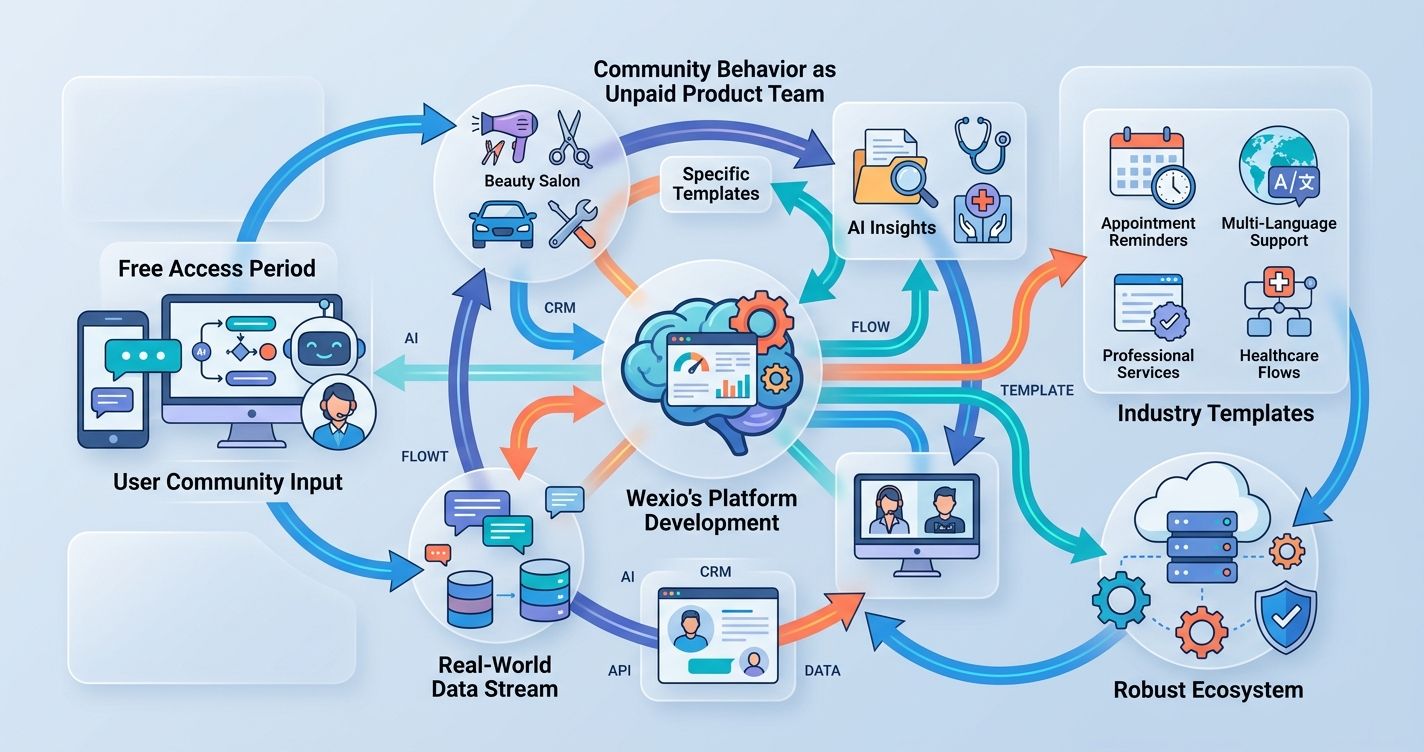
A product built in isolation is a product built on assumptions. Wexio's free access period served a dual purpose: it helped businesses while simultaneously feeding the development team a constant stream of real-world data. Every automated flow created, every conversation routed, every AI assistant configured told the team something about how people actually use the platform.
This wasn't a one-way street. Users got a powerful tool. Wexio got something equally valuable: clarity on what to build next.
Building a Robust Ecosystem via Community Input
The early user community became, in effect, an unpaid product team. Not because anyone asked them to be, but because their behavior told the story. When dozens of beauty salons independently created similar appointment reminder flows, that signaled a need for industry-specific templates. When automotive dealerships kept requesting multi-language support for customer inquiries, that moved up the priority list.
Today, Wexio offers 12+ industry-specific automation templates available out of the box. Those templates didn't come from a product manager's imagination. They came from watching real businesses build real workflows, then packaging the most common patterns into ready-made solutions.
Community input also shaped how the AI assistants work. Early users in professional services discovered that document analysis features saved hours of manual review. Healthcare providers found that classification AI could triage patient inquiries before routing them to the right department. Each of these discoveries refined the platform.
The feedback loop worked because the barrier to participation was zero. When you're not paying for software, you're more willing to experiment, break things, and report what happened. That candor is gold for a development team.
Reviewing chat transcripts from early adopters became a form of free user research. The team identified logic gaps in automation flows, spotted unanticipated questions that bots couldn't handle, and pinpointed exact moments where users dropped off. Those insights drove dozens of product improvements that paying users will benefit from for years.
Stress-Testing Infrastructure at Scale
Free access didn't just bring feedback. It brought volume. And volume is exactly what you need to test whether your infrastructure can handle real-world demand.
When thousands of businesses are running automated conversations simultaneously across four messaging channels, every weakness in your system gets exposed. Slow response times under load? Found it. Database bottlenecks during peak hours? Found those too. Edge cases in the flow builder that caused errors with specific message types? Discovered and fixed before they could affect paying customers.
This kind of stress testing is expensive to simulate artificially. Load-testing tools can approximate traffic patterns, but they can't replicate the unpredictable behavior of real humans interacting with real bots across real messaging apps. The free period gave Wexio something no amount of engineering simulation could provide: proof that the platform holds up when it matters.
The infrastructure now supports up to 3 million operations per month at the enterprise tier. That confidence comes directly from the stress the free period put on the system. Security also benefited from this approach. With real data flowing through the platform, the team hardened encryption protocols, confirmed GDPR compliance under actual operating conditions, and validated that EU-hosted infrastructure met performance expectations across different regions.
AES-256 encryption and TLS 1.3 aren't just checkbox features. They've been battle-tested with real business data from real users during the free access window.
Wexio's Long-Term Strategy and 2026 Roadmap
Free access was never the endgame. It was the foundation for something bigger. Now that 2026 is here, the transition from free to paid is underway, and the strategy behind it has been in motion for years.
The question was never "if" Wexio would charge for its platform. It was "when" and "how." The free period answered both questions by establishing a user base that understands the product's value firsthand.
Establishing Market Presence Before Monetization
Most startups face a chicken-and-egg problem. You need users to prove your product works, but you need revenue to keep building. Wexio chose to solve the user side first and worry about revenue second.
That approach required patience and funding runway, but it paid off in market positioning. By the time paid tiers launched, Wexio wasn't an unknown asking businesses to take a leap of faith. It was a platform thousands of companies already relied on daily.
This is the same playbook that built some of the most successful software companies in history. Slack grew through free team adoption before converting to paid plans. Zoom offered generous free tiers that made it the default video tool before monetizing enterprise features. The pattern works because it aligns the company's success with the user's experience.
For Wexio, the free period also created a competitive moat. Businesses that spent months building automation flows, training AI assistants on their specific data, and integrating the platform with their existing CRM and marketing stacks aren't going to switch to an alternative platform over a modest subscription fee. The switching cost is real, and it was earned through genuine value delivery, not vendor lock-in tricks.
Transitioning to a Sustainable Revenue Model
The shift to paid plans follows a pay-as-you-go structure designed to match how businesses actually grow. You don't jump from free to expensive overnight. The free tier still exists with 100 operations per month and no credit card required, giving new users the same zero-risk entry point that early adopters enjoyed.
From there, pricing scales with usage. A small salon running a few hundred automated appointment confirmations per month pays differently than a retail chain processing thousands of order updates across four channels. That granularity matters because it means you're never paying for capacity you don't use.
The 2026 roadmap includes expanded AI capabilities, deeper integrations with popular CRM platforms, and new channel support. Revenue from paid tiers funds this development directly. Early adopters who helped shape the product through their free usage now benefit from a platform that's financially sustainable and actively improving.
This isn't a bait-and-switch. It's the natural evolution of a product that earned its right to charge by proving its worth first.
What Users Can Expect During the Free Period
Even as paid tiers roll out, the free access philosophy hasn't disappeared. New users still get meaningful access, and existing free users have been given clear timelines and fair transition paths. Nobody woke up to an unexpected invoice.
Full Feature Access Without Restrictions
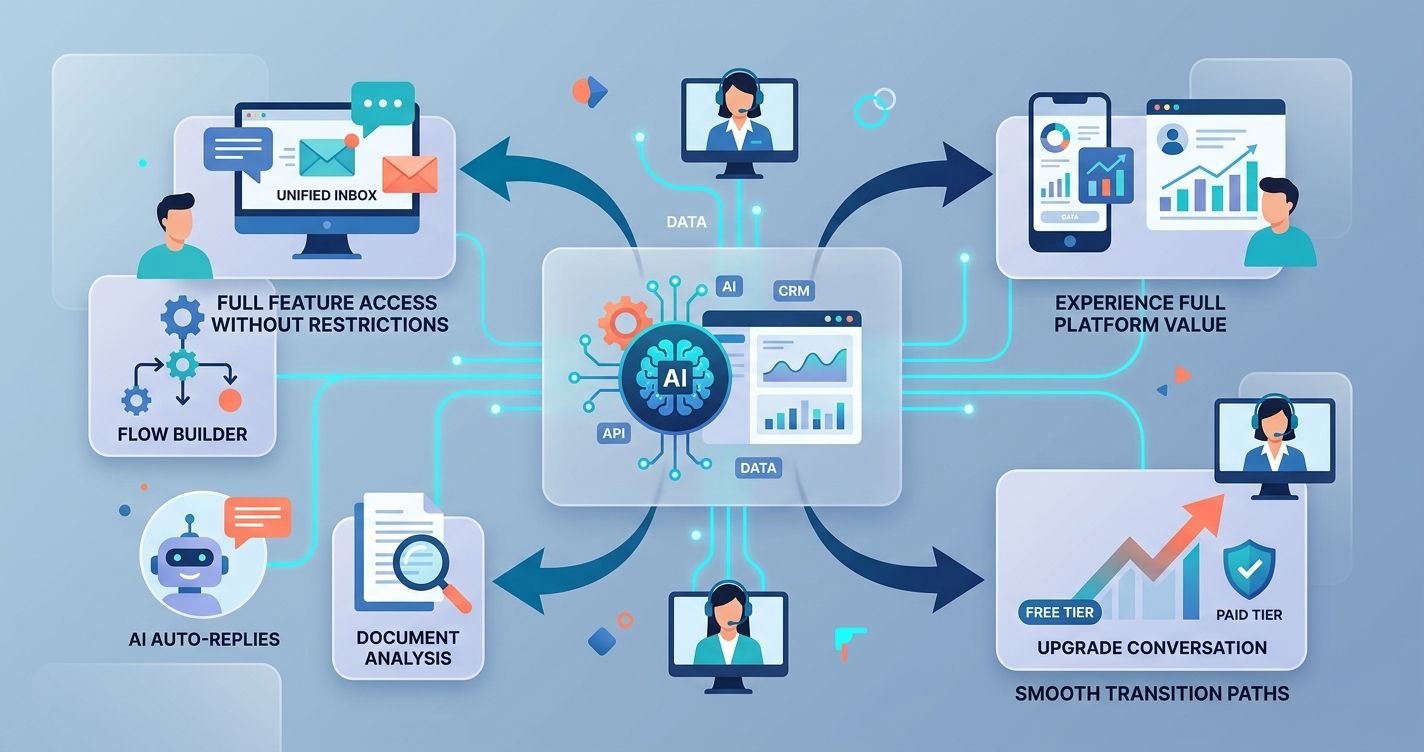
During the extended free period, Wexio didn't hold back features to create artificial upgrade pressure. The unified omnichannel inbox, the visual flow builder, AI-powered auto-replies, document analysis: all of it was available. This was a conscious decision to let users experience the full platform so their feedback reflected the complete product, not a stripped-down version.
That approach had a practical benefit too. When users build workflows using advanced features during a free period, they're far more likely to continue paying for those features when the transition happens. They've already seen the value. They've already built systems that depend on conditional branching and AI classification. The upgrade conversation becomes "keep what you have" rather than "buy something new."
For businesses currently on the free tier, the 100 monthly operations still cover basic use cases. A professional services firm can automate initial client intake. An education provider can handle course inquiry responses. It's enough to get started and see results before committing budget.
Priority Support and Beta Testing Opportunities
Early adopters didn't just get free software. They got a direct line to the development team. Bug reports were addressed quickly because the team needed those fixes as much as the users did. Feature requests from active users carried real weight in sprint planning.
Beta testing opportunities gave power users early access to new capabilities before general release. This created a virtuous cycle: engaged users tested new features, provided feedback, and helped refine them before wider rollout. Those users became advocates not because they were asked to, but because they felt ownership over the product's direction.
Clear triggers for human handoff were one feature refined through this process. Users told the team exactly when automated conversations should route to a live agent: negative sentiment detection, repeated failed bot responses, or explicit requests from customers. Those escalation rules, now built into Wexio's Route to Operator feature, exist because real businesses described real scenarios where bots weren't enough.
The support experience during the free period set expectations for what paid support would look like. Fast responses. Actual humans who understood the platform. Solutions, not scripted deflections.
Securing Your Spot in the Wexio Community Today
The window for joining Wexio at its most accessible is still open, but the landscape is shifting. Free tier access remains available, and the 100 operations per month give you enough room to test automation workflows, connect your messaging channels, and see real results before spending anything.
What made the free period special wasn't just the price tag. It was the community that formed around it. Thousands of businesses across industries contributed to a product that's now stronger, faster, and smarter than it would have been if built behind closed doors. The reason Wexio offered free access for everyone was simple: great products are built with users, not just for them.
If you've been waiting to automate customer conversations across WhatsApp, Telegram, Instagram, or Viber, there's no better time to start. Wexio's unified inbox and AI-powered automation handle the repetitive work so your team can focus on conversations that actually need a human touch. Get started free at Wexio and see what your business looks like with smarter messaging.
The businesses that joined early shaped the platform. The ones joining now get to benefit from everything those early adopters helped build. Either way, you win.