Every business owner has faced this question at some point: should you let a bot handle customer conversations, or keep a human on the other end? The answer isn't as simple as picking one. The debate around AI chatbots versus live chat support has shifted dramatically in the past few years. Chatbot adoption across businesses grew roughly 4.7x between 2020 and 2025, and that number keeps climbing. Yet live chat with real agents still earns some of the highest satisfaction scores in customer service. The truth is, both tools solve different problems. Your job is figuring out which problems matter most to your customers and your bottom line. That's what this piece is about: a real, honest comparison so you can make a smart call for your business.
Defining the Modern Support Landscape: AI vs. Human Agents
The support world has split into two camps. One side bets on automation. The other insists humans can't be replaced. Both are right, and both are wrong.
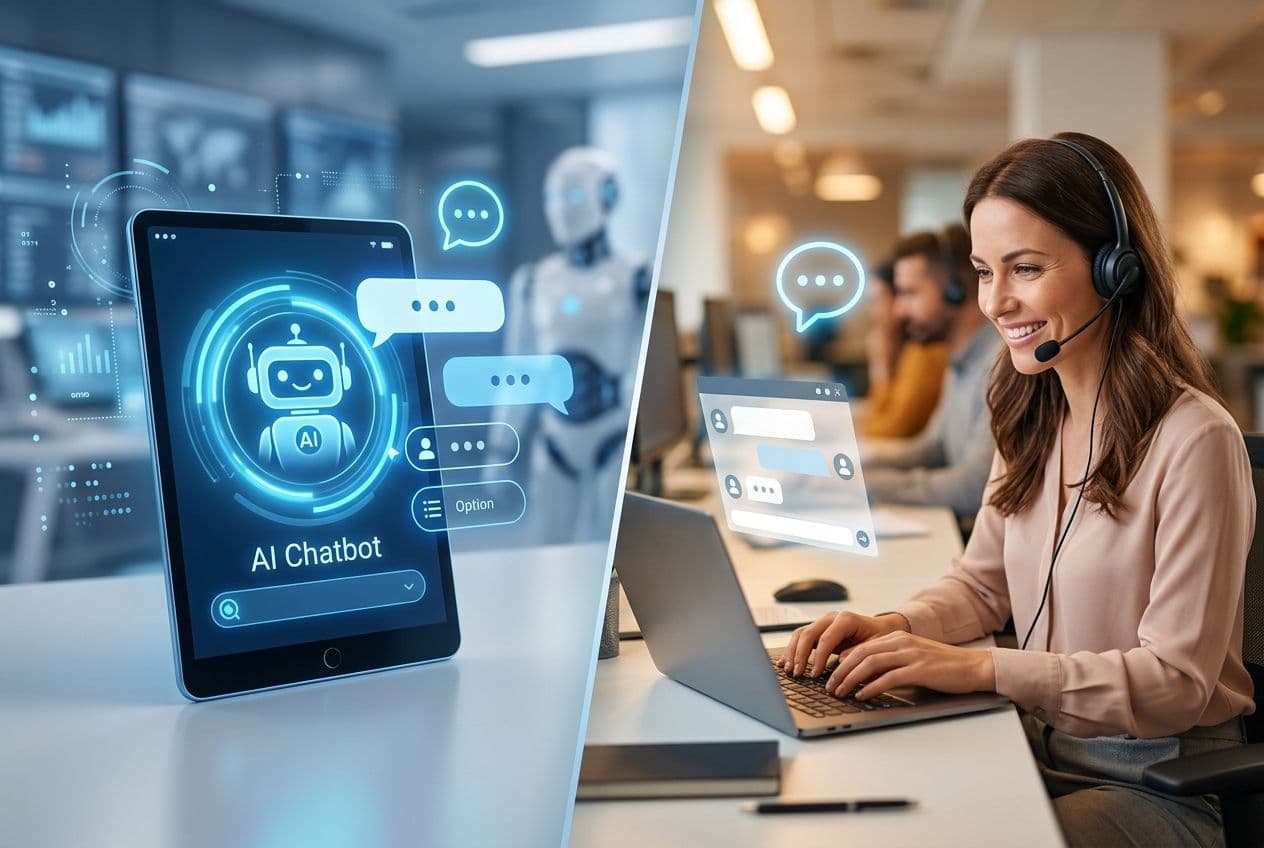
AI chatbots have evolved from clunky decision trees into genuinely capable conversational tools. They understand context, remember previous messages, and can pull data from your CRM to personalize responses. Human agents, meanwhile, still do things no algorithm can replicate: they read between the lines, pick up on frustration, and adjust their tone mid-sentence.
The real question isn't which is "better." As one Mailchimp analysis puts it, "the difference between chatbot and live chat isn't which is better - it's understanding when each delivers value based on volume, demographics, and complexity." That framing changes everything. You stop looking for a winner and start building a system where each tool handles what it does best.
Capabilities of Generative AI Chatbots
Modern AI chatbots aren't the same frustrating bots you remember from 2018. Generative AI models like GPT-4 and Claude can hold multi-turn conversations, classify intent on the fly, and even analyze uploaded documents. They don't just match keywords to canned answers anymore.
Here's what today's AI chatbots can actually do well:
- Intent classification: They figure out what a customer wants within the first message, routing the conversation accordingly.
- Multilingual support: Many bots handle dozens of languages without needing separate configurations.
- Data retrieval: Connected to your backend systems, a bot can pull order status, account details, or appointment availability in seconds.
- Document analysis: Some platforms let bots read PDFs, invoices, or policy documents and answer questions about them.
Platforms like Wexio build these capabilities into a no-code visual flow builder. You drag, drop, and configure AI cards with conditional branching, so your bot handles real business logic, not just "Hi, how can I help?" loops. The AI assistants are powered by GPT-4 and Claude, meaning they classify, auto-reply, and analyze without you writing a single line of code.
The Unique Value of Live Chat Human Interaction
Bots are fast. Humans are nuanced. That distinction matters more than most businesses realize.
A live agent can hear the panic in a customer's message about a billing error. They can say, "I totally understand why that's frustrating, let me fix this right now." That kind of response builds loyalty in ways a bot simply can't replicate. Live chat satisfaction rates back this up: 73% of customers report being satisfied with their live chat experience, one of the highest ratings across all support channels.
Humans also excel at creative problem-solving. When a customer's issue doesn't fit neatly into a category, an agent improvises. They escalate, they make judgment calls, they offer goodwill gestures. These moments turn angry customers into brand advocates. No chatbot has that instinct.
There's also the trust factor. For high-stakes interactions like financial disputes, medical inquiries, or large purchases, people want to know a real person is on the other end. That's not irrational. It's human nature.
The Benefits of AI Chatbots for Scalable Support
If your support queue grows faster than your hiring budget, automation is your friend. AI chatbots shine brightest when volume is high and questions are repetitive.
Think about the questions your team answers fifty times a day. "Where's my order?" "What are your hours?" "How do I reset my password?" These are perfect bot territory. AI chatbots can handle up to 80% of routine customer queries without any human involvement. That's not a small number. It means your agents spend their time on the 20% that actually needs a human brain.
24/7 Availability and Instant Response Times
Your customers don't operate on a 9-to-5 schedule. A salon client books at 11 PM. A retail shopper has a question at 6 AM on a Sunday. A patient wants to confirm an appointment at midnight.
AI chatbots don't sleep. They don't take lunch breaks. They respond in under a second, every single time. For small and mid-size businesses that can't afford three shifts of support staff, this is a massive advantage. You're essentially staffing a 24/7 help desk for a fraction of what it would cost to hire overnight agents.
Speed matters too. Research consistently shows that response time is the single biggest factor in customer satisfaction for chat-based support. A bot that answers in two seconds beats a human who takes three minutes to type a reply, at least for straightforward questions.
Reducing Operational Costs and Ticket Volume
Let's talk money. Hiring a full-time support agent costs anywhere from $30,000 to $60,000 per year, depending on your market. Benefits, training, and turnover add even more. A chatbot platform might run you a few hundred dollars a month, and it handles thousands of conversations simultaneously.
The AI customer service market is projected to reach $47.82 billion by 2030, growing at a 25.8% annual rate. Businesses are investing because the ROI is clear. When a bot deflects 80% of routine tickets, your human agents handle fewer conversations with more focus. That means shorter queues, faster resolutions, and less burnout.
Wexio's pay-as-you-go pricing makes this accessible even for small teams. There's a free tier with 100 operations per month, no credit card required, so you can test the waters before committing. Plans scale up to 3 million operations monthly for larger operations.
Where Live Chat Outperforms Automation
Bots have limits. Pretending otherwise will cost you customers.
Some conversations require judgment, empathy, or deep technical knowledge that AI simply doesn't possess yet. Knowing where those boundaries are keeps you from frustrating the very people you're trying to help. The worst customer experience isn't slow support. It's a bot that keeps looping through unhelpful responses while the customer gets angrier with each message.
Handling Complex Technical Inquiries
Picture this: a customer contacts your SaaS company because their API integration broke after an update. They've already tried the knowledge base. They need someone who can look at their specific configuration, ask follow-up questions, and troubleshoot in real time.
A chatbot might identify the topic correctly. It might even surface a relevant help article. But it can't dig into the customer's unique setup, cross-reference error logs, and walk them through a custom fix. That takes a human who understands the product deeply.
The same applies in healthcare (complex symptom discussions), finance (disputed transactions with unusual circumstances), and automotive (diagnosing intermittent vehicle issues from a customer's description). These aren't edge cases. They're the conversations that determine whether a customer stays or leaves.
Building Trust Through Emotional Intelligence
A customer just got charged twice for a $500 service. They're upset. They message your support chat. What they need first isn't a refund process: it's acknowledgment.
"I see the duplicate charge, and I'm really sorry about that. Let me fix this for you right now." That sentence, delivered by a human, defuses tension instantly. A bot might say something similar, but the customer knows it's scripted. The emotional weight is different.
Trust is especially critical in industries like finance, healthcare, and education. When someone's money, health, or child's enrollment is on the line, they want a person. Companies using AI in customer interactions saw a 22.3% jump in satisfaction scores, but those gains came from using AI strategically, not from replacing humans entirely.
Emotional intelligence isn't a nice-to-have. It's a competitive advantage that bots can't fake.
Key Comparison Factors: Speed, Accuracy, and Cost
Comparing AI chatbots against live chat support comes down to three things: how fast, how accurate, and how expensive.
Speed goes to the bots, hands down. They respond instantly. Human agents need time to read, think, and type. For simple queries, a bot resolves the issue before an agent even finishes reading the message.
Accuracy is more nuanced. Bots are incredibly accurate for well-defined questions with clear answers. "What's your return policy?" gets a perfect response every time. But throw in ambiguity, and accuracy drops. "I think I might need to return this, but I'm not sure if it qualifies" requires interpretation that bots sometimes fumble.
Cost favors automation for high-volume, low-complexity work. A single bot handles thousands of simultaneous conversations. A single agent handles maybe three to five. But cost per interaction isn't the whole picture. A botched bot interaction that drives a customer away costs far more than the agent who would have retained them.
Here's a quick breakdown:
| Factor | AI Chatbot | Live Chat Agent |
|---|---|---|
| Response time | Under 2 seconds | 30 seconds to 3 minutes |
| Availability | 24/7/365 | Limited by shifts |
| Cost per interaction | $0.50 to $2.00 | $6.00 to $12.00 |
| Complex issue handling | Limited | Strong |
| Emotional connection | Minimal | High |
| Simultaneous conversations | Unlimited | 3 to 5 |
The smart move isn't choosing one column. It's designing a system that plays to the strengths of both.
The Hybrid Model: Combining Both for Maximum Efficiency
Most businesses don't need to pick sides. They need a hybrid model where bots and humans work together, each handling what they do best.
The hybrid approach starts with AI on the front line. The bot greets the customer, identifies their intent, and handles routine requests. When the conversation gets complicated, emotional, or falls outside the bot's confidence threshold, it hands off to a live agent with full context. No one repeats themselves. No one starts over.
This model is where the real magic happens. You get the speed and cost savings of automation with the empathy and problem-solving of human agents. Companies that implement hybrid support consistently report higher satisfaction scores and lower operating costs than those using either approach alone.
Seamless Handoffs from Bot to Human
A bad handoff kills the customer experience. You've probably experienced it yourself: a bot transfers you to an agent, and suddenly you're re-explaining everything from scratch. That's a failure of design, not technology.
Good handoff systems pass the full conversation transcript, customer data, and detected intent to the agent. The agent picks up exactly where the bot left off. The customer feels like they're talking to one continuous support team, not two disconnected systems.
Here are the triggers that should prompt a handoff:
- The bot detects negative sentiment (frustration, anger, sarcasm).
- The customer explicitly asks for a human.
- The bot fails to resolve the query after two attempts.
- The conversation involves a high-value account or sensitive topic.
Wexio's "Route to Operator" feature handles this natively. The bot conversation flows through the visual builder, and when any trigger fires, the full context transfers to an agent in the unified inbox. The agent sees the entire thread across WhatsApp, Telegram, Instagram, or Viber, all in one dashboard.
Using AI to Assist Live Agents in Real-Time
Here's where things get really interesting. AI doesn't have to disappear once a human takes over. It can work alongside the agent, making them faster and more effective.
Real-time AI assistance looks like this: while an agent chats with a customer, the AI suggests responses, pulls up relevant knowledge base articles, and auto-fills order details. The agent stays in control but works twice as fast. It's like having a research assistant who reads every help article instantly.
This approach also helps with consistency. New agents get AI-suggested responses that match your brand voice and policy guidelines. Senior agents use AI to handle administrative tasks, like tagging conversations or updating CRM records, so they can focus on the actual conversation.
Review your chat transcripts regularly. They're free user research. You'll spot logic gaps in your bot flows, discover questions you didn't anticipate, and identify where customers drop off. Use median resolution times instead of averages when analyzing performance: a few outlier conversations can skew your averages and hide real problems.
Choosing the Right Solution for Your Business Size
Your ideal setup depends on your volume, your budget, and the complexity of your typical support request. There's no universal answer, but there are clear patterns.
If you're a solo operator or micro-business handling fewer than 50 conversations a day, a well-configured chatbot covers most of your needs. You can't afford to staff live chat around the clock, and most of your questions are probably repetitive. Start with a bot, and jump in personally for the tough ones.
Small businesses with 50 to 500 daily conversations benefit most from the hybrid model. Use a bot to handle the first touch, qualify the inquiry, and resolve simple questions. Route complex issues to your small support team. This setup lets three or four agents do the work of ten.
Mid-size companies with dedicated support teams should invest in AI-assisted live chat. Your agents are your strength, and AI makes them faster. Use bots for after-hours coverage and first-line triage during business hours. Give your agents real-time AI tools so they resolve issues in fewer messages.
Here's a practical starting path:
- Step one: Audit your last 500 support conversations. Categorize them by complexity. How many could a bot have handled?
- Step two: Set up automated flows for your top five most common questions. Wexio offers 12 or more industry-specific automation templates out of the box, so you're not starting from scratch.
- Step three: Define your handoff triggers. Don't wait for customers to ask for a human. Detect when the bot is struggling and route proactively.
- Step four: Train your agents to work with AI tools, not against them. Show them how AI suggestions speed up their workflow.
- Step five: Review transcripts weekly. Look for patterns, gaps, and opportunities to expand your bot's capabilities.
The businesses that get this right don't treat it as a one-time decision. They iterate. They watch the data. They adjust their bot flows and agent workflows monthly.
Your support system should connect to your existing CRM and marketing stack. Isolated tools create data silos, and data silos create inconsistent customer experiences. Make sure whatever platform you choose integrates with the tools you already use. Wexio's unified omnichannel inbox pulls conversations from WhatsApp, Telegram, Instagram, and Viber into one place, with enterprise-grade security including AES-256 encryption, TLS 1.3, and GDPR-compliant EU-hosted infrastructure.
The question was never really "AI chatbot or live chat?" It was always "how do I use both to give my customers the best experience while keeping costs sane?" Now you have a framework to answer that.
If you're ready to build a support system that combines intelligent automation with human expertise across every major messaging channel, get started with Wexio and see how a unified platform handles the heavy lifting so your team can focus on the conversations that matter most.
Sources
- https://yourgpt.ai/blog/growth/ai-customer-service-statistics
- https://www.chatbot.com/blog/chatbot-statistics/
- https://www.surveymonkey.com/curiosity/customer-service-statistics/
- https://elfsight.com/blog/ai-chatbot-vs-live-chat/
- https://masterofcode.com/blog/ai-in-customer-service-statistics
- https://mailchimp.com/resources/chatbot-vs-live-chat/