The right Intercom alternative depends on what made you look. If it's the AI bill, you want a tool that doesn't meter every resolved conversation. If it's seat cost, a helpdesk that prices per workspace or per cheaper seat. If it's channels, something built around WhatsApp, Instagram and Telegram instead of web chat and email.
Most roundups rank tools by feature count. I think that's the wrong sort. Intercom is a good product, and nobody switches because of a missing feature. They switch because of an invoice, a channel gap or a setup that needed a person to maintain it. So this page is organised by those three reasons, and I'll say plainly where staying put is the better call.
Full disclosure: I'm the founder of Wexio, which is on this list. Everything about other vendors comes from their public pricing pages, linked where I quote a number. Prices move, so check the page before you decide.
If the AI bill is what you're leaving over
This is the most common reason, and it's about the shape of the pricing, not the size.
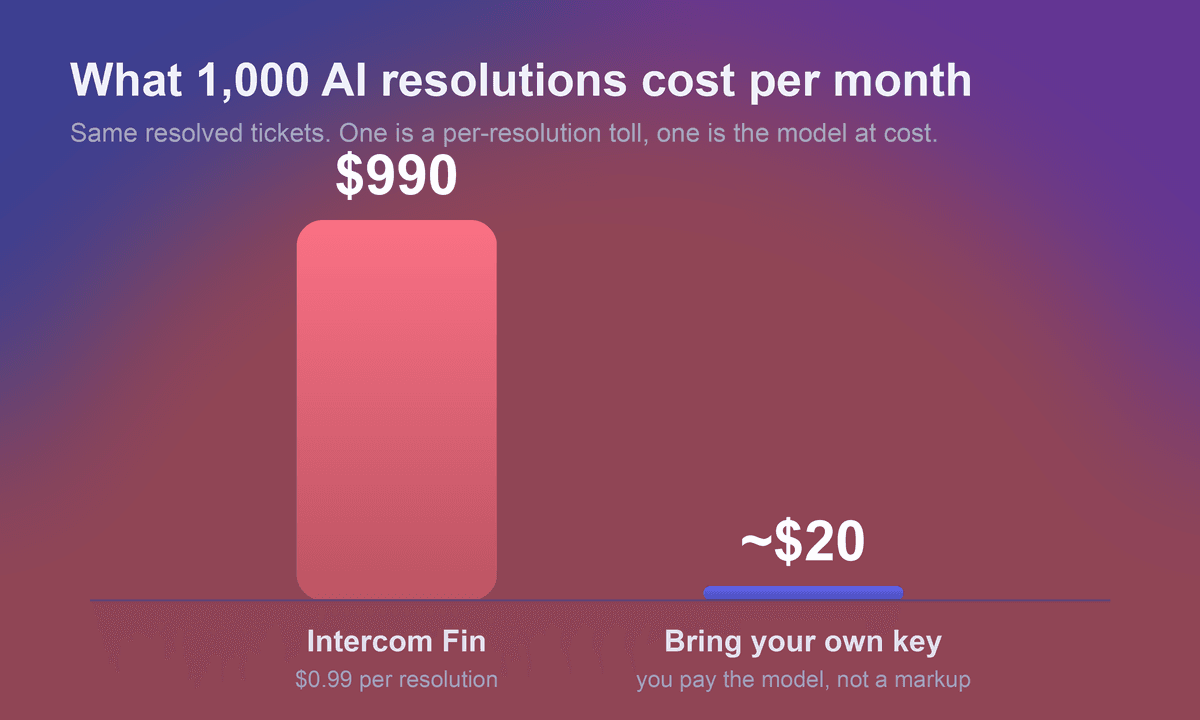
Intercom's pricing page lists Fin, its AI agent, at $0.99 per resolution, on top of seats. Seats start at $29 per month on Essential when billed annually, and Advanced and Expert cost more. The arithmetic is simple. A thousand resolutions is $990 before you count a single seat. Five thousand is $4,950.
Now picture a clothing or footwear shop in the week after a sale. Customers ask where the parcel is, whether the shoe runs large, how to start a return. These are exactly the questions an AI agent should close without a human. The more of them it closes, the higher the invoice. Your best month for automation is your most expensive month for software.
That isn't a trick. It's a pricing model that charges for outcomes. Some teams like that, because they only pay when the AI works. But for a store with high volume and repetitive questions, it means your costs scale one-for-one with your success, and they stay uncapped.
What bring-your-own-key changes
You'll see "BYOK" in this part of the market. It means you paste your own OpenAI or Anthropic API key into the platform. The platform charges you for the software and automation, and the model provider bills you directly for the AI calls, at their rate. The question to ask any vendor is simple: is the AI a separate line I can see, and who marks it up?
I won't put a figure on what a resolution costs at model rates, because it depends on the model and on how much context each conversation carries. Test it on your own conversations before trusting anyone's estimate, including mine.
The options for this problem
- Chatwoot. Open source, so you can self-host it or pay for their cloud. You control the stack. The price is that you operate it. Good if you have an engineer who enjoys that; a poor fit if you don't.
- Wexio. The AI agent answers customers and hands over to a person when it should, and it stops answering the moment a person joins the conversation. The AI is part of the plan, so check pricing for exactly how it's billed. I'm not going to quote figures here. We're early: live with our first 40 users since the Portugal Tech Week launch. If you need a deep enterprise integration catalogue today, we're not there yet.
If you want the wider field of AI-first tools beyond helpdesk replacements, my roundup of AI chatbots for business goes broader.
If the seat price is the problem
Sometimes there's no AI problem at all. You have six or eight people answering email and chat, and per-seat pricing multiplies fast. These are real helpdesks that cost less per head, or don't charge per head at all.
- Crisp. The pricing logic is different: you pay per workspace, not per person. At the time of writing, the Mini plan is $45 per month with four seats included. For a small team, that comparison with a per-seat tool is not close.
- Help Scout. Email-first, clean, and popular with small teams whose support is mostly an inbox. Its pricing page is where to check the per-user cost and how its AI answers are charged. Read that line carefully: if AI is metered per resolution there too, you've moved the problem, not removed it.
- Freshchat and Freshdesk. Per-agent pricing that starts well below Intercom's upper tiers, from a large, stable company. Its AI is a separate add-on, so the same warning applies. Start at the vendor's pricing page.
One rule of thumb: when you compare these, price two scenarios, not one. First the quiet month with no AI. Then the busy month where the AI does the most. A tool that wins the first can lose the second.
Free Intercom alternatives, and what free actually costs
If you came to Intercom for a chat bubble and got quoted something that looks like a salary, free is a legitimate answer. Just know what you're giving up.
- tawk.to. Live chat that's genuinely free. The revenue comes from add-ons, such as removing the "powered by" branding, and from hired agents, per their pricing page. You get a working widget. You don't get much depth in automation or reporting.
- Chatwoot, self-hosted. Free in licence cost, not in time. You carry the hosting, updates and backups.
- Tidio. Has a free tier, with its Lyro AI agent metered in tiers of AI conversations on paid plans. See their pricing. It's popular with small online stores. I compared it with Intercom and Wexio head to head in Tidio vs Intercom vs Wexio, so I won't repeat that here.
- Wexio. There's a free trial at app.wexio.io. It's a trial, not a free forever plan, and I'd rather say that than let you find out later.
The honest trade with free tools: the cost moves from the invoice to your time. That's fine if time is the thing you have. It isn't if you're the only person in the business.
If you're still choosing between chat widgets in general, my live chat comparison covers that decision.
If your customers message you on WhatsApp, Instagram and Telegram
Intercom grew up around websites and email. If most of your customers reach you through a messaging app, a web-first tool can feel like a guest in someone else's house. A fashion brand's customers often start on Instagram, switch to WhatsApp to ask about a delivery, and only open the website to buy.
- respond.io. Built for messaging channels, with workflows on top. A real option if messaging is where your business lives. Check how its AI is priced before the volume arrives.
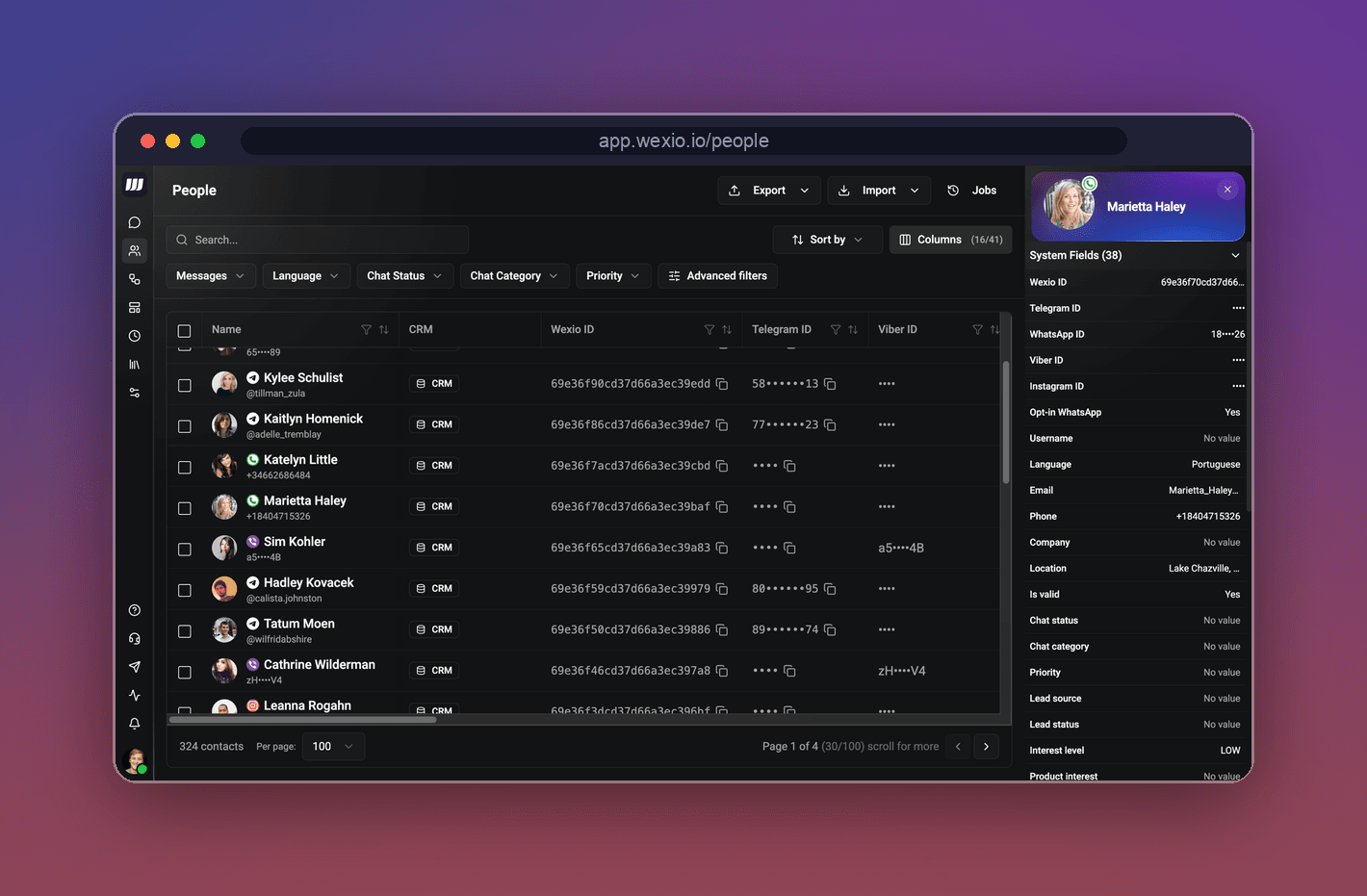
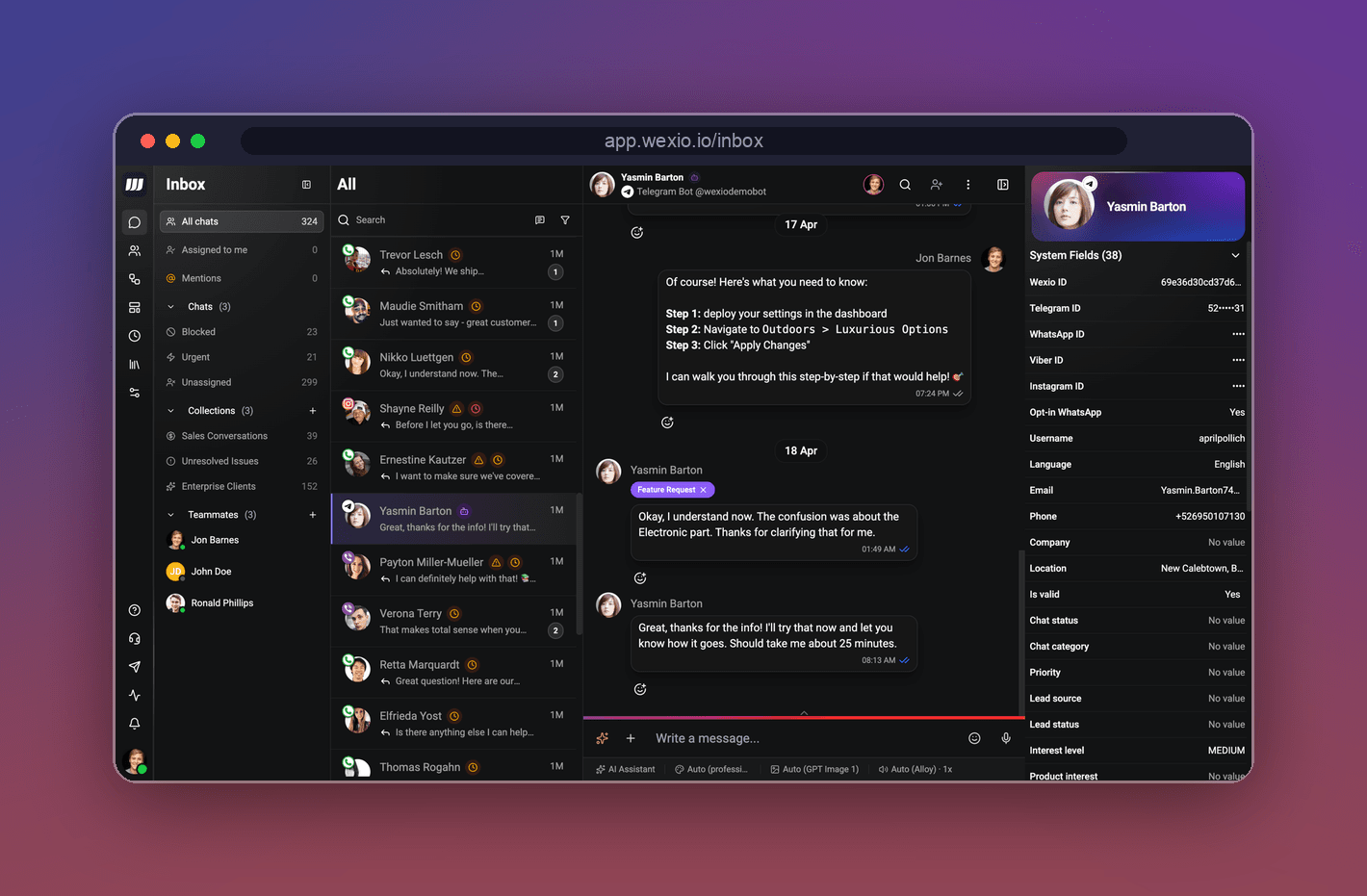
- Wexio. Web chat, WhatsApp, Instagram DMs, Telegram (including Telegram Business), Viber and email all arrive in one inbox, with one conversation history per customer in the CRM people view. Facebook Messenger is not supported, and I'd rather you know that now. Instagram comment-to-DM and comment moderation are still pending Meta review, so I won't claim them.
If WhatsApp specifically is the draw, my Wati alternatives post looks at platforms built around that channel's API.
What about Intercom's mobile competitors
People search for "Intercom mobile competitors" for two different jobs, and they need different tools. One is in-app messaging, a chat window inside your own iOS or Android app, which needs a mobile SDK. Check each vendor's developer docs for that. I haven't listed an in-app SDK for Wexio, so don't pick us for that job. The other is reaching customers on their phones through the apps they already use. That's WhatsApp, Instagram, Telegram and Viber, and that's what we do.
If setup weight is the problem: what a lighter replacement looks like
The quiet reason many teams leave a big platform is that someone has to maintain it. Rules, audiences, workflows, a sprawl of settings. If that's your reason, the test for any alternative is how fast you can get one real conversation answered correctly.
Here's the order I'd follow in Wexio for a shop with returns, sizing and delivery questions. Start the free trial at app.wexio.io and work through this:
- Connect the web chat widget first. Add it to your site. It's the easiest channel and it lets you test before anything customer-facing on messaging apps.
- Write down your ten most repeated questions and your answers. Returns window, delivery times, sizing guidance, how to change an address. Put the ones customers read themselves in help center articles inside the widget. Give the AI agent the same policies so it answers consistently.
- Decide what a person must handle. Refund disputes, damaged goods, an angry customer. Set those to hand off. When a person joins a conversation, the AI stops answering. That's the whole point of AI that knows its place.
- Use the flow builder for the fixed parts. For something like a returns request, a no-code flow that collects the order number and reason, then passes the conversation to a person, is more predictable than hoping the AI improvises.
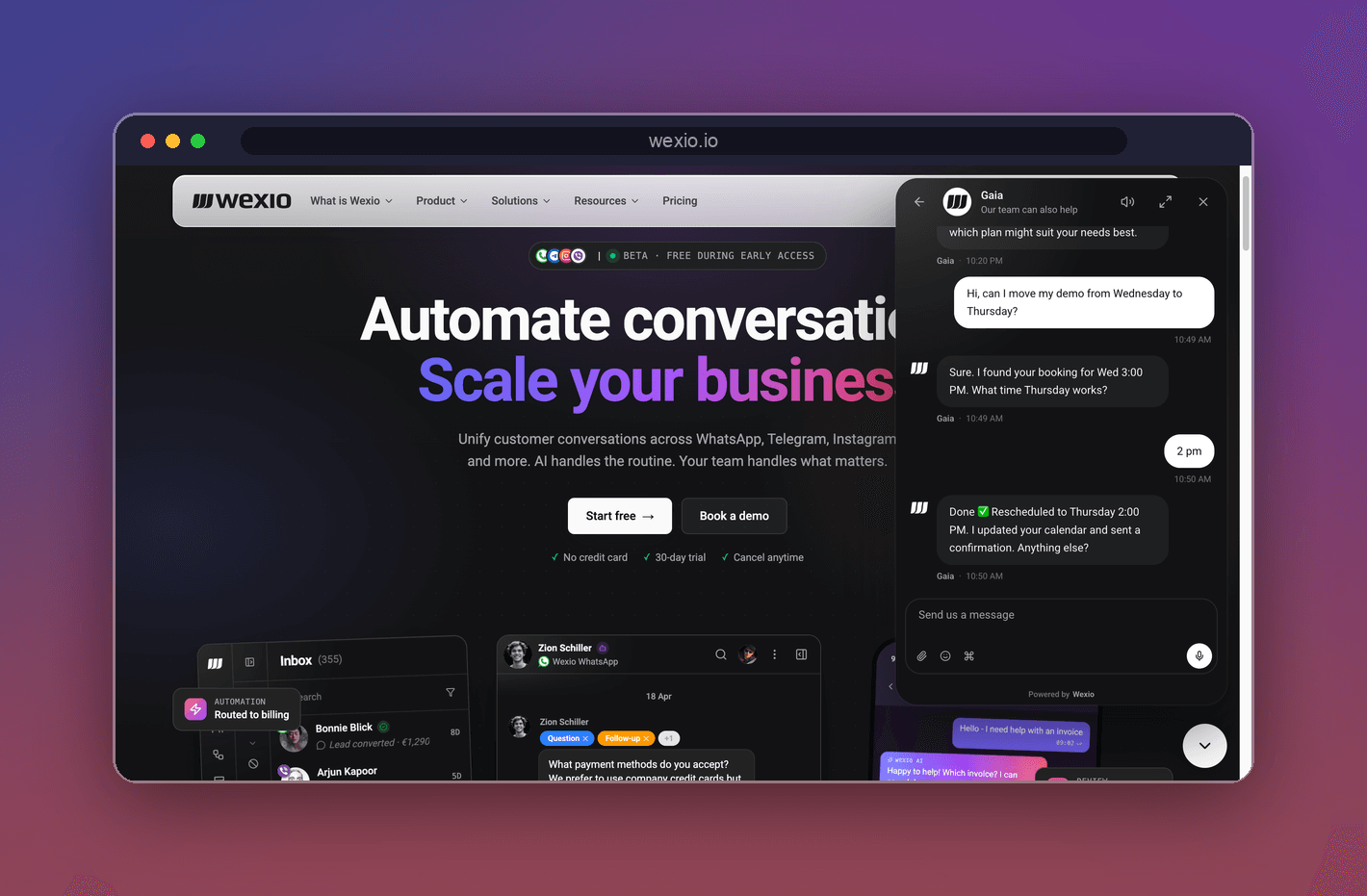
- If you sell appointments, connect your calendar. For a consultancy, a fitting session or an advisor's call, the AI agent and the web widget can book into Google Calendar and others, so a message at night becomes a booking by morning.
- Add the other channels one at a time. WhatsApp, Instagram, Telegram, Viber, email. Each lands in the same inbox, and each customer keeps one history in CRM people.
You should be able to do the first three in an afternoon, but I can't promise your data will cooperate. Moving off Intercom means rebuilding your saved replies as articles and agent instructions, not importing them. That takes a day or two of tidying. It's the real cost of switching, and it's the same with any alternative.
If you want to see what a store-specific setup looks like, the retail page goes through it. The integrations page shows what connects today.
Intercom alternatives side by side
Prices are what vendors publish, at the time of writing. The AI line is the one that moves, so read it first.
| Tool | Pricing basis | How AI is charged | Fits best |
|---|---|---|---|
| Intercom | Per seat, from $29 per month (Essential, annual) | Fin at $0.99 per resolution, on top of seats | Funded teams that want the category incumbent |
| Wexio | Plans, see pricing; free trial | Part of the plan, check pricing | Messaging-first shops and service businesses |
| Chatwoot | Free self-hosted, or paid cloud | Check docs | Teams with an engineer |
| Crisp | Per workspace, Mini $45 per month with 4 seats | Check pricing page | Small teams who hate per-seat pricing |
| Help Scout | Per user | Check pricing page | Email-first support |
| Freshchat / Freshdesk | Per agent | Add-on | Cheaper conventional helpdesk |
| Tidio | Free tier, then paid | Metered in tiers | Small online stores |
| tawk.to | Free | Limited | Zero-budget live chat |
| respond.io | Paid tiers | Check pricing page | Messaging-heavy operations |
If you also look at chat automation platforms rather than helpdesks, the same AI-pricing question applies. I went through it for a different tool in why ManyChat's AI add-on costs more than the platform.
When staying on Intercom is the right call
I'd be lying if I said never. Stay if your support is high-touch and low-volume, so a per-resolution fee never adds up to real money. Stay if you're well funded and want the most polished product, deep reporting and a large integration ecosystem, because that's real and we don't match it today. Stay if your customers are on your website and in email and nowhere else.
And if you're not sure whether your AI should answer first or a person should, that's a design question before it's a vendor question. AI chatbot vs live chat covers how to split the work.
The signal that you should move is simple: your costs rise in step with your success, or your customers are somewhere your tool isn't. Those are the two problems worth paying to fix.
Questions people ask before switching
What's the cheapest Intercom alternative? tawk.to for live chat, free. Chatwoot self-hosted if you have an engineer. For a paid tool that still feels complete, Crisp's workspace pricing is hard to beat for a small team.
Is there a free alternative to Intercom with AI? Several tools offer free tiers, but AI is usually where the limits sit. Tidio has a free tier with metered AI on paid plans. Wexio has a free trial. Read the AI limits before assuming free means free.
What does Fin cost? Intercom lists $0.99 per resolution on its pricing page, billed on top of seats. Multiply by your monthly volume of AI-closed conversations to see your number.
Intercom or Wexio, which should I pick? If your support lives on web chat and email with a funded team, Intercom. If your customers write on WhatsApp, Instagram, Telegram or Viber and you want a person to take over cleanly, try Wexio. For a three-way view with Tidio, read that comparison.
Are there alternatives to Wexio too? Yes. If you want self-hosting, Chatwoot. If you want a bigger, older helpdesk, Freshdesk or Help Scout. If you want messaging-first with a different setup, respond.io. The table above is the shortlist I'd start from.