WhatsApp has over 2.7 billion active users worldwide, and roughly 175 million of them message a business account every single day. If you're still answering customer queries one by one, you're bleeding time your team can't afford to lose. Learning how to automate WhatsApp for business isn't some futuristic idea reserved for enterprise corporations. It's a practical, accessible move that small and mid-size companies across retail, healthcare, education, and dozens of other sectors are making right now. The payoff? Faster responses, fewer dropped leads, and a support operation that doesn't collapse when message volume spikes. Whether you run a dental clinic or a car dealership, automation on WhatsApp can shrink your response time from hours to seconds, and this guide shows you exactly how to set it up, which tools to pick, and what pitfalls to dodge.
The Strategic Value of WhatsApp Automation
Businesses that treat WhatsApp like just another inbox are missing the bigger picture. Automation turns a messaging app into a full customer engagement engine. It handles the repetitive stuff so your team focuses on conversations that actually need a human touch.
A 2025 Salesforce study found that 73% of customers expect companies to understand their unique needs. Automation makes that possible at scale. You can greet returning customers by name, recall their last order, and route them to the right department, all before a human agent even picks up the chat.
Enhancing Customer Experience with Instant Responses
Nobody likes waiting. A Harvard Business Review study showed that companies responding to leads within five minutes are 100 times more likely to connect than those waiting 30 minutes. Automated welcome messages and FAQ bots eliminate that wait entirely.
Picture a beauty salon on a Saturday morning. The phone's ringing, clients are checking in, and 14 WhatsApp messages are piling up asking about pricing and availability. An automated greeting paired with a menu of common questions handles most of those without pulling a single staff member away from their work.
Instant responses also chip away at a subtle trust problem. When customers message and hear nothing back for hours, confidence drops. A quick, helpful auto-reply signals professionalism, even if the full answer comes later from a live agent.
Scaling Operations Without Increasing Headcount
Hiring is expensive. The average cost to onboard a new customer service rep in 2026 hovers around $4,700, according to SHRM data. Automation lets you handle two or three times the message volume without adding headcount.
Think about it this way: a single agent can manage maybe 40-60 conversations per day. A well-built chatbot can handle thousands simultaneously. That doesn't mean you fire your team. It means your team stops answering "What are your hours?" for the 200th time and starts closing deals instead.
The tab-switching tax is real, too. Agents bouncing between WhatsApp, email, and Instagram DMs lose focus and make mistakes. A unified inbox, like the one Wexio offers across WhatsApp, Telegram, Instagram, and Viber, eliminates that context-switching entirely.
Choosing the Right Automation Tools
Your choice of tools determines how far your automation can go. Pick wrong and you'll hit a ceiling within weeks.
WhatsApp Business App vs. WhatsApp Business API
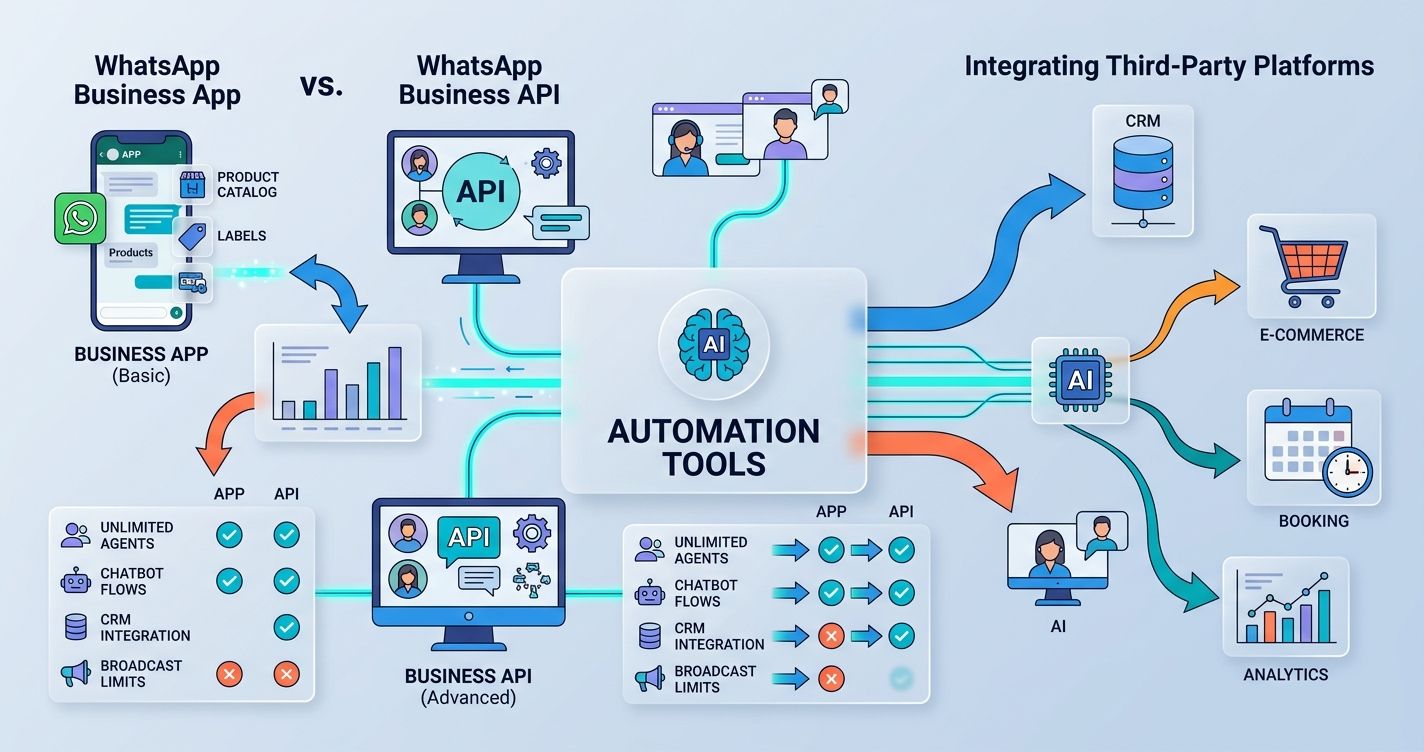
The free WhatsApp Business App works for solo operators and tiny teams. You get quick replies, labels, and a basic product catalog. But it's limited to one device (or up to four linked devices), has no CRM integration, and can't support chatbot flows.
The WhatsApp Business API is where real automation lives. It supports unlimited agents, programmable message templates, and deep integrations with external systems. You don't access the API through a standalone app. You need an official Business Solution Provider (BSP) to connect.
Here's a quick comparison:
| Feature | Business App | Business API |
|---|---|---|
| Price | Free | Pay-per-conversation model |
| Agents | 1-4 devices | Unlimited |
| Chatbot support | No | Yes |
| CRM integration | No | Yes |
| Broadcast limits | 256 contacts | Thousands (with opt-in) |
| Approval required | No | Yes (via BSP) |
If you're handling more than 50 conversations a day, the API is the only serious option.
Integrating Third-Party CRM and Marketing Platforms
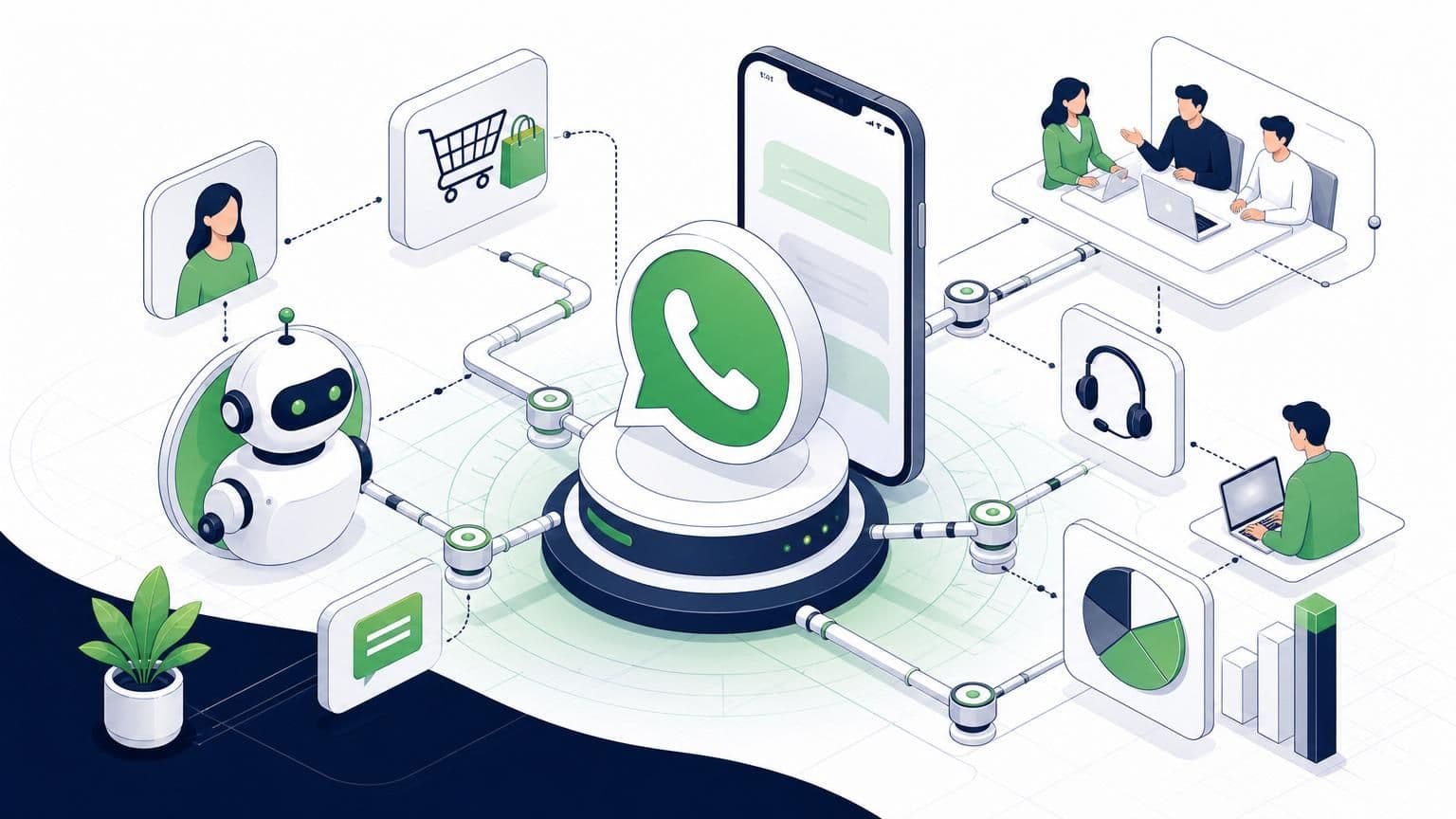
Automation without data is just a fancy auto-reply. The real power kicks in when your WhatsApp messages connect to your CRM, your booking system, or your e-commerce platform.
Say a customer asks about an order. If your chatbot can pull tracking info directly from Shopify or WooCommerce, that's a resolved ticket with zero human involvement. If it can't, someone on your team has to look it up manually, type it out, and hit send.
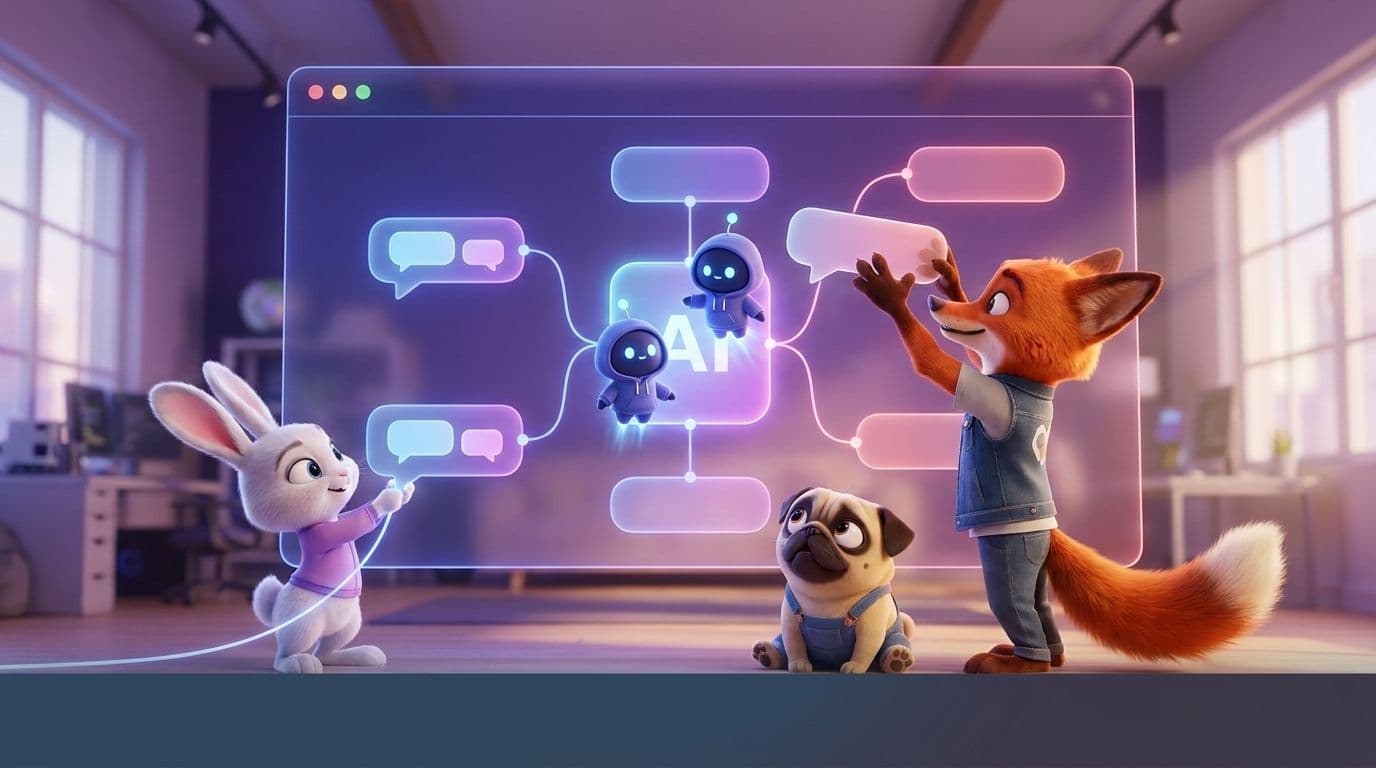
Wexio's no-code visual flow builder makes these connections straightforward. You can map conditional branches, like "if order status is shipped, send tracking link; if delayed, route to agent," without writing a line of code. The platform also supports AI cards powered by GPT-4 and Claude, so your bot can classify intent and draft context-aware replies on the fly.
Core Automation Workflows for Business Growth
Not every workflow deserves automation. Focus on high-volume, repetitive interactions first. These three categories deliver the fastest ROI.
Automating Lead Generation and Qualification
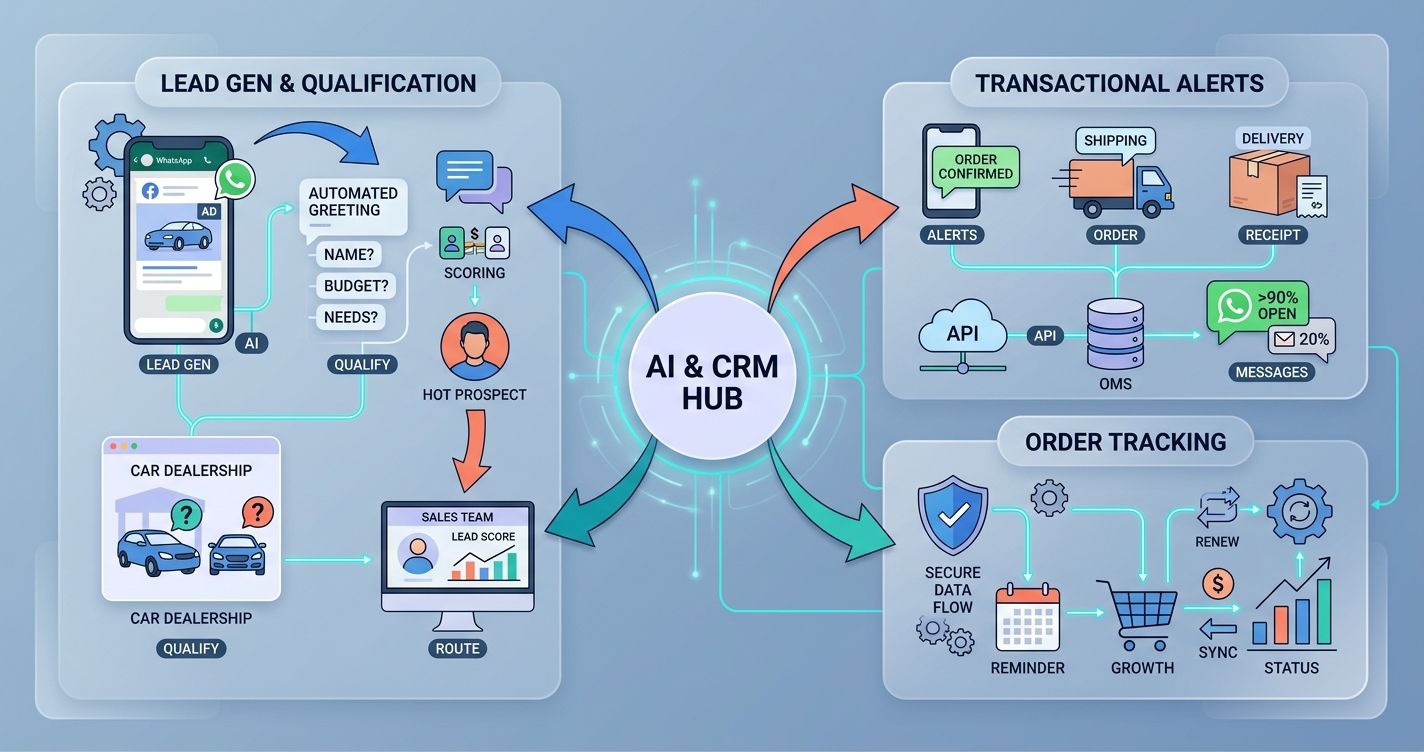
Most leads go cold because businesses respond too slowly. An automated WhatsApp flow can capture a lead's name, budget, and needs within 60 seconds of their first message.
Step one: set up a click-to-WhatsApp ad on Facebook or Instagram. Step two: trigger an automated greeting that asks two or three qualifying questions. Step three: score the lead based on their answers and route hot prospects to your sales team immediately.
A car dealership using this approach might ask about preferred vehicle type, budget range, and trade-in status. Within 90 seconds, the sales rep gets a warm lead with context, not a cold "Hi, I'm interested" message.
Transactional Alerts and Order Tracking
Customers don't want to hunt for updates. They want updates delivered to them. Automated transactional messages handle this perfectly.
Common examples include order confirmations, shipping notifications, delivery updates, payment receipts, and subscription renewal reminders. These messages have open rates above 90% on WhatsApp, compared to roughly 20% for email, according to a 2025 Gartner report on messaging engagement.
The key is connecting your order management system to the API so messages fire automatically. No one on your team should be manually sending "Your order has shipped" messages in 2026.
Appointment Reminders and Scheduling Bots
No-shows cost service businesses real money. The healthcare sector alone loses an estimated $150 billion annually to missed appointments, per a SCI Solutions study. Automated reminders cut no-show rates by 29% on average.
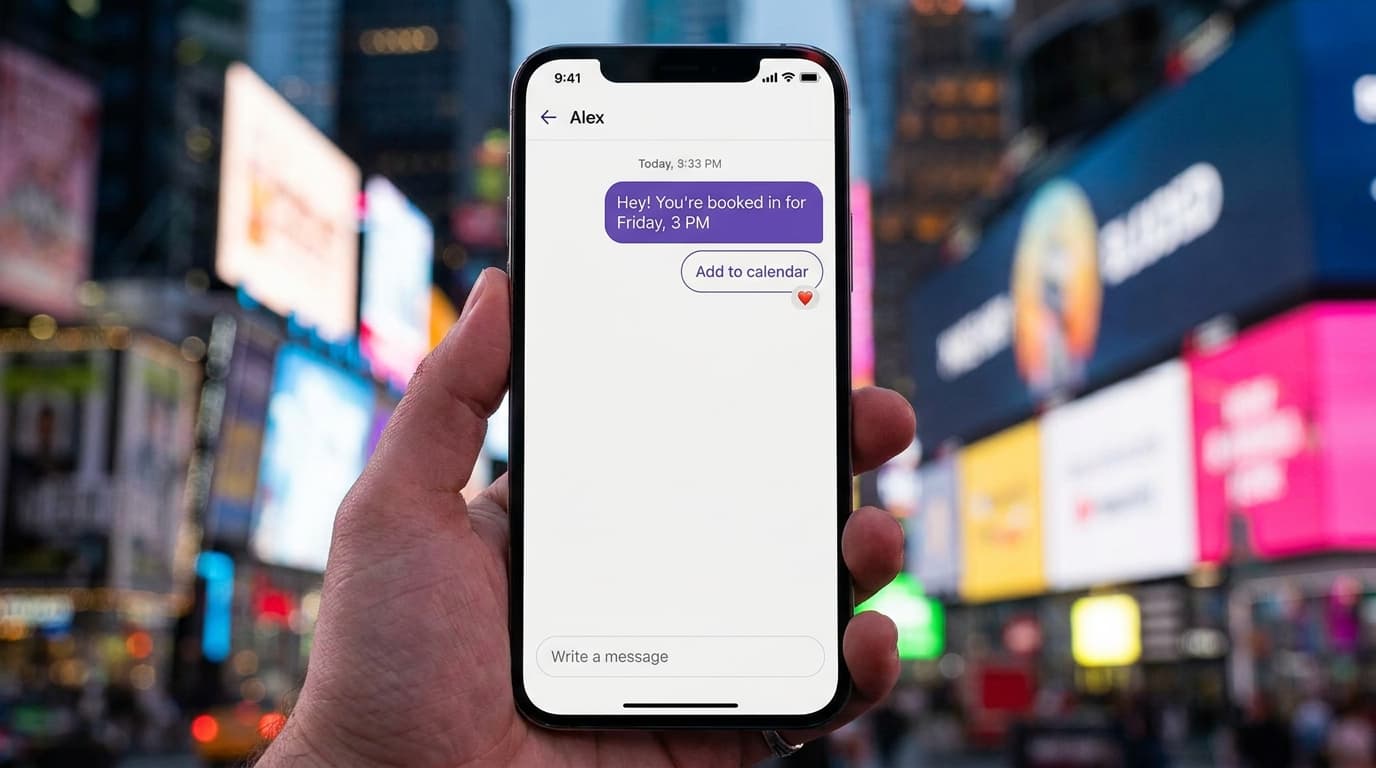
A scheduling bot can go further than reminders. It can let patients or clients book, reschedule, or cancel directly within WhatsApp. No phone calls, no email chains, no third-party booking links.
For a platform like Wexio, this means building a flow where the bot checks available slots against your calendar API, confirms the booking, and sends a reminder 24 hours before. The whole thing runs without human intervention.
Designing Effective AI Chatbot Interactions
A bad chatbot is worse than no chatbot. If your bot frustrates customers, they'll leave and won't come back. Design matters.
Building Natural Conversation Flows
The biggest mistake is trying to make your bot do everything. Start narrow. Identify your top five customer questions and build flows for those first.
Use short, clear messages. Nobody wants to read a 200-word paragraph in a chat bubble. Break information into digestible chunks and offer buttons or quick replies to guide the conversation forward.
Test your flows with real users before going live. Review chat transcripts from your first week religiously. They're free user research. You'll spot logic gaps, dead ends, and questions you didn't anticipate. Look at median response times and completion rates rather than just averages, since a few outlier conversations can skew your data badly.
Personality matters too. A bot for a children's tutoring center should sound different from one for a financial advisory firm. Match the tone to your brand.
Implementing Human-in-the-Loop Handover
Every bot needs an escape hatch. When a customer's problem is too complex, too emotional, or too unusual, the conversation must transfer to a human agent smoothly.
Set clear triggers for handover. Three good ones: the customer explicitly asks for a human, the bot fails to understand two consecutive messages, or sentiment analysis detects frustration. Wexio's "Route to Operator" feature handles this transition, passing the full conversation history to the agent so the customer doesn't repeat themselves.
The handover moment is fragile. If the customer has to start over, trust evaporates. Make sure your system carries context forward, including the customer's name, issue summary, and any data the bot already collected.
Best Practices for Compliance and Security
Automating WhatsApp for business success means nothing if you get banned or fined. Compliance isn't optional.
Navigating WhatsApp's Commerce and Opt-In Policies
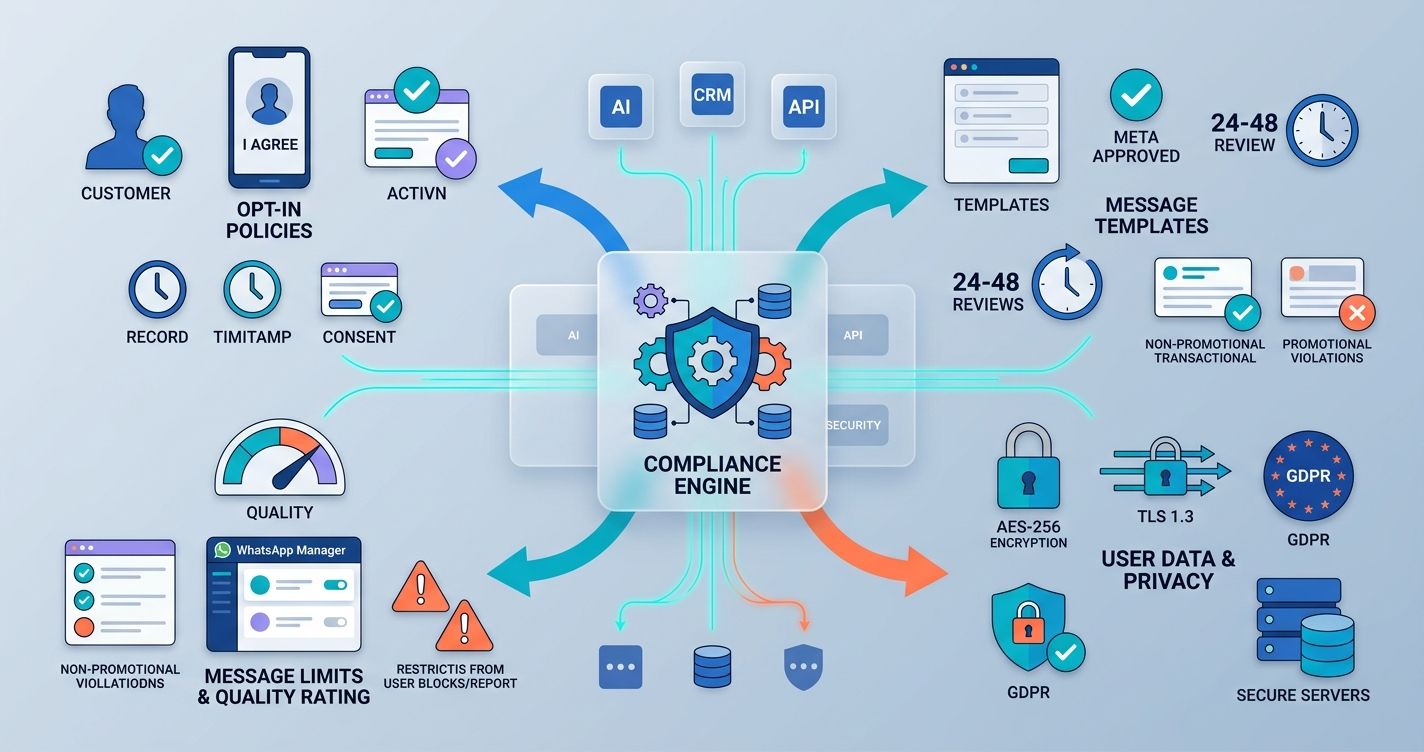
WhatsApp enforces strict rules about who you can message and what you can say. Every business-initiated conversation requires prior opt-in from the customer. You can't just upload your contact list and start blasting promotions.
Opt-in must be active and specific. A pre-checked box on your website doesn't count. The customer needs to explicitly agree to receive WhatsApp messages from your business. Keep records of every opt-in, including the timestamp, source, and exact consent language.
Message templates for business-initiated conversations must be pre-approved by Meta. Expect a review period of 24-48 hours. Rejected templates usually fail because of promotional language in transactional categories or missing variable placeholders.
WhatsApp also limits messaging frequency. If too many users block or report your number, your quality rating drops, and Meta can restrict or ban your account. Monitor your quality score in the WhatsApp Manager dashboard weekly.
Protecting User Data and Privacy
Customer conversations contain sensitive information: addresses, payment details, health records. Your automation platform needs enterprise-grade security, not just promises.
Look for AES-256 encryption at rest, TLS 1.3 in transit, and GDPR compliance if you serve European customers. Wexio, for example, hosts its infrastructure within the EU and is SOC 2 ready with end-to-end encryption, which matters if you're in healthcare, finance, or any regulated industry.
Data retention policies deserve attention too. Don't store conversation data longer than necessary. Set automatic deletion schedules and give customers a clear way to request data removal.
Train your team on data handling. The fanciest encryption in the world won't help if an agent screenshots a conversation and shares it on a personal device.
Measuring Success and Optimizing Performance
You can't improve what you don't measure. Track these metrics from day one.
Response time is the obvious starting point. What's your median first-response time? Not the average, the median. A few quick replies can mask a pile of slow ones if you only look at averages.
Resolution rate tells you how often the bot fully resolves an issue without human help. Aim for 60-70% on common queries. If you're below 40%, your flows need work.
Customer satisfaction (CSAT) scores collected at the end of bot conversations give you direct feedback. A simple "Was this helpful? Yes/No" question works. Don't overthink it.
Conversion metrics matter for sales-focused bots. Track how many leads enter your WhatsApp funnel versus how many book a demo, make a purchase, or schedule an appointment. Attribute revenue back to specific flows so you know which automations earn their keep.
Review chat transcripts weekly. They'll reveal patterns no dashboard can show you. Maybe customers keep asking about a product feature your bot doesn't cover. Maybe the handover to a human happens too late. These insights are gold.
Run A/B tests on message copy, button labels, and flow structures. Small changes, like rewording a qualifying question or reordering menu options, can lift completion rates by 10-15%.
WhatsApp automation isn't a set-it-and-forget-it project. The businesses that win are the ones that treat their bots like living systems: constantly reviewed, regularly updated, and always improving.
If you're ready to stop losing leads to slow replies and start running a smarter messaging operation, Wexio's unified platform and AI-powered flows can get you there. The free tier gives you 100 operations per month with no credit card required, so there's zero risk in testing it out. Get started here.
Sources:
- Salesforce, "State of the Connected Customer," 6th Edition, 2025
- Harvard Business Review, "The Short Life of Online Sales Leads," 2011 (updated 2024)
- SHRM, "Average Cost-Per-Hire for U.S. Companies," 2025
- Gartner, "Messaging Channel Engagement Benchmarks," 2025
- SCI Solutions, "The Cost of Missed Appointments in Healthcare," 2024