
Real estate has always been a relationship business. But the mechanics behind those relationships - finding leads, qualifying buyers, scheduling showings, reviewing contracts - have been painfully manual for decades. That's changing fast. AI agents for real estate are now handling tasks that used to eat up hours of an agent's day, from answering midnight inquiries to predicting neighborhood appreciation rates. The shift isn't theoretical. Brokerages across North America and Europe are already deploying autonomous AI systems that do far more than spit out canned responses. They qualify leads, analyze documents, and coordinate transactions with minimal human oversight. By 2026, the National Association of Realtors reports that 37% of brokerages have integrated some form of AI agent into their daily operations, up from just 14% in 2024. This isn't about replacing human agents. It's about giving them superpowers. The hours you used to spend on data entry and follow-up emails? Those hours now go toward what actually closes deals: building trust, negotiating terms, and guiding clients through one of the biggest financial decisions of their lives. Here's how this technology is reshaping every stage of the real estate process.
The Evolution of AI Agents in the Real Estate Ecosystem
The journey from basic automation to intelligent AI agents has been surprisingly quick. Just five years ago, property tech meant a chatbot on your website that could answer three questions before hitting a dead end. Now we're looking at systems that can reason, plan, and execute multi-step workflows on their own. Understanding this evolution helps you see where the industry is headed and why the current moment matters.
Transitioning from Chatbots to Autonomous Agents
Early real estate chatbots were essentially decision trees with a friendly face. You'd click "Buy" or "Rent," pick a price range, and get a list of links. If your question fell outside the script, you'd hit a wall. That experience frustrated more buyers than it helped.
The shift to autonomous agents happened in stages. First came natural language processing, which let bots understand free-form questions. Then came memory, so systems could recall previous conversations. The real breakthrough arrived with agentic frameworks: AI systems that can break a goal into subtasks, call external tools, and adjust their approach based on results.
A modern real estate AI agent doesn't just answer "What's available in Brooklyn under $800K?" It checks current MLS listings, cross-references your stated preferences from last week's conversation, filters by commute time to your office, and sends you a curated shortlist. If you ask a follow-up about school districts, it pulls that data too, without starting over. That's not a chatbot. That's a digital colleague.
The Role of Generative AI and LLMs in Property Tech
Large language models gave property tech its biggest leap. GPT-4, Claude, and similar models can parse listing descriptions, summarize inspection reports, and draft client communications that actually sound human. They understand context, nuance, and intent in ways that rule-based systems never could.
Generative AI also powers property description writing, marketing copy, and even virtual staging descriptions. A brokerage can feed in property photos and specs and get polished listing copy in seconds. That used to take 30 minutes per listing.
But the real value is in reasoning. LLMs can analyze a 40-page lease agreement and flag unusual clauses. They can compare a property's asking price against recent comps and explain why it seems high or low. This analytical capability turns AI from a convenience into a genuine competitive advantage for agents who adopt it early.
Revolutionizing the Home Search and Discovery Process
Finding the right property has always been a needle-in-a-haystack problem. Buyers scroll through hundreds of listings, most of which don't match what they actually want. AI agents are flipping this dynamic by bringing relevant properties to buyers instead of making buyers hunt.
Hyper-Personalized Property Recommendations
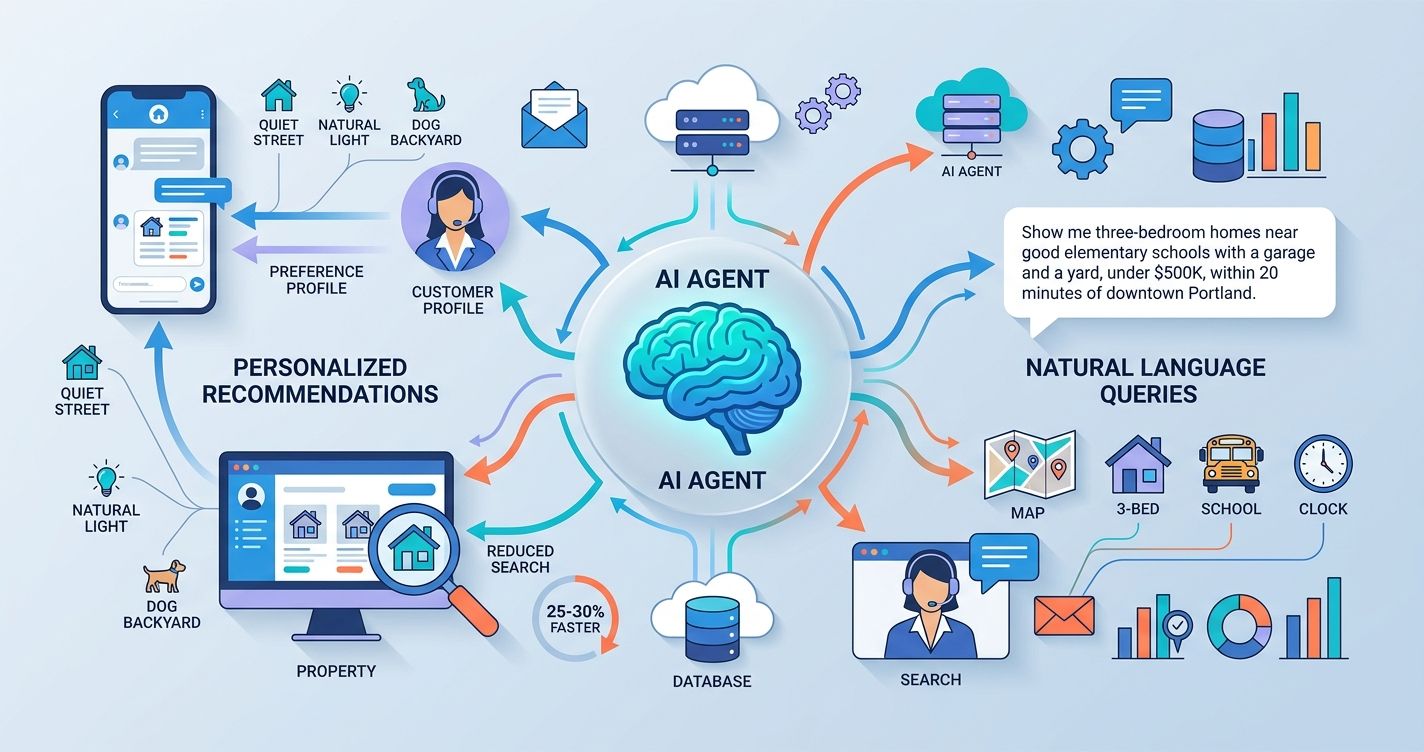
Traditional search filters are blunt instruments. You set a price range, bedroom count, and zip code. But what about the buyer who wants a quiet street, natural light in the kitchen, and a backyard big enough for a dog? Those preferences don't fit neatly into dropdown menus.
AI agents build preference profiles over time. Every interaction teaches the system something new. When a buyer lingers on a listing with exposed brick, the agent notes that. When they dismiss a property because the commute is too long, that data point gets stored too. The result is a recommendation engine that gets sharper with every conversation.
Some brokerages report that AI-driven recommendations reduce the average home search timeline by 25-30%. Buyers see fewer but better-matched listings, which means fewer wasted showings and faster decisions.
Natural Language Queries for Complex Listing Searches
"Show me three-bedroom homes near good elementary schools with a garage and a yard, under $500K, within 20 minutes of downtown Portland." Try typing that into a traditional search bar. You can't.
AI agents handle these complex, conversational queries natively. They parse the intent, break it into searchable parameters, and return results that match the full picture. If no listings hit every criterion, the agent explains the tradeoffs: "I found two homes that match everything except the garage. Want to see them?"
This conversational search model works especially well on messaging platforms. Buyers can text their criteria through WhatsApp or Telegram and get instant results without ever opening a browser. Platforms like Wexio make this possible by connecting AI assistants to messaging channels through a single dashboard, so brokerages can meet buyers wherever they already communicate.
Automating Lead Management and Client Engagement
Here's a reality check. The average real estate agent spends roughly 35% of their time on lead management tasks that don't directly generate revenue. That's follow-up emails, missed calls, and manually entering contact info into a CRM. AI agents are reclaiming those hours.
24/7 Lead Qualification and Instant Response Systems
Speed matters more than most agents realize. A study by the Harvard Business Review found that companies responding to leads within five minutes are 100 times more likely to make contact than those waiting 30 minutes. In real estate, where inquiries spike on evenings and weekends, a five-minute response time is nearly impossible without automation.
AI agents respond instantly, any time of day. But they don't just say "Thanks for your inquiry!" They ask qualifying questions: What's your budget? Are you pre-approved? What's your timeline? Based on the answers, they score the lead and route it accordingly.
Hot leads - pre-approved buyers ready to move within 30 days - get flagged for immediate human follow-up. Tire-kickers get nurtured with automated drip sequences. This sorting process alone can double a team's conversion rate by ensuring agents spend their energy on the most promising prospects.
Clear triggers should determine when the AI hands off to a human: negative sentiment, repeated unanswered questions, or an explicit request to speak with someone. Getting this handoff right is critical. A botched transition chips away at trust faster than a slow response.
Automated Appointment Scheduling and Calendar Syncing
Scheduling showings is one of those tasks that sounds simple but bleeds time. You're coordinating between a buyer's availability, the listing agent's schedule, and the seller's preferences. Three-way phone tag can stretch a 10-minute task into a multi-day ordeal.
AI agents handle this by accessing calendar systems directly. A buyer says "I'm free Saturday afternoon," and the agent checks availability, books the slot, sends confirmations, and adds it to everyone's calendar. If there's a conflict, it suggests alternatives.
The best implementations sync with your existing CRM and marketing stack. When an appointment is booked, the lead's status updates automatically. When a showing is completed, a follow-up message triggers. This connected workflow eliminates the tab-switching tax that drains productivity.
Enhancing Property Valuation and Investment Analysis
Pricing a property correctly is part science, part art. AI agents are dramatically improving the science part, giving agents and investors data-driven confidence that used to require expensive appraisals or years of local market experience.
Real-Time Market Data and Comparative Market Analysis
Comparative market analysis, or CMA, is the backbone of property pricing. Traditionally, an agent pulls recent sales of similar properties, adjusts for differences, and arrives at a suggested price. It works, but it's slow and subjective.
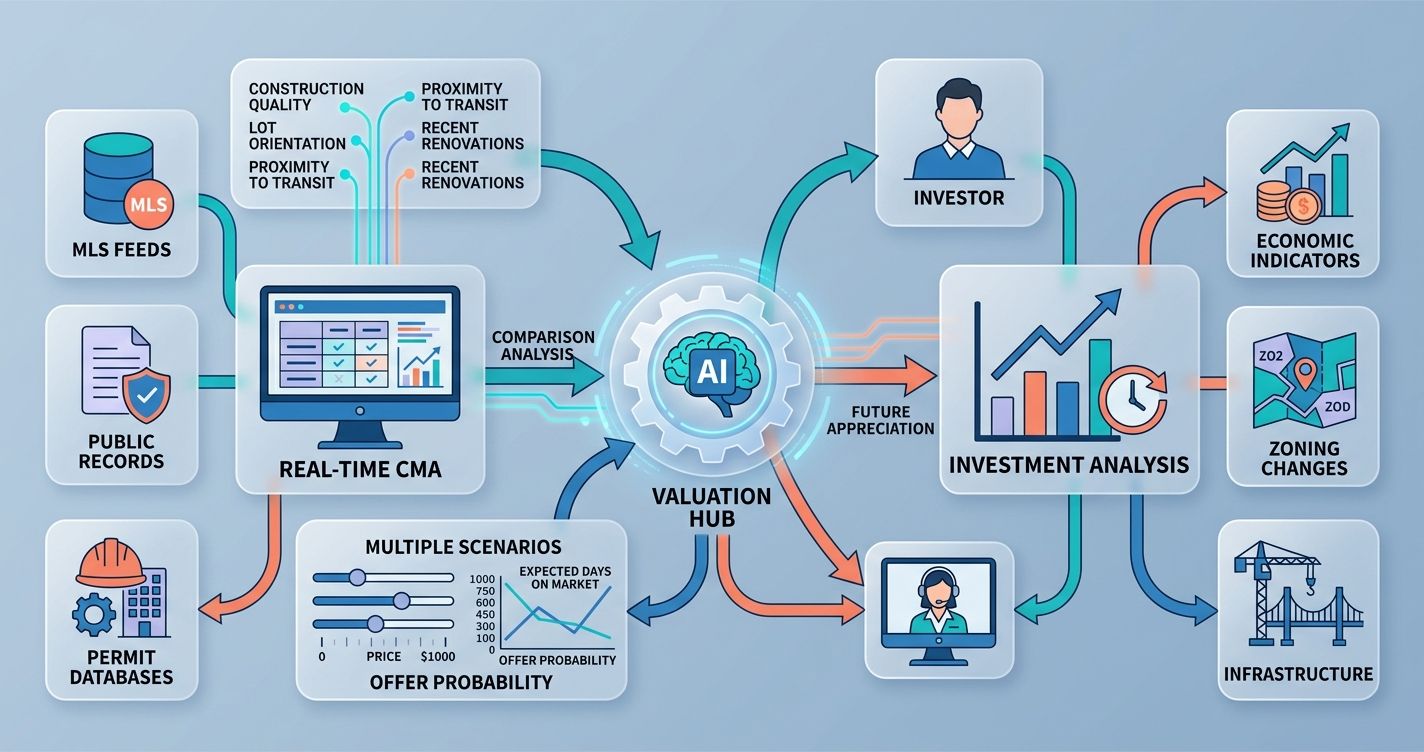
AI agents pull real-time data from MLS feeds, public records, and even permit databases. They identify truly comparable properties based on dozens of variables, not just bedrooms and square footage. Construction quality, lot orientation, proximity to transit, recent renovations: all of these factor into the analysis.
The output is a CMA that would take a human agent two hours, delivered in under a minute. Agents can run multiple scenarios: "What if we list at $475K versus $490K?" The AI models expected days on market and probability of offers at each price point. When reviewing these outputs, smart agents look at median values rather than just averages, since a single outlier sale can skew the picture dramatically.
Predictive Analytics for Future Property Appreciation
Investors care about where a market is going, not just where it's been. AI agents trained on economic indicators, zoning changes, infrastructure plans, and demographic shifts can model appreciation trajectories with surprising accuracy.
A system might flag that a particular neighborhood is likely to see 8-12% appreciation over the next three years because a new transit line is under construction and commercial permits have tripled. That's the kind of insight that used to require a dedicated research analyst.
These predictions aren't crystal balls. They're probability models with confidence intervals. The best AI agents present them honestly: "There's a 70% probability of 8%+ appreciation based on current data." That transparency helps investors make informed decisions rather than gambling on gut feelings.
Streamlining Transaction Coordination and Operations
The period between an accepted offer and closing day is where deals go to die. Missed deadlines, overlooked contingencies, and document errors cause roughly 25% of real estate deals to fall through or face significant delays, according to a 2025 Zillow report. AI agents are attacking this problem head-on.
AI-Driven Document Review and Contract Analysis
A standard residential purchase agreement runs 10-20 pages. Add addenda, disclosures, inspection reports, and title documents, and you're looking at a stack that can easily hit 100 pages per transaction. Human review is essential but error-prone, especially when an agent is juggling multiple deals.
AI agents powered by LLMs can scan these documents in seconds. They flag missing signatures, inconsistent dates, unusual clauses, and potential compliance issues. One common catch: escalation clauses that conflict with the stated offer price. A human might miss that on a busy Friday afternoon. The AI won't.
This doesn't eliminate the need for attorney review on complex deals. But it catches the routine errors that cause 80% of closing delays. Think of it as a first-pass filter that lets humans focus on judgment calls rather than proofreading.
Automating Compliance and Workflow Management
Real estate transactions involve dozens of sequential steps, each with its own deadline. Inspection periods, financing contingencies, title searches, appraisal orders: miss one deadline and the whole deal can unravel.
AI agents manage these workflows by tracking every milestone and sending proactive alerts. Three days before the inspection contingency expires? The buyer's agent gets a reminder. Appraisal report hasn't arrived and closing is in two weeks? The system flags it and suggests follow-up actions.
Wexio's no-code flow builder is particularly useful here. Transaction coordinators can set up automated workflows with conditional branching: if the appraisal comes in low, trigger one sequence; if it meets the purchase price, trigger another. These flows connect across messaging channels, so all parties stay informed whether they prefer WhatsApp, Telegram, or email. With 12+ industry-specific automation templates available out of the box, teams can get started without building everything from scratch.
Regularly reviewing chat transcripts from these automated workflows is free user research. You'll spot where clients get confused, where the AI stumbles, and where your process has gaps. That feedback loop is how good automation becomes great automation.
The Future of Human-AI Collaboration in Brokerages
The brokerages winning right now aren't the ones with the most agents or the biggest ad budgets. They're the ones that figured out the right division of labor between humans and AI. The pattern is clear: AI handles speed, data, and consistency. Humans handle empathy, negotiation, and complex judgment.
By late 2026, expect to see AI agents managing 60-70% of pre-closing administrative tasks at high-performing brokerages. The human agent's role shifts toward being an advisor, negotiator, and trusted guide. That's actually what most agents got into the business to do in the first place.
The technology is ready. The question is whether you'll adopt it now or play catch-up later. AI agents for real estate aren't a future trend. They're a present reality that's already separating top performers from everyone else.
If your brokerage or real estate business communicates with clients across multiple messaging platforms, consolidating those conversations into one place is the logical first step. Wexio's unified inbox and AI-powered automation handle WhatsApp, Telegram, Instagram, and Viber from a single dashboard, with enterprise-grade encryption and a free tier to get started. Try it out and see how much time you get back.
Sources:
- National Association of Realtors, "Technology in Real Estate Report," 2026
- Harvard Business Review, "The Short Life of Online Sales Leads," updated 2024
- Zillow Research, "Transaction Failure Rates and Common Causes," 2025