Tidio vs Intercom vs Wexio: Honest Comparison for 2026
Three customer messaging tools that look almost identical on paper. All three offer:
- A website chat widget
- AI-powered automated replies
- A shared inbox for human agents
- Integrations with the usual CRMs and helpdesks
In practice, they're built for completely different teams and budgets. Picking the wrong one wastes two months and $500-$2,500 before you realize. This is the side-by-side I wish existed when our team was deciding.
TL;DR
- Intercom is for companies with a sales team and a $50k+ monthly software budget.
- Tidio is for solo founders and small e-commerce stores that want a Drift-shaped widget without paying Drift prices.
- Wexio is for teams whose customers come through messaging apps (WhatsApp, Telegram, Instagram, Viber) and want full-featured website chat too, without enterprise pricing.
If you're not sure which of those describes you, read the rest.
Quick comparison table
| Tidio | Intercom | Wexio | |
|---|---|---|---|
| Starting price | $24.17/mo | $74/seat/mo | Standard $16/mo (Free trial: 100 ops, no AI) |
| Free tier | 50 conversations | None | 100 ops trial (no AI) |
| Primary channel | Website chat | Website chat | Messaging apps + web widget |
| Channels supported | Web, FB, IG, WhatsApp | Web, email, FB, IG, WhatsApp, SMS | WhatsApp, Telegram, IG, Viber + full web widget (home/messages/FAQs/news, passkey + Google + JWT auth) |
| AI | Lyro (proprietary) | Fin (proprietary) | BYO key (OpenAI, Anthropic, Google) |
| Best for company size | 1-10 employees | 50+ employees | 1-50 employees |
| Sales motion | Self-serve | Sales-led | Self-serve |
| Built for | E-commerce SMBs | B2B SaaS, enterprise | Multi-channel teams |

Where each one actually shines
Tidio - small e-commerce, low budget, web traffic
Tidio's product-market fit is "Shopify store with under 10 employees that wants a chat bubble." The widget is polished, the AI ("Lyro") answers the top 20% of customer questions reliably, and the pricing ($24.17/mo for the entry plan) is reachable for a side project.
The flow builder is intentionally simple. There's no graph editor - you build conversations as a linear list of steps. This is great until your flow needs branching logic, conditions, or sub-flows. Once it does, you'll feel the ceiling.
Tidio is right for you if:
- You're a Shopify or BigCommerce store under $1M ARR
- Your customers find you through search and convert on the website
- Your top customer questions are predictable (order status, returns, sizing)
Tidio is wrong for you if:
- Your customers DM you on Instagram or WhatsApp more than they email
- You need conditional logic in flows
- You're building a B2B product with high-touch sales
Intercom - enterprise B2B, ample budget, sales team
Intercom is the industry default for B2B SaaS over $5M ARR. The product is good - the inbox is fast, Fin (the AI) is genuinely strong, and the sales playbook integrations save real money for teams doing chat-to-meeting funnels.
The catch is the price. Intercom's base seat is $74/mo, but real customer bills are 3-5x that. The AI add-on ("Fin") is $0.99 per resolved conversation, which compounds fast on B2C volumes. A 30-seat customer-support team running Fin can spend $5,000-$10,000/mo without trying.
Intercom is right for you if:
- You're 50+ employees
- Your average customer is worth >$5k/year
- You have a sales team that books meetings from chat
- Your team needs ticketing, knowledge base, and CRM in one product
Intercom is wrong for you if:
- You're under $5M ARR
- Your customers are in DM channels, not on your site
- You don't have someone who can babysit the product (Intercom requires admin time)
Wexio - multi-channel teams, growing AI usage
Wexio was built specifically for the case where your customer base lives outside the website - WhatsApp groups, Telegram chats, Instagram DMs, Viber. The inbox unifies all of them into one feed with one set of automations.
Wexio's AI supports two modes - use built-in models (OpenAI GPT-4 or Anthropic Claude, counted in your plan's operations) or connect your own provider key and pay the model directly with no markup. This is a structural difference: Tidio and Intercom build their own AI products and charge you a marked-up rate per resolved conversation. Wexio lets you pick the model and the bill.
The web widget is in active development and ships in June 2026. It mirrors what Intercom Messenger does: a home page with 11+ embeddable widgets, messages tab, FAQs page, and a news page that parses your client's existing RSS feed automatically. User verification supports passkey, Google login, server-side JWT, or anonymous mode with optional pre-chat forms. Multi-language is built in for the full widget. The point: get Intercom Messenger's full UX without Intercom's per-resolved-conversation AI markup.
Wexio is right for you if:
- 50%+ of your customer messages come from messaging apps
- You want to use the latest frontier model (Claude 4.6, GPT-4o, Gemini) without waiting for a vendor to support it
- You're cost-sensitive and want predictable AI bills
- You want one inbox for 4-5 channels, not a separate tool per channel
Wexio is wrong for you if:
- Your team is 100+ seats with established Intercom workflows. Migration cost is real, and Intercom's marketplace integrations still beat ours
- You're an enterprise expecting white-glove onboarding (we're a small team)
- You need 200+ pre-built integrations (Intercom has a bigger ecosystem)
Disclosure: I work on Wexio. Tidio and Intercom are competitors I respect - the comparisons below try to be fair even when it doesn't favor us.
Side by side on the things that actually matter
Channel coverage
| Channel | Tidio | Intercom | Wexio |
|---|---|---|---|
| Website widget | ✓ best in class | ✓ best in class | ✓ ships June 2026 (full Messenger-class) |
| Add-on | ✓ core | (planned) | |
| ✓ via partner | ✓ direct | ✓ direct (no markup) | |
| Instagram DM | ✓ | ✓ | ✓ |
| Facebook Messenger | ✓ | ✓ | (planned) |
| Telegram | ✗ | ✗ | ✓ |
| Viber | ✗ | ✗ | ✓ |
| SMS | Add-on | Add-on | (planned) |
| Voice / phone | ✗ | ✓ | (planned) |
Read this honestly: if your channels are website + email + WhatsApp, Intercom is the only one that does all three well today. Wexio's web widget ships June 2026 and will close that gap for web + WhatsApp setups. If you need Telegram or Viber, Wexio is the only option here. Tidio is the cheapest if you can scope down to web + Instagram.
AI
| Tidio | Intercom | Wexio | |
|---|---|---|---|
| Built-in AI | Lyro (proprietary) | Fin (proprietary) | None - BYO key |
| Latest models supported | OpenAI-based, vendor-managed | OpenAI + Anthropic, vendor-managed | Whatever you set: GPT-4o, Claude 4.6, Gemini 2.5 |
| Pricing | Per conversation | $0.99 per resolved conversation | Pass-through to your provider |
| Custom prompts | Limited | Limited | Yes, per flow |
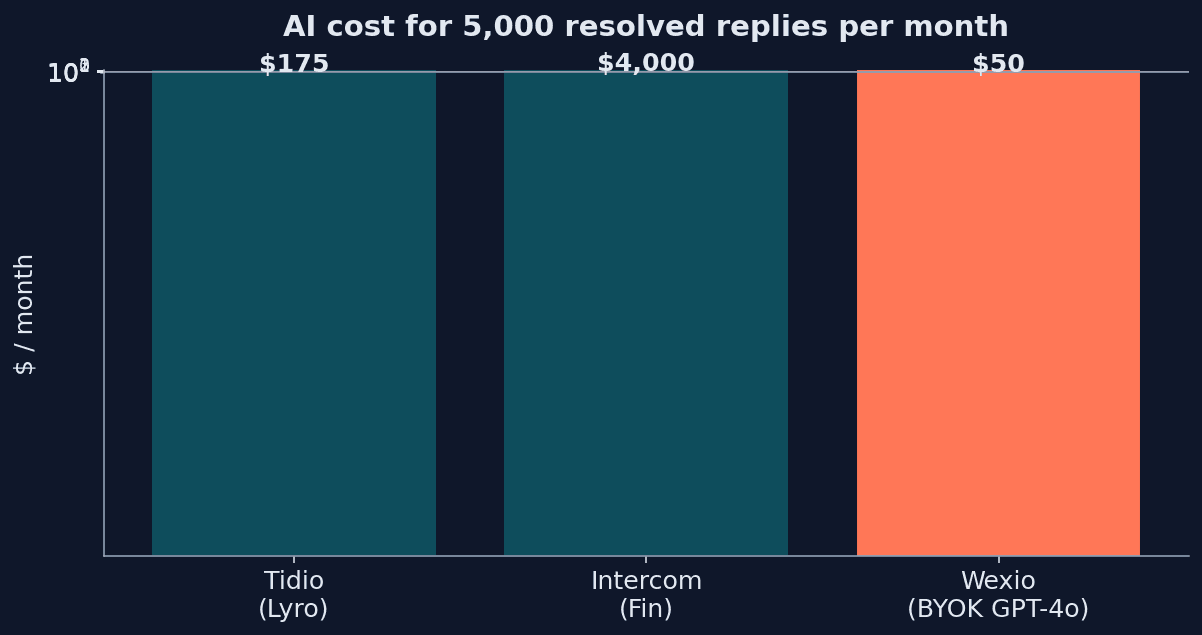
| Cost for 5k AI replies/mo | ~$150-200 | ~$4,000+ | ~$15-50 (OpenAI direct) |
The AI cost difference is the single biggest financial gap between these tools. At 5,000 resolved AI conversations per month, you're looking at $4,000 with Intercom Fin vs ~$30-50 with Wexio using GPT-4o directly. For high-volume support teams this is the deciding factor.
That said, Tidio's Lyro and Intercom's Fin work out of the box - they're optimized for support questions and have guardrails. Wexio's BYO setup needs you to think about prompts, system messages, and which model fits which case. If you don't want to think about that, Lyro or Fin save you the work.
Pricing for a realistic scenario
Take a small team: 3 agents, 2,000 active customers, 800 monthly conversations, AI handling 50% (400 resolved).
| Tidio | Intercom | Wexio | |
|---|---|---|---|
| Seats | 3 × $24.17 = $72.51 | 3 × $74 = $222 | Free |
| Conversations | Included | Included | Included |
| AI / 400 resolved | Lyro add-on ~$39 | Fin: $396 | OpenAI direct ~$15 |
| Monthly total | ~$112 | ~$618 | ~$15 |
| Annual | $1,344 | $7,416 | $180 |
This is illustrative, not a quote - actual costs depend on plan tier, region, and add-ons. But the order-of-magnitude difference is real and consistent across team sizes.
Implementation effort
Day-zero setup time, assuming you know what you're doing:
- Tidio: 1 hour. Embed a script, configure a few AI prompts, done. Hardest part is connecting Shopify if you use it.
- Intercom: 2-4 weeks. The product is complex enough that most teams pay for a Solutions Engineer (~$2k one-time) for first-pass setup. The benefit comes after the setup curve.
- Wexio: 2-3 hours for first channel. Connecting a WhatsApp business number takes the longest (Meta verification, hours to days). Once connected, the flow builder is fast.
Where each gets bad reviews
Searching G2 and Capterra for honest 1-2 star reviews, the recurring complaints are:
Tidio (recurring): Lyro hallucinates on long conversations. Pricing tiers jump suddenly (the gap between Plus and Premium is steep). Customer support response time has slipped in 2026. If you're evaluating support metrics, the free support cost calculator helps you put a number on what reply-time delays actually cost.
Intercom (recurring): Price increases are unannounced and steep - many customers report 30-50% YoY price hikes. Fin's per-resolved-conversation pricing creates surprise bills. Sales-led process means you can't try the actual full product without a demo call.
Wexio (recurring): Smaller team means slower feature requests (we're honest about this - features take 2-6 weeks). Smaller template library than Intercom's marketplace. WhatsApp BSP-onboarding has a learning curve.
The decision framework
If you have less than 30 seconds, here's the cheat:
- Is your customer in WhatsApp/Telegram/Viber? → Wexio
- Want Intercom Messenger's UX (home + news + FAQs + auth + multi-lang) without per-resolved-conversation AI markup? → Wexio (web widget ships June 2026)
- Is your customer on a website you control, single channel, and budget <$2k/mo? → Tidio
- Are you 50+ employees with established B2B sales workflows? → Intercom
The only "wrong" mistake is buying Intercom when you're 5 employees, or sticking with Tidio when 80% of your traffic is on WhatsApp.
What about Crisp, Zendesk, HubSpot?
These come up in the same search. Quick takes:
- Crisp - Tidio competitor, open-source-friendly, European-based. Better than Tidio for technical teams, slightly less polished AI.
- Zendesk - enterprise helpdesk with chat bolted on. Heavyweight, expensive, but solid if your support is ticketing-first.
- HubSpot Conversations - bundled with HubSpot CRM. Free if you're already paying for HubSpot. Limited if you're not.
For most teams switching off Tidio or Intercom, these aren't a step up - they're sideways moves.
FAQ
Can I use multiple of these tools at once? Technically yes (different channels on different tools). Practically: the unified inbox is the whole point. Splitting it across tools loses the value of having one tool.
Which is best for AI customer support specifically? Intercom Fin is the highest quality out of the box if you don't want to think about it. Wexio with Claude 4.6 or GPT-4o is the highest quality if you're willing to tune prompts. Tidio Lyro is the cheapest "decent" option.
What if my company grows from 5 to 50 employees? Migration is real work but not catastrophic. The common upgrade paths:
- Tidio → Intercom (if you stay web-first)
- Tidio → Wexio (if you add messaging channels)
- Wexio → Intercom (if you become enterprise B2B)
Plan the migration when you're at 30 employees, not 50.
Is the Wexio free tier real? It's a real free trial, not a real free production tier. The Free plan caps at 100 operations per month and excludes AI - enough to test the flow builder, channels, and inbox UI but not enough for real traffic. The Standard plan at $16/mo ($12/mo annual) is where AI auto-replies and 10,000 operations enable; that's the practical commercial entry. Pro and Enterprise scale further via a slider up to 3M+ operations.
What to do next
- Pick the 2 tools that fit your situation from the framework above.
- Sign up for free trials of both. Connect your primary channel. Test the AI on 5 real questions you've answered manually before.
- The tool that gives you better answers in fewer steps wins.
Try Wexio free - no card required. Compare plans on the pricing page, browse pre-built flow templates for common use cases, or read the getting started guide if you want to see the setup flow before you sign up.