I spent a couple of years at a WhatsApp BSP before Wexio, and the phrase that made me wince most in sales calls was "AI chatbot." Not because AI is hype. Because nine times out of ten, the thing behind the phrase was a decision tree with a language model bolted to the front, billed to the customer as if it were a digital employee.
An AI chatbot for business is real, and in 2026 it's genuinely good. But the gap between what the category promises and what most tools ship is wide enough to drive a support backlog through. So here's the honest version: what an AI chatbot actually does when it works, where it quietly fails, what it really costs, and how to pick one without buying a glorified FAQ page.
The distinction that actually matters
Every vendor now says "AI." That word tells you almost nothing. Here's the split that does.
A scripted bot follows a flow you built. Button, condition, reply, repeat. It's fast, predictable, and it falls apart the second a customer phrases something you didn't anticipate. If you've ever rage-typed "talk to a human" three times, you met one.
An AI chatbot understands the message, not just the keywords. It reads intent, pulls from your own content, and answers in your voice. That's the part vendors sell.
But the real dividing line in 2026 isn't "AI or not." It's whether the bot can take an action. Answering a question is table stakes now. The chatbots worth paying for book the meeting, take the Stripe payment, update the customer record, and hand off to a person with the full context when they should. Everything else is a search box that talks.
That's the test I'd apply to any tool: not "does it use AI," but "can it do the thing the customer actually wanted done."
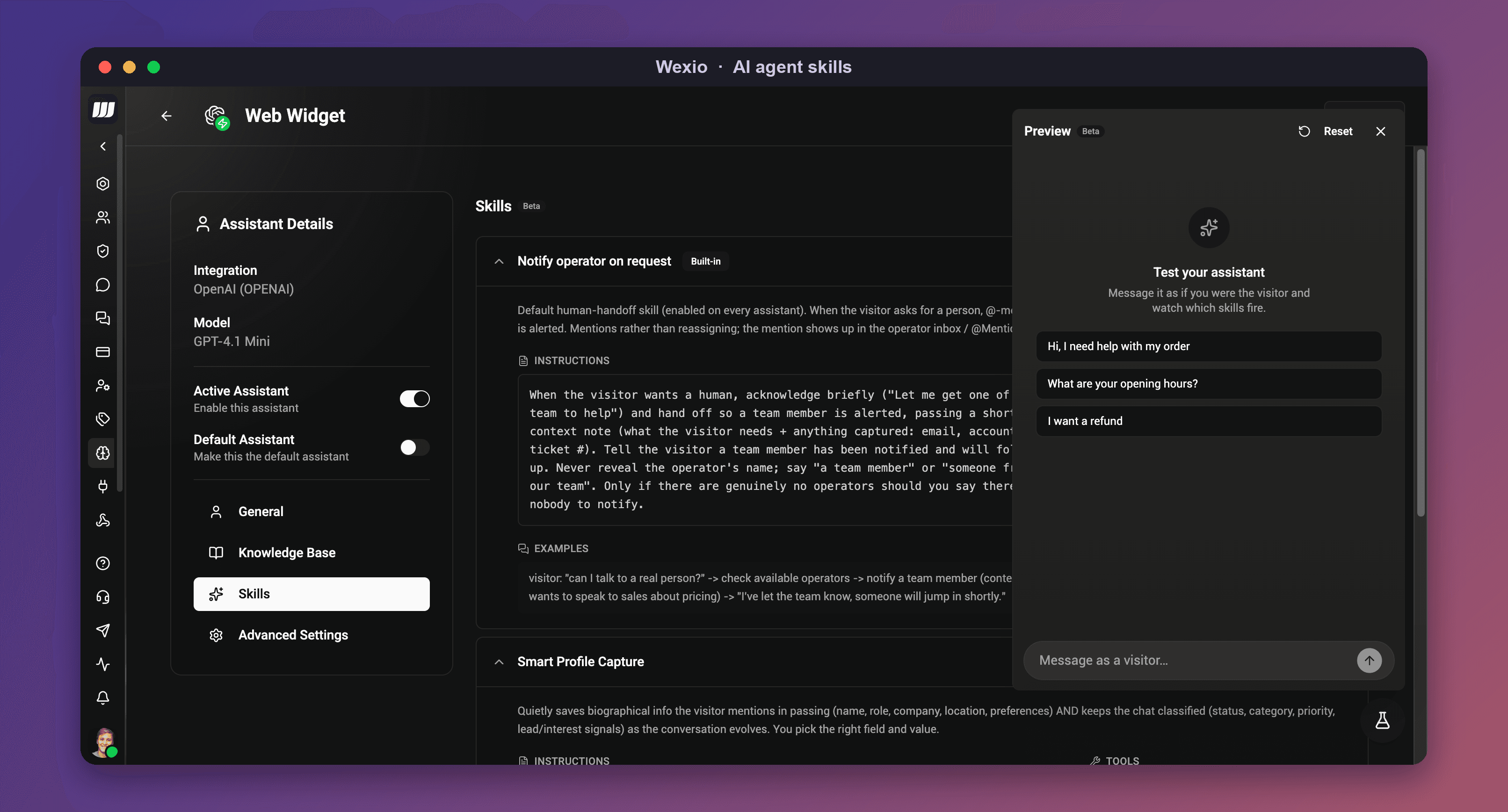 This is where "takes an action" gets real: each skill is a thing the bot can actually do, like hand off to a person with context, or quietly save what it learned about the customer.
Where an AI chatbot earns its keep
The mistake most teams make is aiming it at the wrong work. An AI chatbot for business isn't there to replace your team. It's there to take the volume that was never worth a human's attention in the first place, so the humans get the conversations that are.
Instant first response, at 2am. There's a well-worn number in sales that a lead is around 100x more likely to qualify if you reply within five minutes instead of an hour. No small team hits that consistently by hand. A bot does it every time, including the weekend inquiry you'd have seen Monday.
The same forty questions. Hours, pricing, "where's my order," "do you integrate with X." A well-grounded AI answers these from your own docs and site, instantly, without a human touching them. This is the bulk of most inboxes, and it's the least rewarding work your team does.
Qualifying and routing. Before a person ever joins, the bot can ask the three questions that decide whether this is a hot lead or a tire-kicker, and route accordingly.
Actually finishing the job. Booking a slot, taking a deposit, capturing the details into your CRM. This is where "chatbot" stops meaning "chat" and starts meaning "does work."
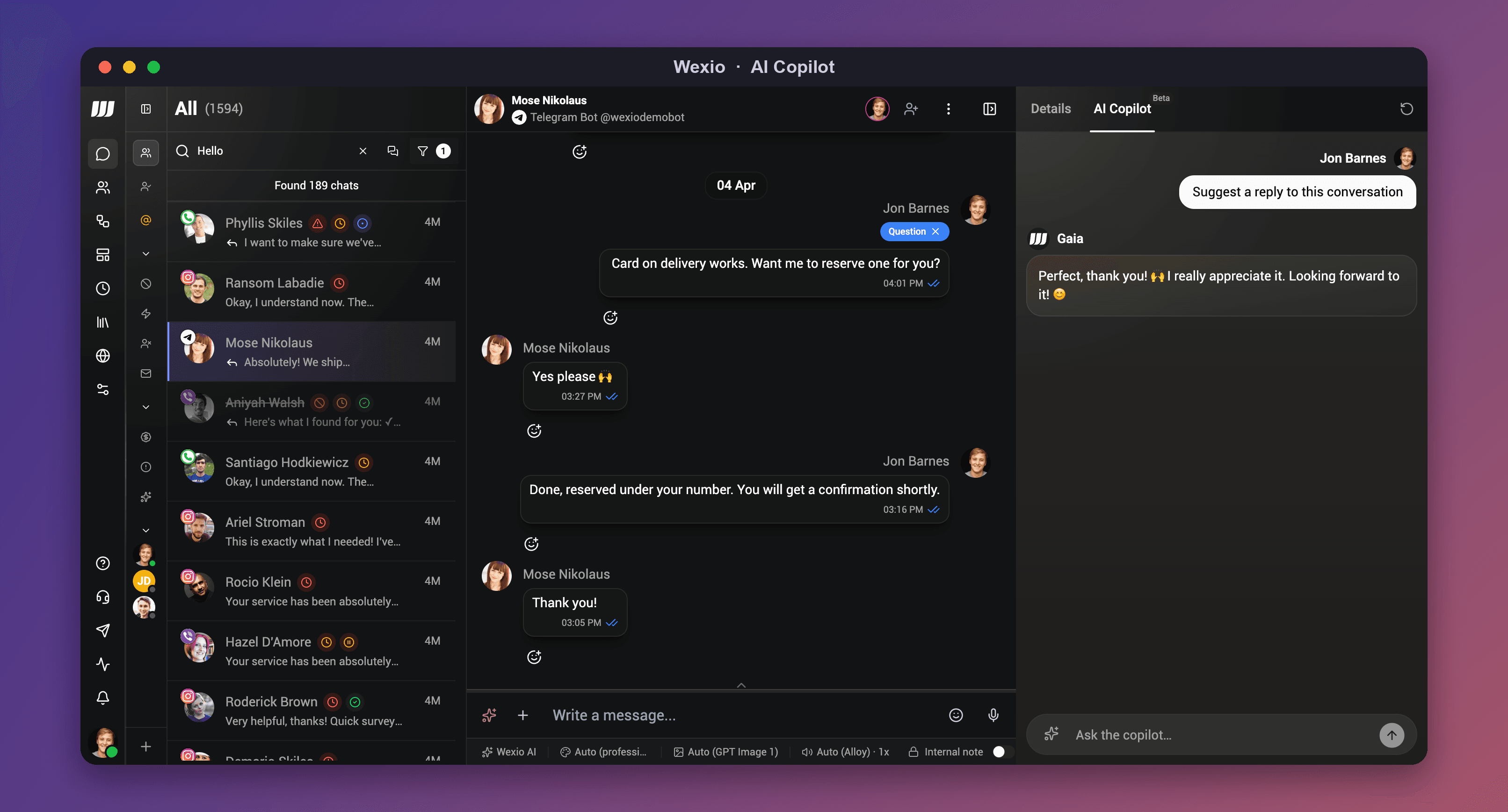 A real conversation in our inbox: the AI answered, and the full customer context sits right beside it for the human who takes over.
Where it doesn't help (and where competitors genuinely win)
I'd rather tell you this than have you find out after the invoice.
An AI chatbot is bad at anything requiring judgment, empathy on a bad day, or a decision that costs real money. A refund dispute, an angry churn risk, a complex custom quote. Route those to a human fast. The best setups aren't bot-only, they're bot-first with a clean handoff.
It's also only as good as what you feed it. Point it at a thin, outdated help center and it'll confidently make things up. Grounding beats cleverness. Boring, well-maintained content is the real moat.
And on the honesty point: if you're a large enterprise deflecting tens of thousands of tickets, Intercom's Fin is genuinely strong. The polish, the reporting, the ecosystem are real. It's expensive on purpose, and for that buyer, sometimes worth it. I'll say that plainly, then show you why most businesses are overpaying for it, which brings us to cost.
The cost trap nobody quotes you
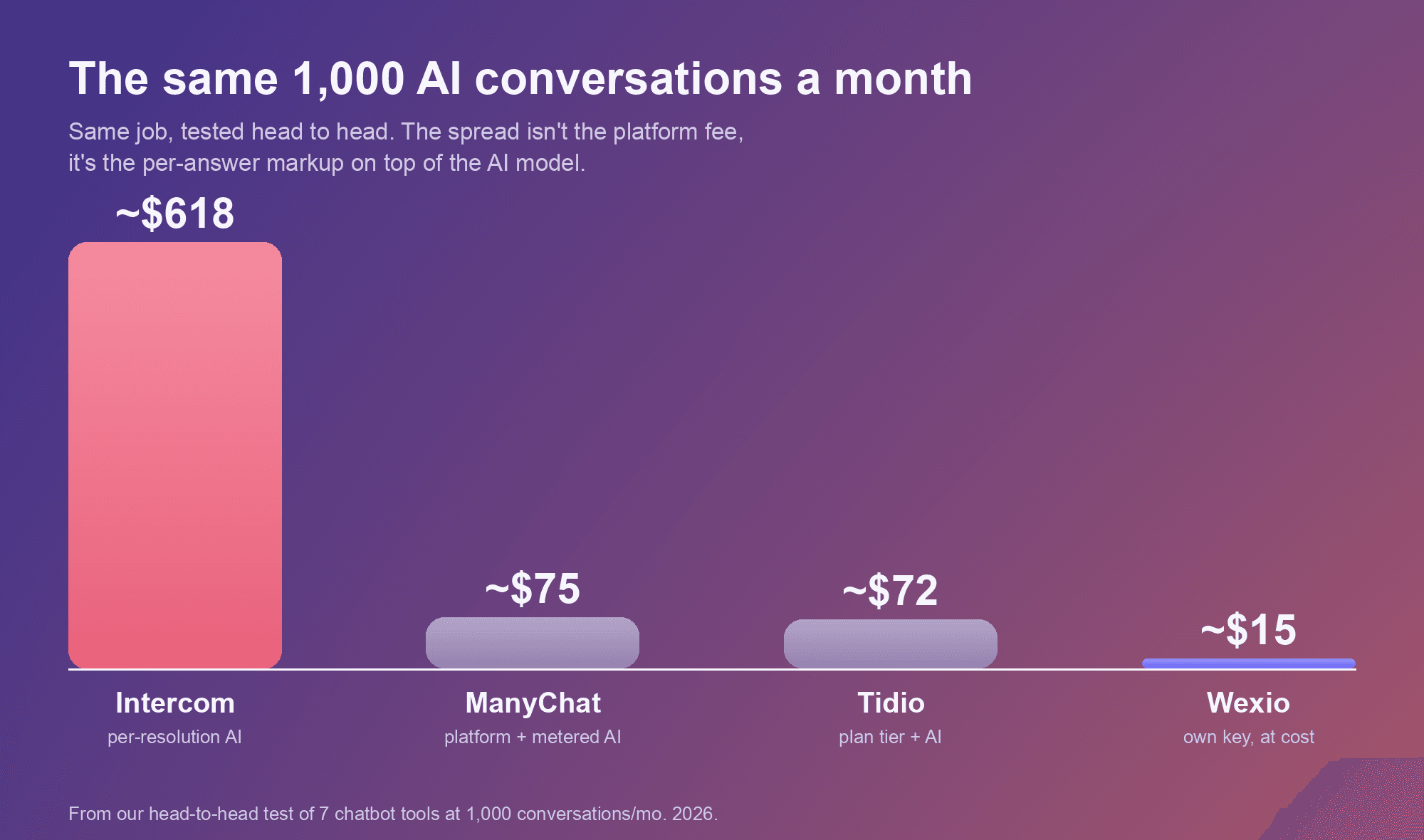
Here's the thing that surprised even me when we ran the numbers. We built the same five-step lead-qualification flow across seven tools and pushed real conversations through each. The spread on running an AI at 1,000 conversations a month wasn't 20 percent. It was this:
| Setup | ~1,000 AI conversations / mo | What you're paying for |
|---|---|---|
| Intercom (Fin) | ~$618 | Per-resolution AI (~$0.99 each) + seats |
| ManyChat + AI add-on | ~$75 | Platform + metered AI |
| Tidio | ~$72 | Plan tier + AI |
| Self-hosted open source | ~$0 + your time | You run and maintain it |
| Wexio (bring your own AI key) | ~$15 | Usage-based, model billed at cost, no markup |
Same job. Roughly a 40x spread. The trick almost every "AI chatbot" platform plays is a per-answer toll on top of the model. The model itself costs a fraction of a cent. The platform charges you a nickel and pockets the difference at scale. You don't feel it in month one. You feel it the month your volume doubles.
This is the one strong opinion I'll plant a flag on: you should never pay a per-answer markup on top of the AI model. Either the tool bills the model at cost and lets you bring your own key, or it's quietly taxing every conversation. If you want to sanity-check your own numbers before you commit, our support cost calculator and ROI calculator do the math on your real volume. The full seven-tool teardown is in our best chatbot for small business test if you want the receipts.
One bot, every channel
A detail that gets skipped: your customers aren't all in one place. Some message on your website, some on Telegram, some will want WhatsApp. A chatbot that only lives on your site is doing a third of the job.
The version that actually helps a small team is one AI answering across every channel into a single inbox, so nobody's flipping between six apps and losing context. I just set up the WhatsApp Cloud API side myself this month, and the reality worth knowing is that the messaging layer has a free tier (Meta gives you a batch of free service conversations), while the intelligence and the tooling around it are what you actually invest in. Same honesty point I made in the free WhatsApp Business API breakdown.
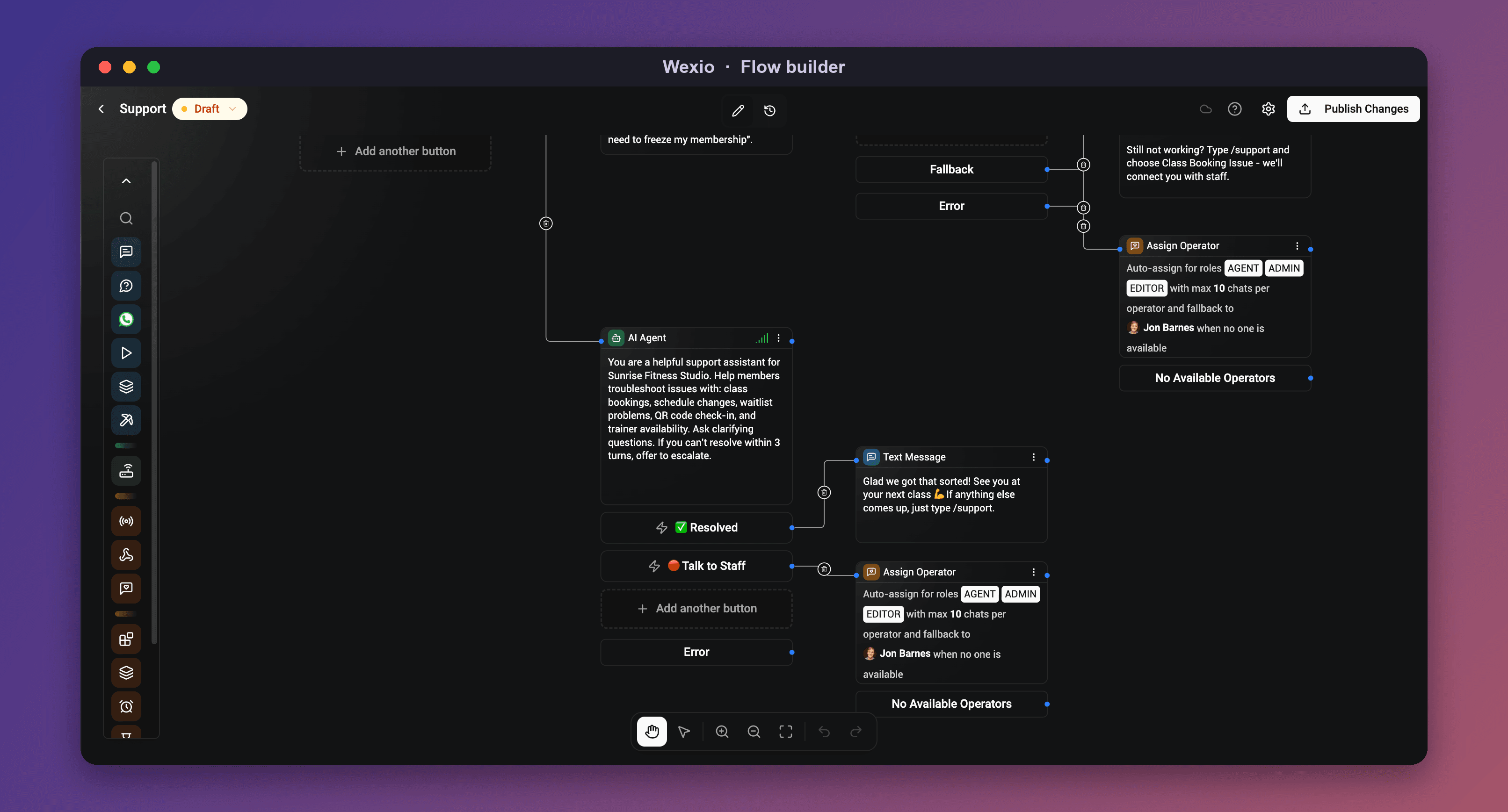 Where the logic lives: a no-code flow, so the bot's actions and human handoffs are visible, not a black box.
How to pick one without getting burned
Skip the 20-tool listicles. Answer these instead, in order.
- Can it take actions, not just answer? Book, pay, update a record, hand off. If it can only reply, it's a search box.
- How is the AI billed? Own-key or at-cost is a green flag. Per-resolution markup is a slow leak. Ask for the price at 5,000 conversations a month, not 500.
- What channels, one inbox? Web, Telegram, WhatsApp, email, into a single place, or six disconnected apps.
- How clean is the human handoff? The bot should escalate with full context, instantly. Test this before you buy.
- Is it grounded in your content? It should answer from your docs and site, not vibes.
If you want the tool-by-tool version of this, the best chatbot for small business test scores seven of them against exactly these criteria, and the ManyChat and Intercom alternative breakdowns go deeper on two of the big names.
Where Wexio fits
Disclosure: I work on Wexio, so weigh this accordingly. We built it as the answer to the cost trap above. The AI answers customers instantly, grounded in your own content, and it doesn't just chat: it books, takes a Stripe payment, updates records, and hands off to a human when it should. It runs across web chat and Telegram today, with WhatsApp rolling out, all into one inbox, and the logic is a no-code flow you can actually see.
On cost, it's usage-based with a free plan to start, and the AI is built in or you bring your own OpenAI or Anthropic key and pay the model directly with no markup. If you want to wire your own key, the AI provider docs walk through it. That's the whole pitch: the intelligence at cost, not a toll on every answer.
FAQ
What's the difference between a chatbot and an AI chatbot? A chatbot follows a script you built. An AI chatbot understands the message and answers from your content in natural language. In 2026 the real question is a step further: can it take an action (book, pay, update a record), or does it just reply?
How much does an AI chatbot for business cost? The platform ranges from free to hundreds a month, and the AI itself is where the real spread is. At around 1,000 conversations a month, the same job runs from roughly $15 (own-key, at-cost) to about $618 (per-resolution pricing). The number that bites you is the per-answer markup, so always ask for the price at your future volume, not today's.
Can an AI chatbot replace my support team? No, and you don't want it to. It should take the repetitive volume, the FAQs, the after-hours first response, and hand the judgment calls to a person with full context. Bot-first, human-for-the-hard-stuff.
Does it work on WhatsApp? Yes, through the WhatsApp Business Platform, though the WhatsApp layer has its own per-conversation billing (with a free tier). The smarter setup is one AI across web, Telegram, and WhatsApp into a single inbox, not a separate bot per channel.
Will it make things up? It can, if you point it at thin or outdated content. Grounding it in a well-maintained help center and your real site is what keeps it accurate. Boring, current content beats a cleverer model.
The one-line version
An AI chatbot for business in 2026 is worth it when it does the work, not just talks about it: instant answers, real actions, clean handoffs, across every channel. Just watch the one number vendors bury, the per-answer markup, because that's where "affordable AI" quietly becomes a monthly surprise.