I spent a couple of years at a WhatsApp BSP before Wexio, so people ask me this a lot: Telegram or WhatsApp for my business? The honest answer usually annoys them, because it's "probably both, and here's why." But the two are genuinely different tools, and picking the wrong one first can cost you weeks of setup and a channel your customers never actually use.
So here's the real comparison: reach, the API reality, automation, cost, and a clear rule for which to start with. No feature-table padding, just what actually matters when a small team has to choose.
The split that actually matters: reach vs control
Start with where your customers already are, because a channel nobody opens is worthless no matter how good the bot is.
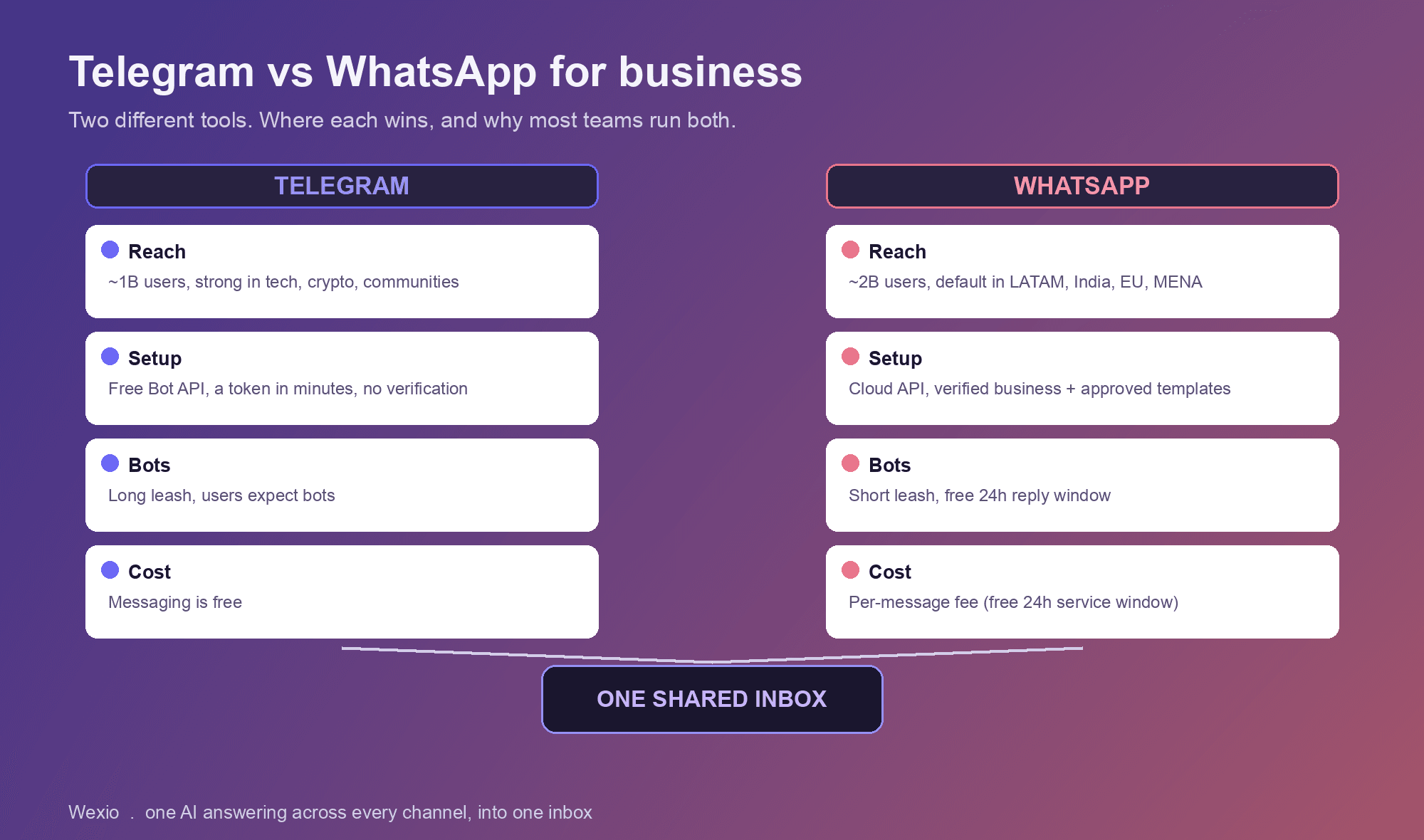
WhatsApp is the bigger consumer net. Around 2 billion people use it, and in Latin America, India, Europe and the Middle East it's often the default way people message a business at all. If you sell to consumers in those markets, WhatsApp is where the buying conversations happen.
Telegram is smaller but stickier in its strongholds. Roughly a billion monthly users, and it dominates in Eastern Europe, crypto, tech, and anywhere community and channels matter. Its users skew more tech-comfortable and are far more tolerant of bots, which changes what you can do with them.
The quiet tiebreaker is speed, and it applies to both. There's a well-worn sales number that you're around 21x more likely to qualify a lead if you reply within five minutes instead of thirty. Neither channel hits that by hand on a small team. Whichever you pick, the automation behind it is what actually wins the deal.
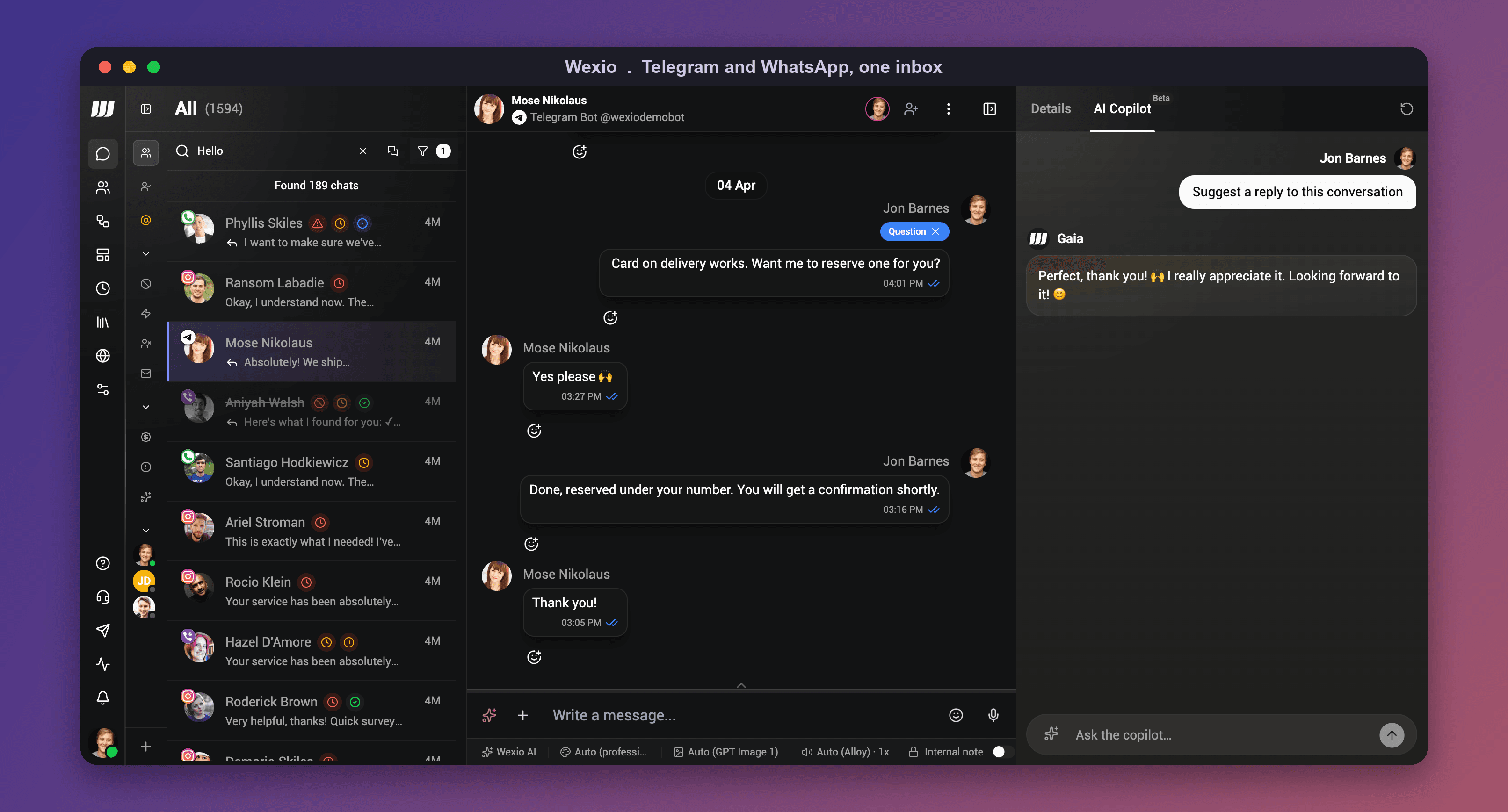 Where this ends up for most teams: both channels landing in one inbox, not two apps on two phones.
The API reality (this is where teams get stuck)
This is the part nobody explains until you're three days into setup, so let me save you the surprise.
WhatsApp is an official, gated platform. To automate it you go through Meta's Cloud API, which means a verified Meta business, an approved display name, and pre-approved message templates for anything you send first. It's very capable and it's the legit path, but it's a setup, not a toggle. I broke the whole thing down in the complete guide to WhatsApp Business messaging and the honest free WhatsApp Business API piece.
Telegram is the opposite: open and fast. The Telegram Bot API is free, you get a bot token from BotFather in minutes, there's no business verification, and the bots are genuinely powerful. For automation-heavy use cases you can be live the same afternoon. We walk through the practical side in using Telegram for business, and the best AI chatbot for Telegram breakdown if you want the bot-specific view.
If you're technical or you want to test an idea this week, Telegram's low friction is a real advantage. If your customers only live on WhatsApp, that friction is worth pushing through.
Automation and bots
Both channels let you build a bot. What differs is the leash.
Telegram gives bots a long leash. They can message freely within a chat, handle rich interactions, run inside groups and channels, and its users expect bots. If your play is a support bot, a community assistant, or a tool people opt into, Telegram is a joy to build on. You can spin up a free Telegram chatbot for business without paying for the messaging layer at all.
WhatsApp keeps bots on a short, well-lit leash. You can reply freely for 24 hours after a customer messages you (the free service window), but to start a conversation you need an approved template, and marketing messages are billed. That's Meta protecting the inbox from spam, and it's why WhatsApp feels more "premium" and less noisy. It's more work, and the payoff is a channel customers actually trust for commerce.
Either way, the bot is only as good as what you feed it. Point it at thin, outdated content and it'll make things up, on both platforms.
Cost, honestly
This is where the two diverge most.
Telegram messaging is free. The Bot API costs nothing; you pay only for whatever tool sits on top to run your inbox and AI. For a bootstrapped team that's a real edge.
WhatsApp has a per-message fee on top of any platform. Meta moved off the old per-conversation model in 2026, so business-initiated template messages are billed per message, while your replies inside the free 24-hour service window (when a customer messages first) stay free. It's not expensive at small scale, but it's a line item Telegram simply doesn't have.
The trap to avoid on either channel is a tool that charges you a markup per AI answer on top of the platform. That's the number that quietly balloons; check it before you commit.
So which one? A simple rule
Skip the agonizing. Answer where your customers are.
- Consumers in LATAM, India, Europe, MENA, and you sell/support at scale? Start with WhatsApp. That's where the buying happens, friction and all.
- Tech, crypto, community, Eastern Europe, or you want to ship an automation this week? Start with Telegram. Free, fast, bot-friendly.
- Not sure, or you have both? Start with the one you can launch fastest (usually Telegram or web chat), prove the flow, then add WhatsApp once it's verified. Don't wait on a two-week verification to test whether people even use the bot.
The mistake is treating it as a permanent either/or. It isn't.
The honest conclusion: run both, into one inbox
Here's the thing that makes the whole debate mostly moot. Your customers don't care which app they're on; they care that you answer. Some will message on WhatsApp, some on Telegram, some on your website. If each channel is a separate app on a separate phone with its own bot, you'll drop conversations and your team will lose their minds.
The setup that actually works is one AI answering across every channel into a single inbox, with each customer's history following them. We built Wexio exactly for that, and I go deeper on the mechanics in the shared team inbox for WhatsApp and Instagram piece.
Where Wexio fits
Disclosure: I work on Wexio, so weigh this accordingly. Today it runs web chat and Telegram, with WhatsApp and Instagram rolling out (they're in Meta review, targeting September), all into one inbox. The AI answers from your own content, books, takes a Stripe payment and hands off to a human with the full thread, and the logic is a no-code flow you can see. On cost it's usage-based with a free plan, and you can bring your own AI key so you pay the model at cost with no per-answer markup. That's the pitch: pick the channel your customers use, and don't pay a toll on every reply.
FAQ
Is Telegram or WhatsApp better for business? It depends on where your customers are. WhatsApp has wider consumer reach (about 2B users, big in LATAM, India, Europe, MENA) and is where most buying conversations happen there. Telegram (about 1B users) is smaller but stronger in tech, crypto and community-heavy regions, and it's far easier and cheaper to automate. Many businesses use both.
Is the Telegram Bot API really free? Yes. The Telegram Bot API costs nothing and you can get a bot token in minutes with no business verification. You only pay for the tool you use to run the inbox and AI on top. WhatsApp, by contrast, has a per-message fee and requires a verified Meta business.
Which is easier to set up? Telegram, by a wide margin. A token from BotFather and you're live the same day. WhatsApp's Cloud API needs a verified Meta business, an approved display name and message templates, so it's a setup, not a toggle.
Can I use Telegram and WhatsApp together? Yes, and for most teams that's the right answer. The clean way is one AI and one team answering across both (plus web chat) into a single inbox, so nobody's juggling apps and no conversation gets dropped.
How much does WhatsApp business messaging cost? Meta bills WhatsApp per message in 2026 (it moved off the old per-conversation model). Business-initiated template messages are billed; replies inside the free 24-hour service window, when a customer messages you first, are free. Telegram has no such fee.
The one-line version
Pick WhatsApp if your customers live there and you'll push through the verification; pick Telegram if you want free, fast, bot-friendly, or you're in its strongholds. Then stop choosing and run both into one inbox, because your customers were never picking a side, they were just trying to reach you.