Most "best AI chatbot for Telegram" lists are written for someone who wants a toy: a GPT wrapper to answer trivia in a private chat. If that's you, this guide covers those too. But I build a product that plugs AI into Telegram for actual businesses, and the bot a solo tinkerer loves is almost never the one a retailer or a support team should trust with real customer messages. They're two different products wearing the same name, and most roundups blur them together.
I previously worked at a WhatsApp BSP before building Wexio, so I've watched plenty of teams grab a shiny bot, wire it to live customers, and then find out it goes down at 9pm on a Friday because it's one developer's side project. So instead of ranking bots one to ten, I've sorted them by what you're actually trying to do. The global AI chatbot market is estimated at $11.77 billion in 2026 and climbing past $41 billion after that, and a lot of that spend is happening inside messaging apps right now. Let's find the right AI chatbot for Telegram for your case, whether that's a free personal assistant or infrastructure you'd stake your support queue on.
Why Telegram is the Leading Hub for AI Chatbots
Telegram isn't just another messaging app. It's a platform built with bots in mind from day one. That distinction matters because it means the infrastructure, the community, and the policies all favor automation. You won't find the same level of openness on most competing platforms. Here's why developers and businesses keep gravitating toward it.
Open API and Developer Flexibility
Telegram's Bot API is free, well-documented, and shockingly permissive. Any developer can create a bot, connect it to an AI model, and distribute it to millions of users without paying a platform fee. Compare that to building a custom app from scratch, which eats months and thousands of dollars.
The API supports inline queries, custom keyboards, webhooks, and rich media responses. That flexibility means bots can do more than just answer text questions. They can send images, files, voice messages, and even process payments. Developers can host their bots anywhere, use any programming language, and integrate with third-party services.
This openness has created a thriving ecosystem. Thousands of AI bots already exist on Telegram, covering everything from language translation to code generation. For businesses, this means you can often find a ready-made solution or build a custom one without heavy engineering overhead.
Privacy and Security Features for AI Interaction
Privacy concerns are real when you're feeding data to an AI. Telegram's end-to-end encryption for Secret Chats and its server-client encryption for standard messages provide a baseline of protection. The platform also stores minimal metadata compared to competitors.
For businesses handling customer conversations, this matters. You don't want sensitive client data floating around unprotected servers. Telegram's optional self-destructing messages and two-factor authentication add extra layers of control. Bots can also be configured to delete conversation history after a set period.
That said, bot conversations aren't end-to-end encrypted by default. You're trusting the bot developer's infrastructure too. That's why choosing bots with clear privacy policies, or building your own on a platform with enterprise-grade security like AES-256 encryption and TLS 1.3, is critical.

Top-Rated General Purpose AI Assistants
If you just want a smart assistant inside your Telegram chats, several bots bring the power of large language models straight to your conversations. These handle everything from answering trivia to drafting emails, summarizing articles, and brainstorming ideas.
ChatGPT Integration via Official and Third-Party Bots
OpenAI doesn't run an official Telegram bot, but dozens of third-party developers have built reliable wrappers around the GPT-4 API. Bots like GPT4Telegrambot and ChatGPT Bot give you direct access to GPT-4's capabilities inside any Telegram chat.
Most of these bots work on a freemium model. You get a handful of free messages per day, then pay for more. Pricing typically runs between $5 and $15 per month for unlimited or high-volume usage. Some bots let you tweak parameters like temperature and system prompts, which is handy if you want the AI to adopt a specific tone.
The experience is surprisingly smooth. You type a question, the bot responds in seconds, and you can maintain context across a conversation thread. For businesses, you can add these bots to group chats so your entire team benefits. The main drawback is reliability: third-party bots depend on the developer's server uptime and their API quota with OpenAI.
Claude and Gemini: Best for Research and Summarization
Anthropic's Claude and Google's Gemini have both found their way onto Telegram through third-party integrations. Claude is particularly strong for long-form research tasks. Its large context window means you can paste entire documents and get accurate summaries.
Gemini bots tend to excel at pulling in real-time information, since Google's model has tighter integration with web search. If you need a bot that can fact-check claims or pull recent data, a Gemini-based Telegram bot is worth testing.
For businesses in education, finance, or professional services, these research-focused bots can cut hours off daily workflows. Imagine a financial advisor pasting a 30-page regulatory update into a Claude bot and getting a clean summary in 20 seconds. That's real time saved. Platforms like Wexio take this a step further by offering built-in AI assistants powered by both GPT-4 and Claude, so you can run classification, auto-replies, and document analysis without juggling separate bot subscriptions.

Specialized AI Bots for Creative and Technical Tasks
Not every AI Telegram bot is a general chatbot. Some are purpose-built for specific jobs: generating images, writing code, or automating repetitive technical tasks. These specialized bots often outperform general assistants within their niche.
AI Image Generators: Midjourney and Stable Diffusion Alternatives
You can't use Midjourney directly inside Telegram, but several bots offer comparable image generation using Stable Diffusion, DALL-E, and other open-source models. Bots like Stable Diffusion Bot and AI Image Generator let you type a prompt and receive a generated image within seconds.
Quality varies. Some bots use older model versions and produce mediocre results. Others run the latest Stable Diffusion XL or DALL-E 3 and deliver genuinely impressive outputs. Pricing ranges from free (with watermarks and slow queues) to $10-$20 per month for priority access.
For businesses, these bots are useful for quick mockups, social media graphics, and product visualization. A beauty salon could generate promotional images on the fly. A retail store could mock up seasonal ad concepts without hiring a designer for every iteration. The key is testing two or three bots before committing to a subscription.
Coding and Productivity Bots for Developers
Developer-focused bots on Telegram can write code snippets, debug errors, explain functions, and even generate entire scripts. Bots built on GPT-4 or Code Llama handle Python, JavaScript, SQL, and most popular languages with solid accuracy.
Some standout options include bots that integrate with GitHub, letting you trigger actions or review pull requests without leaving Telegram. Others connect to project management tools, turning chat messages into tasks or tickets automatically.
Productivity bots go beyond coding too. You'll find bots that transcribe voice messages, convert file formats, translate text in real time, and schedule reminders. For a small development team, a well-chosen set of Telegram bots can replace three or four standalone SaaS tools. That's a real cost saving, especially when you're paying per seat for each separate service.
Best Telegram AI Bot for Each Job
Short version, so you can skip to your row. There's no single "best" bot, only the best one for what you're doing:
| What you want to do | Best pick | Why | Rough cost |
|---|---|---|---|
| Personal research and writing | A GPT-4 or Claude wrapper bot | Fast, good enough, nothing to lose if it breaks | Free to $15/mo |
| Image generation | A Stable Diffusion or DALL-E bot | Purpose-built, decent quality on the latest models | Free to $20/mo |
| Coding help on the go | A GPT-4 or Code Llama dev bot | Snippets, debugging, explanations in-chat | Free to $10/mo |
| Business customer support | A platform you control, like Wexio | Uptime you own, GDPR, human handoff, real analytics | Free tier, scales with volume |
| Support across Telegram + WhatsApp + Instagram | A unified inbox platform | One team, one place, the same AI on every channel | Free tier up |
Here's the honest split: for the top three rows, a $10 wrapper bot genuinely wins. It's cheaper, faster to set up, and you don't need me or anyone else. Don't overthink it. The moment real customers are on the other end, though, the calculus flips, and that's the rest of this guide.
Key Criteria for Choosing the Best Telegram AI
With so many options, picking the right AI chatbot for Telegram comes down to a few practical factors. Flashy features don't matter if the bot is slow, unreliable, or too expensive for your use case.
Response Latency and Uptime Reliability
Speed kills, or rather, slowness kills engagement. If your bot takes 15 seconds to respond, users will abandon the conversation. The best Telegram AI bots respond in under 3 seconds for text queries. Image generation naturally takes longer, but anything over 30 seconds feels broken.
Uptime is equally critical. A bot that's down during peak hours is worse than no bot at all. Before committing, check the bot's status page or community channels. Developers who are transparent about downtime and maintenance schedules tend to run more reliable services.
For business use cases, consider running your own bot infrastructure. Platforms like Wexio offer a no-code visual flow builder with AI cards and conditional branching, so you control the uptime and aren't dependent on a solo developer's hobby project staying online. With 12+ industry-specific automation templates available out of the box, you can get started fast.
Subscription Models vs. Free Usage Limits
Most AI Telegram bots follow a freemium model. Free tiers typically offer 10 to 50 messages per day, with slower response times and older model versions. Paid plans unlock faster responses, newer models, and higher usage caps.
Here's a rough pricing breakdown for popular bot categories:
- General AI assistants: Free to $15/month
- Image generators: Free (with watermarks) to $20/month
- Coding bots: Free to $10/month
- Business automation bots: $0 to $100+/month depending on volume
For businesses, the math is straightforward. Calculate how many customer interactions or internal queries you handle daily. Multiply by the cost per message or the monthly cap. If a $15/month bot saves your team two hours per week, that's a clear win. Watch out for bots that charge per message with no cap: costs can spike unexpectedly during busy periods.
How to Safely Interact with Telegram AI Bots
Telegram's open ecosystem is a double-edged sword. The same openness that attracts great developers also attracts scammers. Protecting yourself and your business requires some basic due diligence.
Identifying Verified Bots and Avoiding Scams
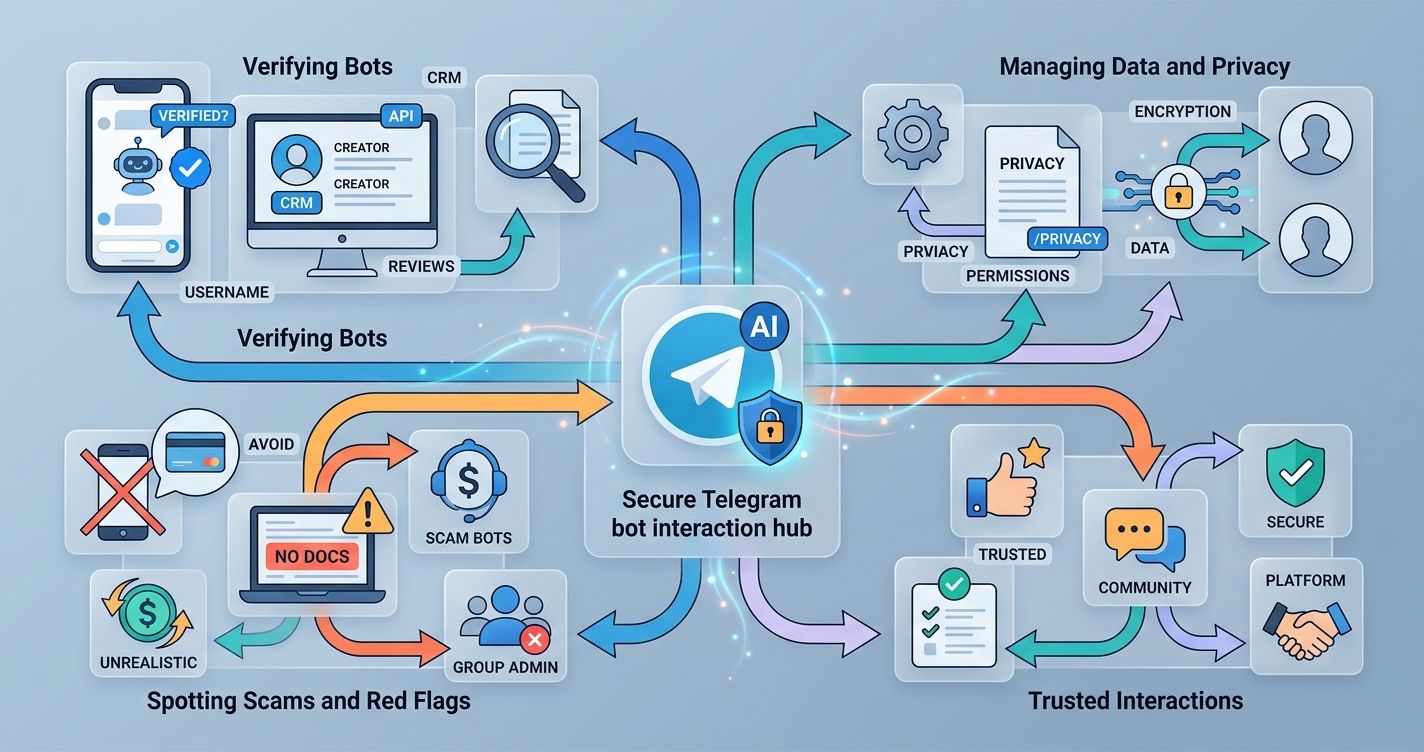
Telegram marks verified bots with a blue checkmark, but not all legitimate bots have one. Your first check should be the bot's username and creator. Search for the bot's name on independent review sites, Reddit, and Telegram community groups before granting it any access.
Red flags to watch for:
- Bots that ask for your phone number, email, or payment details upfront
- Bots with no public documentation or website
- Bots that promise unrealistic capabilities like "free unlimited GPT-4"
- Bots that request admin access to your groups without clear justification
Stick to bots recommended by trusted communities or built on established platforms. If a bot seems too good to be true, it probably is. Scam bots often impersonate popular services, using names that are one character off from the real thing.
Managing Personal Data and Permission Settings
Every bot you interact with on Telegram can access your username, profile photo, and the messages you send it. Some bots request additional permissions. Be deliberate about what you share.
Step one: review what data a bot collects before your first interaction. Check its privacy policy or /privacy command. Step two: avoid sending sensitive personal or business data through unverified bots. Step three: regularly audit the bots you've interacted with in Telegram's settings and block any you no longer use.
For businesses, this is even more important. Customer data flowing through an unvetted bot is a liability. If you're handling customer conversations, choose infrastructure that's GDPR-compliant and hosted in secure data centers. Wexio, for example, runs on EU-hosted infrastructure with TLS 1.3 in transit, AES-256 encryption at rest, and GDPR compliance built in: the kind of setup that keeps compliance teams happy.
Review your bot chat transcripts regularly too. They're a goldmine of free user research. You'll spot logic gaps, unanticipated questions, and drop-off points that help you refine the experience over time. Use median response times rather than averages when analyzing performance: a few outlier timeouts can skew your average and hide real problems.
The Future of AI Integration Within Telegram's Ecosystem
Telegram has been steadily expanding its bot capabilities. Recent updates include bot-powered mini apps, inline payments, and web app integration. The trajectory is clear: Telegram wants bots to do more, not less.
We're already seeing AI bots that handle entire customer service workflows inside Telegram: greeting users, answering FAQs, routing complex issues to human agents, and even processing orders. The trigger for handoff to a live agent is getting smarter too, with bots detecting negative sentiment, repeated failed responses, or explicit requests for a human.
For businesses, the opportunity is connecting your Telegram bot to your broader CRM and marketing stack. A bot that lives in isolation is useful. A bot that syncs customer data to your CRM, triggers follow-up emails, and logs interactions in a unified inbox is transformative. That's the difference between a toy and a tool.
The best AI chatbot for your Telegram setup isn't necessarily the one with the fanciest model. It's the one that fits your workflow, respects your data, and stays reliable under load. Start with a free tier, test it against real use cases, and upgrade only when you've confirmed the value.
Frequently Asked Questions
Is there a free AI chatbot for Telegram?
Yes. Most GPT and Claude wrapper bots give you a free daily message cap, and platforms aimed at businesses have free tiers too. If you want to wire an AI auto-reply to your own Telegram account rather than rent someone else's bot, you can set that up in an afternoon for nothing.
Does Telegram have an official AI chatbot?
No. OpenAI, Anthropic, and Google don't run official Telegram bots. Everything you see is either a third-party wrapper around their APIs or a business platform that connects to Telegram's Bot API. That's why creator reputation matters so much: you're trusting whoever built the bot, not the AI lab.
Can one AI bot handle Telegram and WhatsApp at the same time?
Not a typical wrapper bot, no. Those are built for a single chat. If you need the same AI answering customers on Telegram, WhatsApp, and Instagram with a shared history and one team behind it, you want a unified inbox platform rather than a bot per channel.
Are Telegram AI bots safe for customer data?
It depends entirely on the developer. Bot conversations aren't end-to-end encrypted by default, so your data sits on whatever server the bot runs on. For anything involving customer information, pick infrastructure with a clear privacy policy, encryption in transit and at rest, and GDPR compliance, not a hobby bot with no website.
If you're running a business across multiple messaging channels and tired of the tab-switching tax, a unified platform can consolidate everything. Get started with Wexio to manage WhatsApp, Telegram, Instagram, and Viber from a single dashboard, with AI-powered automation that scales from your first 100 operations per month (free, no credit card required) to millions.