The best Wati alternative depends on why you're leaving. If the bill is the problem, look at AiSensy or Interakt for a Wati-shaped inbox, or 360dialog, Twilio or Meta's Cloud API directly if you want to pay for messages and little else. If WhatsApp alone is the problem, you need a multi-channel inbox with an AI agent that hands over to a person, which is what we build at Wexio.
Most teams get this wrong. They search "cheaper than Wati", swap one monthly fee for another, and find the bill barely moved. The platform fee is rarely the biggest line. The shape of the bill is.
Disclosure: I work on Wexio, so I'm in this list. I've tried to say plainly where it isn't the right pick.
Why teams leave Wati, and what the bill is really made of

A WhatsApp platform bill has five parts, and only some of them show on the pricing page:
- the platform fee, which is the number you see first
- seats, meaning how many people can answer in the shared inbox
- Meta's own charges for messages you send
- any markup the platform adds on top of Meta's charges
- AI, either bundled, an add-on, or billed by usage
Since 1 July 2025 Meta bills per message rather than per conversation, and the rate depends on the message category and the destination country. Replies inside the 24-hour customer service window are not charged by Meta. The current rules and rate cards are on Meta's WhatsApp pricing page, and I walk through what changed in how per-message billing works.
Here is my opinion, and some comparison pages will not say it. If your traffic is mostly customers writing to you, and you answer within the window, the platform fee and seats are your real cost. If you run big marketing broadcasts, any markup per message is your real cost. Those are different problems with different fixes. Check Wati's pricing page against last quarter's actual invoice before you shop. Work out which of the five lines grew.
In practice I see three reasons people actually move:
- The bill grew in a line they didn't plan for. Seats, marketing messages, or AI.
- They need more than WhatsApp. Customers also write on Instagram, Telegram or the website, and the team ends up in three inboxes.
- They want the AI to do a different job. Answer, qualify, book, and know when to stop, rather than follow a rigid script.
Which Wati alternative fits your reason for leaving
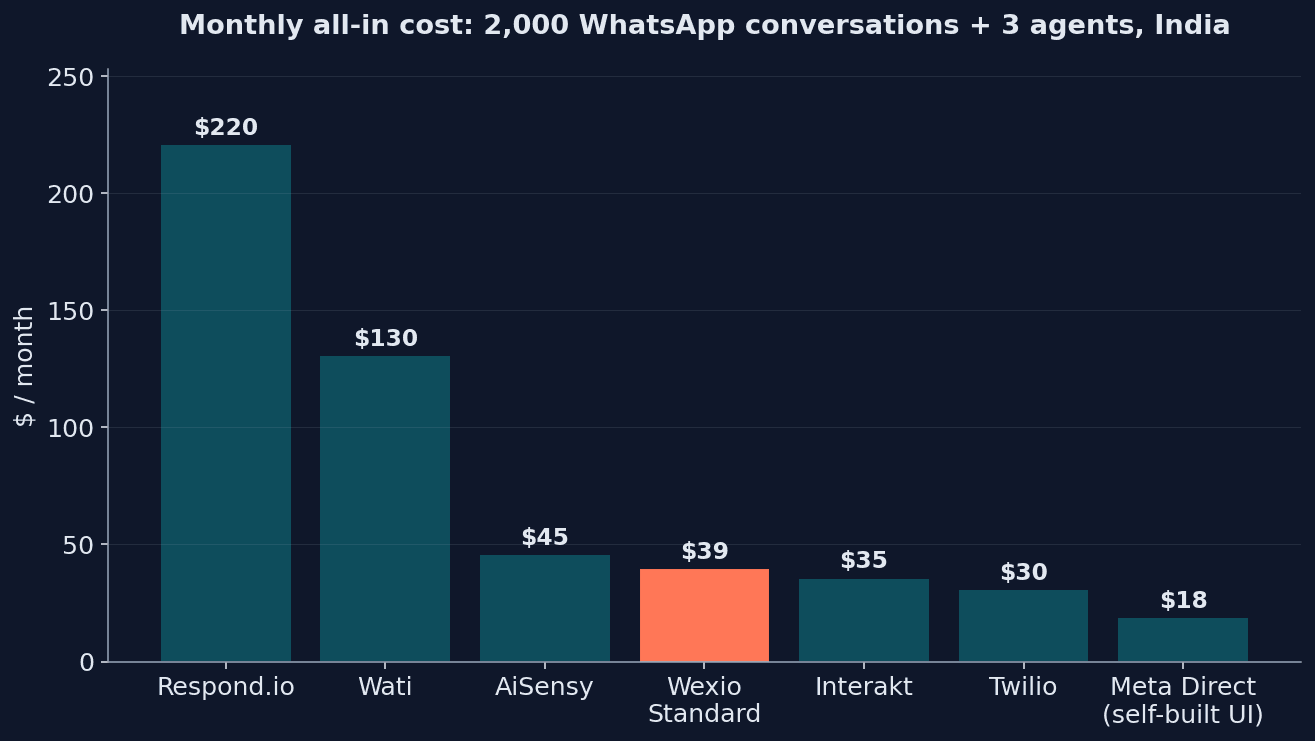
I'm deliberately not publishing a made-up monthly total per tool. Vendor prices change, and they differ by currency and by plan. Use the linked pricing pages for current figures. What does not change quickly is how each one charges.
| If your problem is | Look at | How they charge |
|---|---|---|
| Platform fee too high, same kind of product wanted | AiSensy, Interakt | Monthly plan, WhatsApp-focused inbox and broadcasts |
| Lumpy volume, quiet months still cost money | 360dialog, Twilio | API access with usage-based charges on top of Meta's |
| Lowest possible message cost and you have developers | Meta Cloud API directly | You pay Meta, you build the interface |
| Enterprise omnichannel with a sales process | Bird (formerly MessageBird) | Usage-based, quote-led |
| Customers on several channels, AI that books and hands off | Wexio | Monthly plan, see pricing |
Notice that none of these is simply "Wati, but cheaper". Each one changes what you are buying.
AiSensy and Interakt: the closest swap for a lower fee
AiSensy
AiSensy is the answer to the "AiSensy vs Wati" question for most small teams. It is a WhatsApp-focused platform with broadcasts, a shared inbox and automations, built with Indian businesses in mind. That shows in the pricing currency and in how the product is positioned. Its current plans are on AiSensy's pricing page.
Pick it if you want a product shaped like Wati, you sell mostly to customers in India, and WhatsApp is the only channel you need. Skip it if you need Instagram or Telegram in the same inbox, or if your support hours are far from Indian time zones and you rely on live help from the vendor.
Interakt
Interakt sits in the same niche: broadcasts, automations and a shared inbox, with a focus on stores that send order updates. Its feature set is narrower than Wati's, which is why the entry price is lower. Current plans are on Interakt's pricing page.
Pick it if you run an online store and your WhatsApp use is mostly order updates and a few automations. Skip it if you need deeper flow logic or more than one channel.
With either, you are still on a WhatsApp-only tool. If that was half the reason you were leaving, you have only fixed the other half.
Pay-as-you-go and build-it-yourself: 360dialog, Twilio, Meta direct and Bird
This group is for people whose problem is the platform layer itself. You rent API access, and you pay for what you send.
360dialog
360dialog is an API-first WhatsApp provider. The attraction is paying for usage instead of a seat-based plan, which suits volume that swings between busy and quiet months. The trade-off is that the interface is minimal. You will want to pair it with something that gives you a shared inbox and flows. See 360dialog's pricing page for the current model.
Twilio
Twilio is the developer's default. If WhatsApp is one channel in a product you are building, and you already use it for SMS, it makes sense. If you want a flow editor and an inbox for a support team, you will be building that yourself. Its charges are on Twilio's WhatsApp pricing page.
Meta Cloud API directly
Going straight to Meta's Cloud API removes any platform layer between you and Meta's message charges. It is the lowest-cost route on paper. In practice you are now building and maintaining the inbox, the templates workflow, agent tools and the hand-off logic. For a team without engineers, the cheapest line item becomes the most expensive project. I covered where "free" really ends in the honest guide to a free WhatsApp Business API.
Bird (formerly MessageBird)
Bird sells omnichannel messaging to larger companies, with WhatsApp alongside SMS, email and voice. Pricing is usage-based and goes through sales. It makes sense once you have the volume and the procurement process for it. For a ten-person shop, it is more machinery than you need.
If you are comparing the infrastructure options more seriously, I put them side by side in the best WhatsApp Business API providers for high volume.
Wexio: one inbox across channels, with an agent that knows when to stop
Wexio's pitch is not a lower WhatsApp fee. It is that WhatsApp stops being a separate place. Web chat, WhatsApp, Instagram DMs, Telegram, Viber and email all land in one inbox. We are live with our first 40 users since the Portugal Tech Week launch, so it is young, and I'd rather say that than dress it up.
Here is a scene I keep in mind. A customer asks a shoe shop on Instagram at 23:00 whether a style runs small. Another writes on WhatsApp to ask how to return a pair that arrived in the wrong size. A third types a question into the website chat. In a WhatsApp-only tool, only one of those arrives where your team works. In one inbox, the AI agent can answer the sizing question, explain the returns process from the answers you gave it, and pass the complicated return to a person with the conversation attached. When a person joins a conversation, the AI stops answering. That is the part I care about most. Answers everyone. Answers to you.
What you get, as listed in our product facts:
- An AI agent that answers customers and hands off to a person
- A no-code flow builder for automations
- Broadcasts, for when you need to message a group
- CRM people: contacts with their conversations and fields in one place
- Bookings into Google Calendar, made by the AI agent in chat or by the customer in the web widget
- Help center articles inside the web widget
To try it, start the free trial at app.wexio.io. Connect the channels you use, tell the AI agent what it should answer and when it should pass a chat to a person, and run it on real messages. Plans are on the pricing page. For stores and shops, the retail page shows the kind of questions it is set up for.
Where Wexio is the wrong choice
- You only need WhatsApp, and Wati already works. If your team is happy there, the cost of moving is real. Do not move for novelty.
- You need a large vendor support organisation with formal enterprise terms. We are a small team. You will talk to the people who build it, which some buyers love and some cannot accept.
- You want to build the whole stack on the raw API. Then go direct to Meta or use a developer-first provider.
Looking for wexio.io alternatives?
Fair question, and the answer follows the same logic as above. If you want the closest thing to a WhatsApp-only inbox with broadcasts, AiSensy and Interakt are the nearest in shape. If you want to own the build, use 360dialog, Twilio or the Cloud API. If you need an enterprise rollout across voice, SMS and email, look at Bird. If you want a no-code AI inbox for customer chats across WhatsApp, Instagram, Telegram, Viber, web chat and email, with a person always able to step in, that is the gap Wexio fills.
I would also compare AI approaches, not just channels. A tool whose AI just follows a script behaves very differently from one that answers freely and then hands over. The roundup Best AI Chatbots for Business in 2026 sorts the options by job.
Moving off Wati without losing your number or your week
Migration is the part that stops most teams, and it is smaller than it looks if you do it in the right order.
- Decide the cut-over day. Pick a quiet day. Your WhatsApp number can only be registered with one provider at a time, so there is a short window where the number is in transit.
- Export your contacts first. Pull your contact list out of Wati as a file. Ask the new provider how it imports contacts before you commit, because import paths differ.
- List the flows you actually use. Most teams have many flows and use a handful. Rebuild those. Do not copy everything, because no platform imports another's flows.
- Check your message templates. Find out with the new provider whether your approved templates carry across when the number moves, or whether you need to re-submit them for approval. Do this before cut-over, not after.
- Run both for a short overlap if you can. If you use a second number for testing, use it to check the new setup against real questions before the main number moves.
- Keep the old account until the first week is over. You will want the conversation history and any missed export.
If you are new to the API side entirely, the broader picture of what you are signing up for is in WhatsApp Business App vs. API: when to upgrade.
FAQ
Is Wati more expensive than the alternatives?
It depends on which line of your bill is biggest. Compare your last invoice, line by line, against the pricing page of each option. For teams that mostly answer inbound messages, the platform fee and seats dominate. For heavy marketing senders, per-message charges and any markup matter more.
Can I keep my WhatsApp number when I switch?
Generally yes, but it moves from one provider to another and is unavailable for a short period while it does. Plan the cut-over for a quiet day and ask the new provider for their exact steps first.
Which is better, AiSensy or Wati?
They are the same kind of product. AiSensy is built with Indian businesses in mind and tends to be positioned lower on price. Wati is the longer-established, broader tool. If you sell mostly in India and need basics, AiSensy is worth a trial. If you need depth beyond WhatsApp, neither solves it.
Which Wati alternative is best if I want more than WhatsApp?
You need a multi-channel inbox. Wexio covers web chat, WhatsApp, Instagram, Telegram, Viber and email in one place. It does not support Facebook Messenger. You can test it free at app.wexio.io.