Every business owner who's considered WhatsApp for customer communication has hit the same wall: figuring out what it actually costs. The WhatsApp Business API price structure isn't a flat monthly fee. It's a conversation-based model that charges you differently depending on who starts the chat, what you're talking about, and where your customer lives. That makes budgeting tricky if you don't understand the rules. WhatsApp messages boast a 98% open rate, dwarfing the 20% typical for email, so the channel is worth the effort. But you need to know exactly where your money goes. The pricing model has evolved significantly since Meta introduced conversation-based billing, and recent updates through 2025 and into 2026 have reshaped costs again. This guide breaks down every layer of the pricing system so you can forecast spend accurately, avoid surprise charges, and squeeze the most value from every conversation. Whether you're running a small salon or managing a mid-size automotive dealership, the same principles apply. Understanding the cost structure is the first step to making WhatsApp profitable rather than just another expense line.
The Shift to Conversation-Based Pricing Architecture
Meta moved away from per-notification billing years ago. The current model charges per conversation, not per individual message. That's a crucial distinction. Once a conversation opens, you can send multiple messages within that window without extra charges. Industry experts note that this pricing structure helps businesses better predict messaging costs and plan budgets with more confidence.
The shift reflects Meta's goal of encouraging genuine two-way communication rather than one-directional spam blasts. It rewards businesses that engage meaningfully and penalizes those who fire off disconnected messages without context.
Defining the 24-Hour Conversation Window
Every conversation runs on a 24-hour clock. The moment a conversation opens, whether by you or your customer, that window stays active for 24 hours. During that time, you can exchange as many messages as you want under a single charge.
If you need to send another message after the window closes, a new conversation starts and a new charge applies. This is why timing matters. Batching your communication within active windows saves real money. A retail store answering a product question, sending a shipping update, and sharing a promo code all within 24 hours pays for one conversation, not three.
User-Initiated vs. Business-Initiated Sessions
Who opens the conversation determines how much you pay. When a customer messages you first, that's a service conversation. It's the cheapest category. When your business initiates contact using a pre-approved template message, you're paying premium rates.
This split exists because Meta wants to protect users from unwanted outreach. You can't just message someone out of the blue without a template. Templates require Meta's approval, and each one falls into a specific pricing category. Smart businesses design their flows to maximize free service windows and track the return on every template message sent. That discipline is what separates profitable WhatsApp operations from money pits.
Breakdown of the Four Conversation Categories
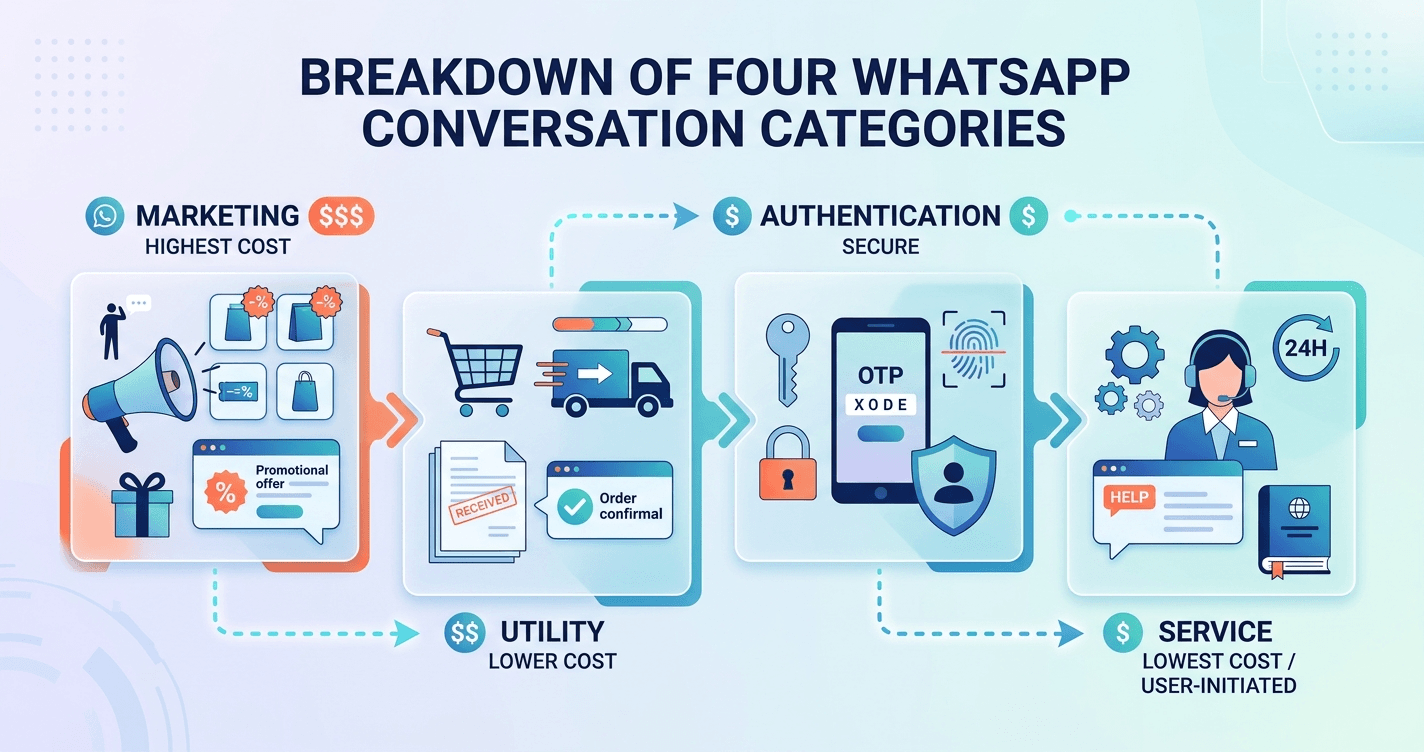
Meta classifies every conversation into one of four buckets: marketing, utility, authentication, and service. Each carries a different price tag. Getting the classification right when you design your templates directly affects your bill.
The category isn't something you choose arbitrarily. Meta reviews each template and assigns it based on the content and intent. A promotional offer goes into marketing. An order confirmation goes into utility. Misclassifying a template during submission leads to rejection or reclassification.
Marketing and Utility Conversation Rates
Marketing conversations are the most expensive. These include promotions, product announcements, upsells, and re-engagement campaigns. You're paying a premium because you're initiating contact for commercial purposes. But the ROI can justify the cost: WhatsApp marketing can achieve conversion rates of 45-60%, far beyond the 2-5% typical of email and SMS.
Utility conversations cover transactional messages: order confirmations, delivery updates, appointment reminders, and payment receipts. These cost significantly less than marketing messages. Utility and authentication messages can be 80-90% cheaper than marketing messages, which is a massive difference at scale.
Authentication and Security Message Costs
Authentication conversations handle one-time passwords, two-factor verification codes, and account recovery messages. They sit in their own pricing tier, generally close to utility rates but with some regional variation.
These messages are time-sensitive by nature. A customer waiting for a login code won't tolerate delays. The pricing reflects the essential, non-promotional nature of these messages. If you're running a fintech app or an e-commerce platform with account security features, authentication costs will be a recurring line item in your budget.
Service Conversations for Customer Support
Service conversations are the cheapest category. They open when a customer messages you first, and they cover support interactions, general inquiries, and complaint resolution. Since the customer initiated contact, Meta charges the lowest rate.
This is where platforms like Wexio can make a real difference. Using AI-powered auto-replies and no-code flow builders, you can resolve most service inquiries within the 24-hour window without human intervention. That means one conversation charge covers the entire interaction. Review your chat transcripts regularly to spot where customers drop off or ask unexpected questions, then refine your flows accordingly.
Regional Price Variations and Currency Impacts
The WhatsApp Business API price isn't universal. Meta sets different rates for different countries, and those rates fluctuate based on local market conditions. A marketing conversation in North America costs significantly more than one in Southeast Asia.
This regional pricing means your total spend depends heavily on where your customers are located. A business serving customers in India will see a very different bill than one targeting users in Germany, even with identical message volumes.
Market-Specific Rates Based on User Country Code
Meta determines the rate based on the recipient's phone number country code, not your business location. If you're a UK-based company messaging a customer in Brazil, you pay Brazil's rate. This creates both opportunities and complications for businesses with international audiences.
Rate changes happen periodically. As of April 1, 2026, there were rate updates in Saudi Arabia, India, Pakistan, and Turkey, with some countries seeing increases and others getting reductions. Staying current on these changes is essential for accurate budgeting. Build a simple spreadsheet tracking your top ten customer markets and their current per-conversation rates. Update it quarterly.
Free Entry Point Conversations and Monthly Credits
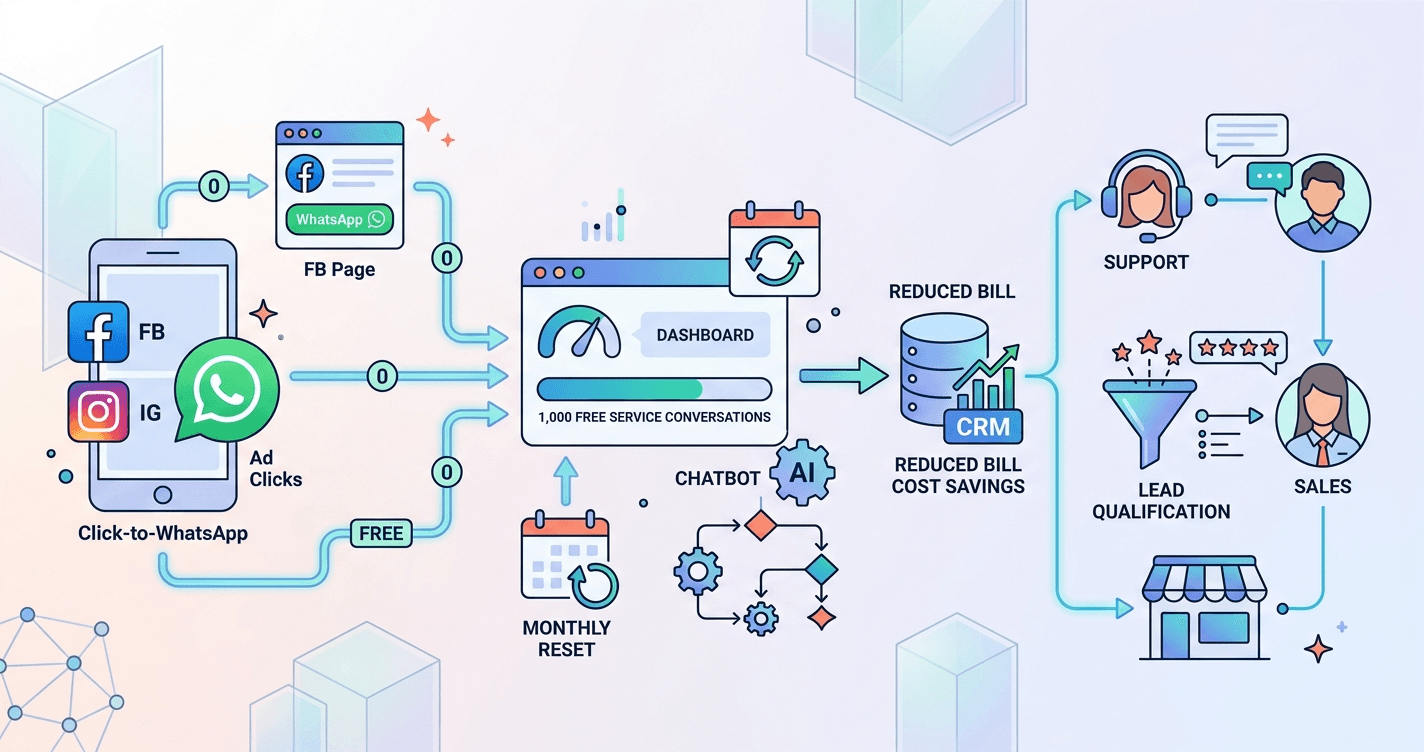
Not every conversation costs money. Meta offers two important cost-saving mechanisms: free entry point conversations and a monthly credit of free service conversations. Both can meaningfully reduce your bill if you structure your strategy around them.
These free tiers aren't just a nice bonus. For small businesses with modest volumes, they can cover a significant chunk of monthly messaging activity.
The 1,000 Free Service Conversations Tier
Every WhatsApp Business API account gets 1,000 free service conversations per month. That's 1,000 customer-initiated interactions at zero cost. For a small beauty salon or a local tutoring center, that might cover all your inbound support needs.
The count resets monthly. If you're hovering around that threshold, consider using automation to handle simple queries within fewer conversations. Wexio's visual flow builder with conditional branching can route common questions to instant answers, keeping your conversation count lean. The platform's free tier with 100 operations per month is enough to test whether automation keeps you under the 1,000-conversation cap.
Click-to-WhatsApp Ads and Organic Entry Points
Conversations that start from Click-to-WhatsApp ads on Facebook or Instagram are classified as free entry point conversations. The first conversation from these ad clicks carries no conversation charge. You're already paying for the ad placement, so Meta doesn't double-dip.
Organic entry points work similarly. If someone taps a WhatsApp button on your Facebook Page, that first conversation is free. This makes Click-to-WhatsApp ads particularly cost-effective for lead generation. You pay for the ad click, get a free conversation, and can qualify the lead within that 24-hour window without additional messaging fees.
BSP Markup Fees vs. Meta Direct Costs
Here's where many businesses get surprised. Meta's conversation rates are only part of your total cost. Most companies access the API through a Business Solution Provider, and BSPs add their own markup.
Standalone WhatsApp Business API platforms can cost $49 to $300+ per month, while comprehensive customer service platforms range from $299 to $2,000+ monthly. Those fees cover the platform, hosting, support, and features on top of Meta's per-conversation charges.
Some BSPs charge a flat monthly fee plus a per-message markup. Others bundle everything into a subscription. Comparing BSPs requires looking at total cost of ownership, not just the sticker price. A cheaper platform that lacks automation features might cost you more in agent hours than a pricier one that resolves 80% of inquiries automatically. Using AI agents can automate responses and maintain conversation flow, helping reduce messaging costs over time.
Optimizing Costs Through Strategic Template Use
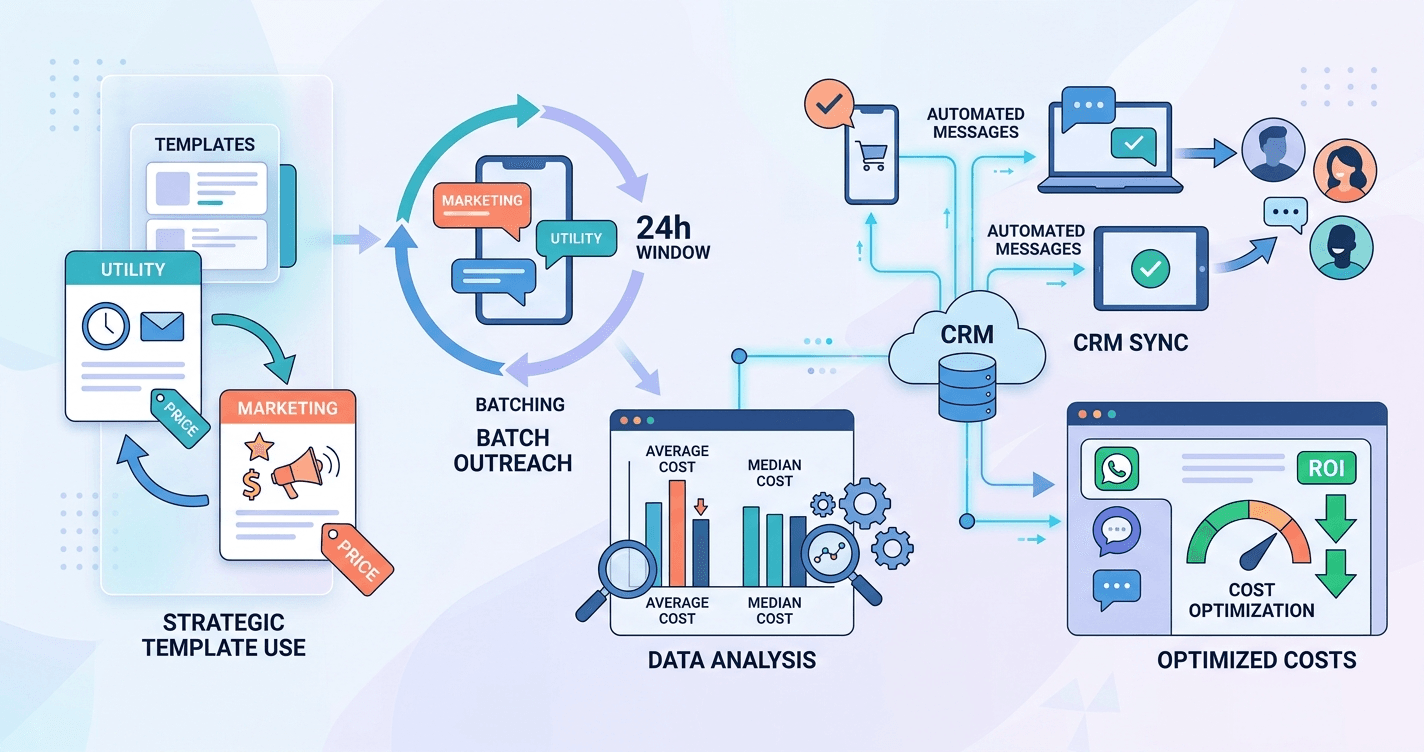
Your template strategy is your biggest cost lever. Every template you submit gets categorized, and that category determines your rate. Designing templates with cost awareness means writing utility-style messages when possible instead of defaulting to marketing language.
Step one: audit your existing templates. Identify which ones fall into the marketing category and ask whether they could be rewritten as utility messages. An appointment reminder with a subtle upsell is marketing. A clean appointment reminder is utility, and it's dramatically cheaper.
Step two: batch your outreach. If you need to send a promotional message and a shipping update to the same customer, do both within one conversation window. Open with the marketing template, then follow up with the utility information before the 24-hour clock expires.
Step three: use median cost-per-conversation data, not just averages, when analyzing your spend. A few expensive international conversations can skew your average and hide patterns in your domestic messaging costs.
Step four: connect your messaging platform to your CRM. When your WhatsApp tool syncs with your customer database, you can trigger messages based on real events rather than arbitrary schedules. That precision reduces wasted conversations and keeps spend tied to actual business outcomes.
The pricing changes reflect Meta's push toward a more transparent and balanced model of interaction between businesses and customers. Companies that adapt their messaging strategy to this model will spend less and get better results.
If you're ready to put these principles into practice across WhatsApp, Telegram, Instagram, and Viber from a single dashboard, get started with Wexio and see how AI-powered automation and unified messaging can cut your per-conversation costs while keeping customers engaged.