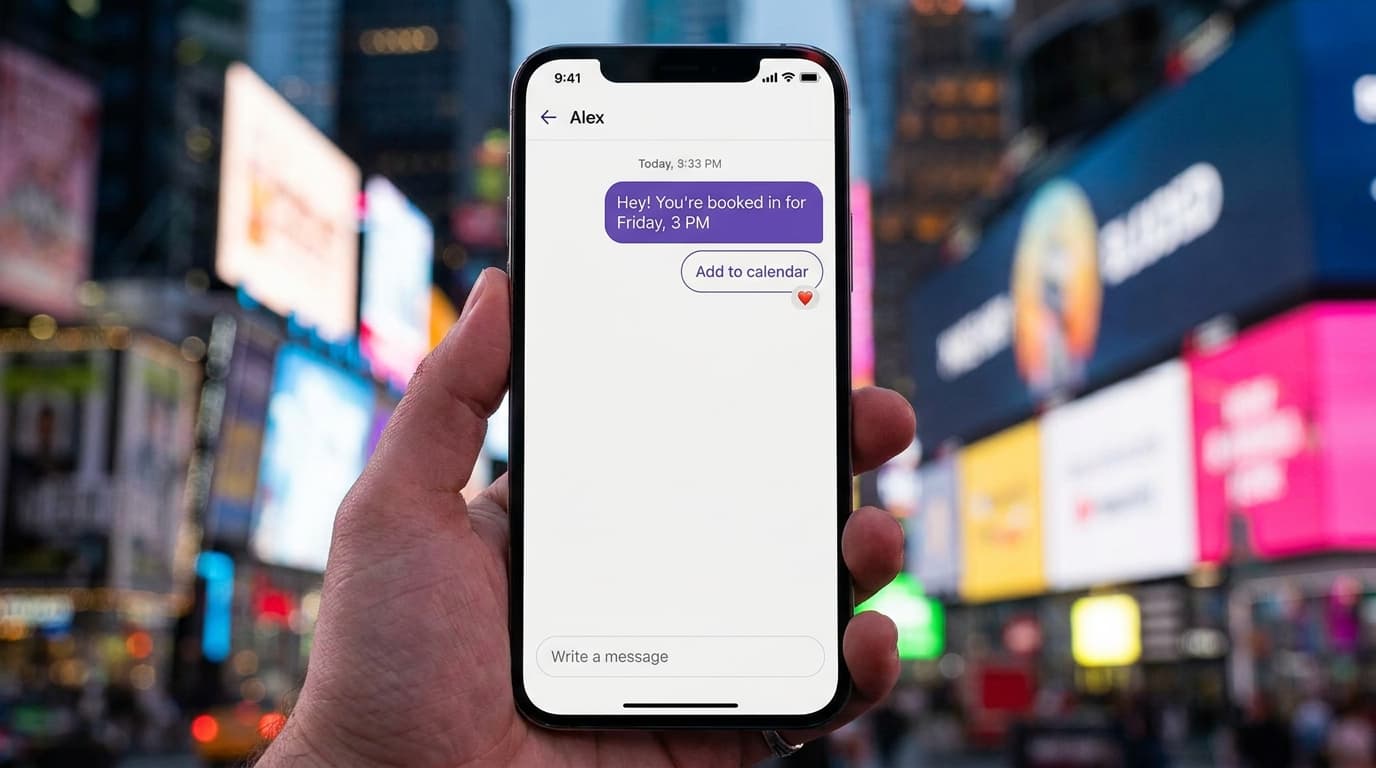
Every day, over two billion people fire off messages, photos, voice notes, and video calls through WhatsApp. Most never think twice about what happens between tapping "send" and seeing those blue check marks. But underneath that simple interface sits a surprisingly sophisticated stack of protocols, encryption layers, and infrastructure decisions. Understanding how WhatsApp works gives you a real appreciation for the engineering that keeps billions of conversations private, fast, and reliable, whether you're chatting with a friend across the room or a customer on another continent. It also matters if you're a business owner building customer communication strategies around messaging platforms. Knowing the technology helps you make smarter decisions about automation, security, and scale. This piece breaks down the core systems powering WhatsApp, from the programming languages running its servers to the cryptographic protocols guarding your messages, the delivery pipeline that handles offline users, VoIP calling infrastructure, data storage, and the platform's plans for the future.
The Evolution and Core Infrastructure of WhatsApp
WhatsApp launched in 2009 as a simple status-update app. Co-founders Jan Koum and Brian Acton pivoted quickly toward messaging after Apple introduced push notifications. By 2014, Facebook acquired the company for $19 billion, and the user base was already approaching 500 million. That kind of growth demanded infrastructure choices that could handle massive concurrency without ballooning costs.
The early engineering team was famously small. Around 50 engineers supported roughly 900 million users at the time of the Facebook acquisition. That ratio tells you something important: the technology choices were deliberate, favoring systems that could do more with less hardware and fewer people.
WhatsApp's servers have historically run on FreeBSD, not Linux. The backend is built primarily in Erlang, a language originally designed by Ericsson for telecom switches. These two choices form the backbone of everything the platform does.
The Role of Erlang and FreeBSD in High Concurrency
Erlang was built to handle millions of simultaneous connections with minimal downtime. Telecom systems can't afford crashes, and neither can a messaging app serving billions. Erlang's actor model treats each user connection as a lightweight process. These processes don't share memory, so one failing connection can't take down another.
FreeBSD complements this nicely. Its networking stack handles high connection counts efficiently, and its jails feature provides solid isolation between services. WhatsApp engineers have spoken publicly about tuning FreeBSD to handle over two million TCP connections per server. That's an extraordinary density.
The practical result? WhatsApp scaled to billions of users with a relatively tiny server fleet. Erlang's hot-code-swapping feature also meant engineers could push updates without restarting servers or dropping active connections. For a messaging app, zero-downtime deployments aren't a luxury. They're a requirement.
Transitioning from XMPP to Proprietary Protocols
WhatsApp originally used XMPP (Extensible Messaging and Presence Protocol) as its messaging protocol. XMPP is an open standard, XML-based, and widely used in chat applications. It gave WhatsApp a fast starting point.
Over time, the team modified XMPP heavily. They stripped out XML overhead and replaced it with a custom binary protocol that was lighter on bandwidth. This mattered enormously for users in developing countries with slow or expensive mobile data. Every byte saved translated to better performance and lower costs for users.
Today, WhatsApp's protocol is proprietary and heavily optimized. It handles message routing, presence updates, typing indicators, and delivery receipts through a compact binary format. The shift away from standard XMPP also gave WhatsApp tighter control over security and feature development. They weren't constrained by the pace of an open standards body.
End-to-End Encryption and the Signal Protocol
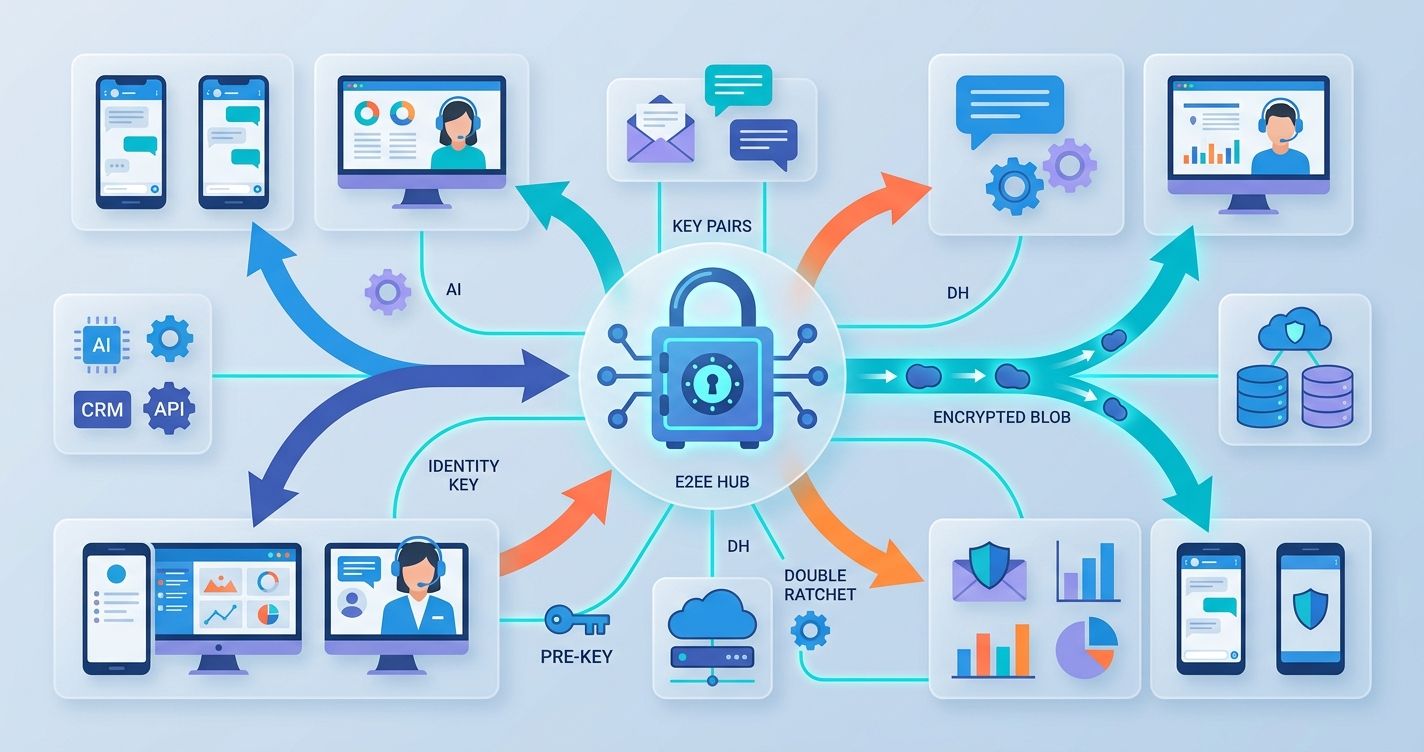
WhatsApp rolled out end-to-end encryption for all messages in April 2016. The implementation uses the Signal Protocol, developed by Open Whisper Systems (now the Signal Foundation). This wasn't a marketing gimmick. The Signal Protocol is widely regarded by cryptographers as one of the strongest messaging encryption systems available.
The core promise is straightforward: only you and the person you're messaging can read the content. WhatsApp's servers relay encrypted blobs they can't decrypt. Even if a government agency served WhatsApp with a court order, the company couldn't hand over message content because it simply doesn't have the keys.
Asymmetric Cryptography and Key Exchange
The Signal Protocol relies on a combination of asymmetric and symmetric cryptography. Each user generates a set of key pairs during registration:
- Identity Key: a long-term Curve25519 key pair that represents the user's identity
- Signed Pre-Key: a medium-term key signed by the identity key, rotated periodically
- One-Time Pre-Keys: a batch of single-use keys uploaded to the server
When you message someone for the first time, your device fetches their public keys from WhatsApp's server. It then performs a triple Diffie-Hellman (X3DH) key agreement to establish a shared secret. From that shared secret, a ratcheting algorithm generates new encryption keys for every single message.
This is called the Double Ratchet. It provides forward secrecy, meaning that even if an attacker compromises your current keys, they can't decrypt past messages. Each message uses a unique key that's discarded after use.
The beauty of this system is that key exchange happens automatically. You don't need to understand cryptography. Your phone handles it silently in the background.
Securing Media Files and Metadata
Photos, videos, voice messages, and documents don't travel through WhatsApp's messaging servers directly. Instead, your device encrypts the media file with a random AES-256 key, uploads the encrypted blob to WhatsApp's content servers, and then sends the AES key and file location to the recipient through the encrypted messaging channel.
The recipient's device downloads the encrypted blob and decrypts it locally. WhatsApp's content servers store encrypted files they can't read. This is a smart architectural split: large files go through optimized content delivery infrastructure, while the small encryption keys travel through the messaging pipeline.
Metadata is trickier. WhatsApp encrypts message content, but it does collect metadata: who messaged whom, when, how often, IP addresses, and device information. This metadata can reveal a lot about communication patterns even without message content. It's a known limitation, and one that privacy advocates regularly flag.
If you're a business running customer interactions through WhatsApp, understanding these encryption boundaries matters. Platforms like Wexio, which connect to WhatsApp's Business API, operate within these encryption constraints while adding automation layers on top, things like AI-powered auto-replies and no-code conversation flows.
Message Delivery Lifecycle and Synchronization
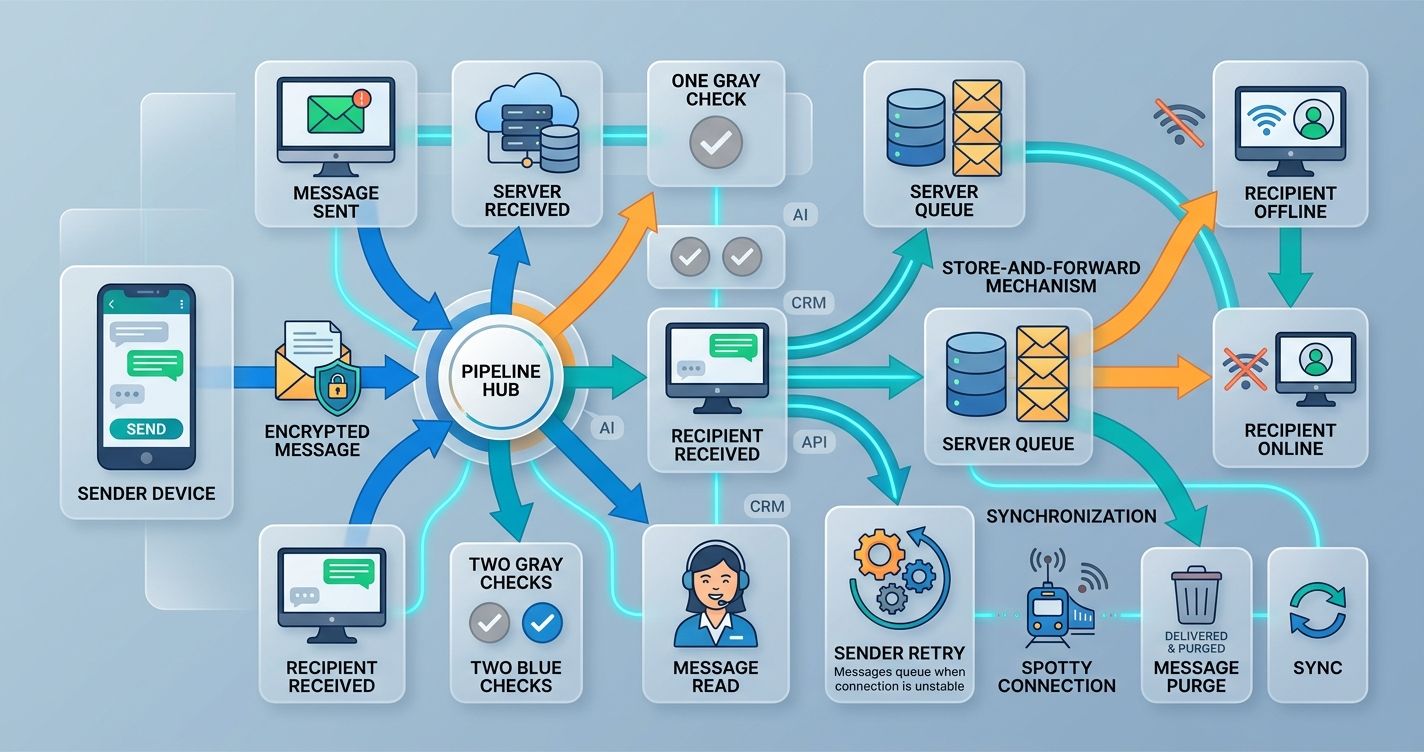
Sending a WhatsApp message feels instant, but there's a multi-step pipeline behind every delivery. Your message gets encrypted on-device, transmitted to WhatsApp's servers, routed to the recipient's server connection, and delivered to their device. The familiar check marks tell you exactly where your message is in this pipeline.
One gray check means the message reached WhatsApp's server. Two gray checks mean it reached the recipient's device. Two blue checks mean they've read it. Each state transition triggers a lightweight acknowledgment packet back to your device.
Store-and-Forward Mechanism for Offline Messaging
What happens when the recipient is offline? WhatsApp uses a store-and-forward model. The server holds encrypted messages until the recipient's device reconnects. Once the device comes online, queued messages get pushed down in order.
This mechanism handles spotty connections gracefully. If you're on a train going through tunnels, your phone constantly disconnects and reconnects. WhatsApp's servers queue outbound messages and deliver them the moment your connection stabilizes. The same applies to the sender's side: if your message can't reach the server immediately, your device queues it locally and retries.
Messages aren't stored on servers indefinitely. WhatsApp's policy is to delete messages from servers once delivered. Undelivered messages are purged after 30 days. This limits the window of exposure for encrypted content sitting on infrastructure the user doesn't control.
Multi-Device Architecture and Independent Linking
WhatsApp's multi-device support was a significant engineering challenge. The original architecture tied your account to a single phone. Your phone was the source of truth, and WhatsApp Web simply mirrored it through a persistent connection.
The newer multi-device system changed this fundamentally. Each linked device (laptop, tablet, secondary phone) gets its own set of encryption keys. When you send a message, your device encrypts it separately for each of the recipient's linked devices. This means your phone doesn't need to be online for your laptop to send and receive messages.
Each device maintains its own local message history and syncs independently with WhatsApp's servers. The tradeoff is more encryption overhead per message, since each recipient device requires its own encrypted copy. But the user experience improvement was worth the engineering cost.
For businesses managing customer conversations across teams, this multi-device reality has practical implications. A platform like Wexio handles this complexity by providing a unified inbox where multiple team members can manage WhatsApp, Telegram, Instagram, and Viber conversations from a single dashboard, no device-juggling required.
Voice and Video Calling via VoIP Technology
WhatsApp calls don't use your carrier's voice network. They run over the internet using VoIP (Voice over Internet Protocol). Audio is captured by your microphone, compressed using a codec like Opus, encrypted, and sent as data packets to the other person's device.
Video calls work similarly but add a video stream encoded with a codec like VP8 or H.264. Both audio and video streams are end-to-end encrypted using the same Signal Protocol framework that protects text messages.
Call quality depends heavily on your internet connection. WhatsApp's client software includes adaptive bitrate algorithms that adjust audio and video quality based on available bandwidth. On a strong Wi-Fi connection, you get high-definition audio. On a congested 3G connection, the codec drops to lower bitrates to keep the call alive.
P2P Connections vs. TURN Relay Servers
WhatsApp tries to establish a direct peer-to-peer connection between callers whenever possible. Direct connections reduce latency and free up server resources. The process starts with STUN (Session Traversal Utilities for NAT) servers, which help each device discover its public IP address and port.
If a direct connection isn't possible, typically because one or both users are behind restrictive NAT firewalls, WhatsApp falls back to TURN (Traversal Using Relays around NAT) relay servers. TURN servers act as intermediaries, forwarding encrypted packets between the two devices. The call is still encrypted end-to-end; the relay server just passes through data it can't read.
Group calls add complexity. With multiple participants, WhatsApp uses a selective forwarding unit (SFU) architecture rather than pure peer-to-peer mesh networking. Each participant sends their stream to a server, which then forwards the appropriate streams to each other participant. A full mesh would require each device to maintain connections to every other device, which doesn't scale well past three or four participants.
Data Management and Cloud Backup Integration
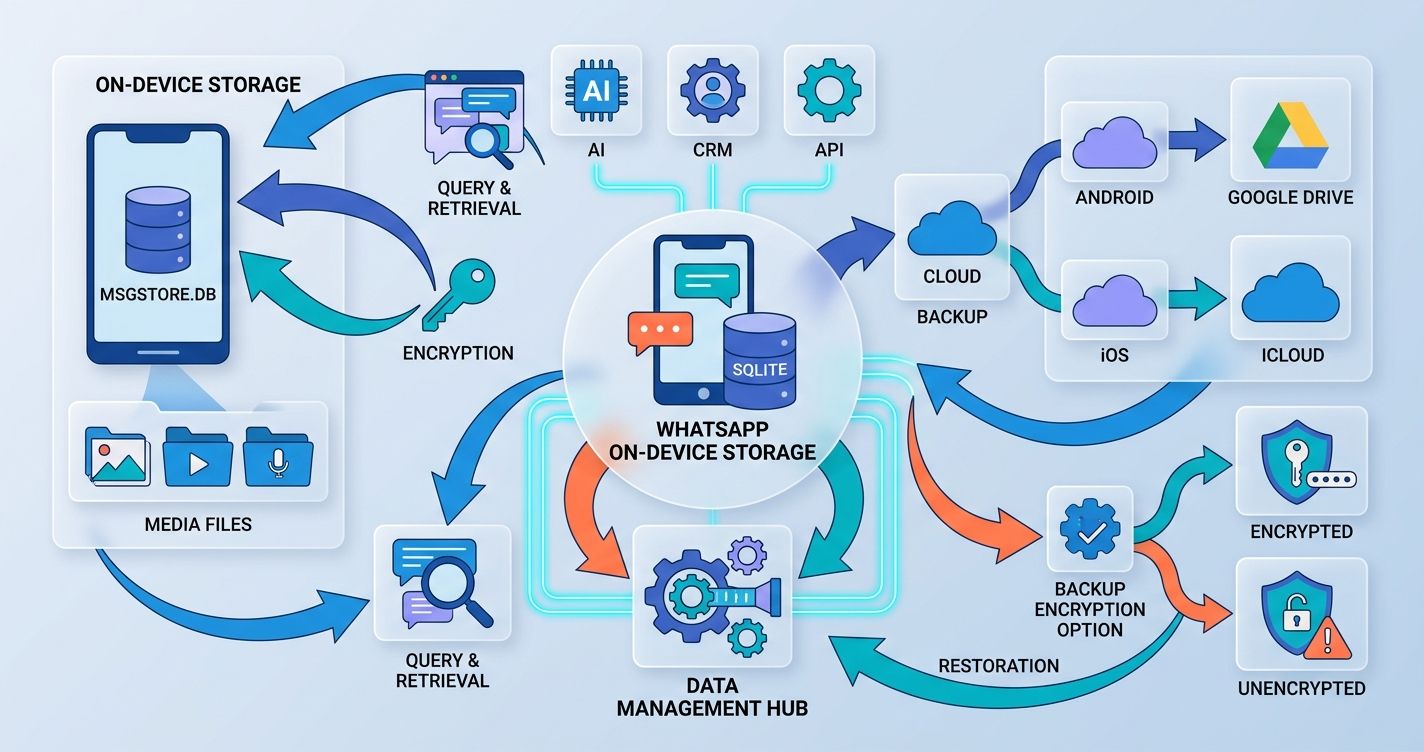
WhatsApp stores your messages locally on your device, not on its servers. Once a message is delivered, the server copy is deleted. Your chat history lives on your phone's storage, which means losing your phone without a backup means losing your messages.
To address this, WhatsApp offers cloud backup integration. On Android, backups go to Google Drive. On iOS, they go to iCloud. These backups can optionally be encrypted with a user-provided password or a 64-digit encryption key. Without this option enabled, backups sit on Google or Apple's servers without WhatsApp's end-to-end encryption, which is a significant privacy consideration many users overlook.
Local SQLite Databases and On-Device Storage
On your device, WhatsApp stores messages in SQLite databases. On Android, the primary database file is msgstore.db. It contains your message history, contact information, and conversation metadata. Media files (photos, videos, voice notes) are stored separately in your device's file system.
SQLite is a smart choice for mobile. It's lightweight, doesn't require a separate server process, and handles concurrent reads well. WhatsApp's app queries this local database every time you open a chat, scroll through history, or search for a message.
The database is encrypted on-device using a key derived from your account credentials. This prevents casual extraction of messages if someone gains physical access to your phone's storage. However, forensic tools used by law enforcement can sometimes extract and decrypt these databases from unlocked devices, which is worth knowing if you handle sensitive customer data.
For businesses, this local-first storage model means your customer conversation data lives on individual devices unless you're using the WhatsApp Business API. API-based solutions route messages through your own infrastructure (or a platform provider's), giving you centralized storage, analytics, and compliance controls. Wexio, for example, provides SOC 2 ready infrastructure with TLS 1.3 and AES-256 encryption for businesses that need enterprise-grade security alongside their messaging automation.
Future-Proofing the Platform for Global Scale
WhatsApp isn't standing still. The platform continues to evolve in several directions that matter for both individual users and businesses.
Interoperability is on the horizon. The EU's Digital Markets Act requires large messaging platforms to open up to third-party services. WhatsApp has begun work on interoperable messaging, though the technical challenges around maintaining end-to-end encryption across different platforms are substantial. The Signal Protocol assumes both parties use the same system, so cross-platform encryption requires new key exchange mechanisms.
AI integration is accelerating. Meta has started embedding AI assistants directly into WhatsApp, powered by their LLaMA models. For businesses, this signals a future where AI-driven customer interactions on WhatsApp become standard rather than exceptional.
Channels, a broadcast feature, continues to expand. WhatsApp is clearly positioning itself as more than a private messaging app. It wants to be a platform for businesses, creators, and communities. The Business API is getting richer, with catalog features, payment integrations, and interactive message templates.
The infrastructure will need to keep pace. WhatsApp already handles over 100 billion messages per day, according to Meta's public disclosures. Supporting richer media, AI features, and interoperability will demand continued investment in server capacity, protocol efficiency, and edge computing.
For small and mid-size businesses, the takeaway is clear: WhatsApp is becoming a primary customer communication channel, not just a personal messaging app. Building your automation strategy around it now, whether through the Business API directly or through platforms that simplify the integration, positions you ahead of competitors still relying solely on email and phone.
If you're ready to build automated customer conversations across WhatsApp and other major messaging channels, Wexio's platform gives you AI-powered flows, a unified inbox, and a free tier with 100 operations per month to get started without risk. Try it out and see what's possible when you meet your customers where they already are.
Sources:
- WhatsApp Engineering Blog, "1 Million is So 2011" (scaling Erlang)
- Signal Foundation, Signal Protocol Technical Documentation
- Meta Platforms, Q4 2023 Earnings Call (100B+ daily messages)
- European Commission, Digital Markets Act (interoperability requirements)
- WhatsApp Security Whitepaper (end-to-end encryption details)