Every business owner knows the frustration. A potential customer messages you at 11 PM, doesn't get a reply, and buys from someone else by morning. That's revenue lost to silence. Conversational AI fixes this problem and about a dozen others you probably haven't considered yet.
The market agrees. The global conversational AI market is projected to reach USD 41.39 billion by 2030, growing at a 23.7% CAGR. That kind of growth isn't hype. It's businesses voting with their wallets because they see real returns. Whether you run a dental clinic, a car dealership, or a boutique hotel, the benefits of conversational AI for business are hard to ignore. From slashing support costs to turning casual browsers into paying customers, AI-powered conversations are reshaping how companies interact with the people who keep them running. Here's exactly how, broken into seven areas that matter most.
Scaling Customer Engagement with 24/7 Availability
Your customers don't work 9-to-5. They browse products during lunch breaks, ask questions at midnight, and expect answers on weekends. A business that can't match this rhythm loses deals to one that can.
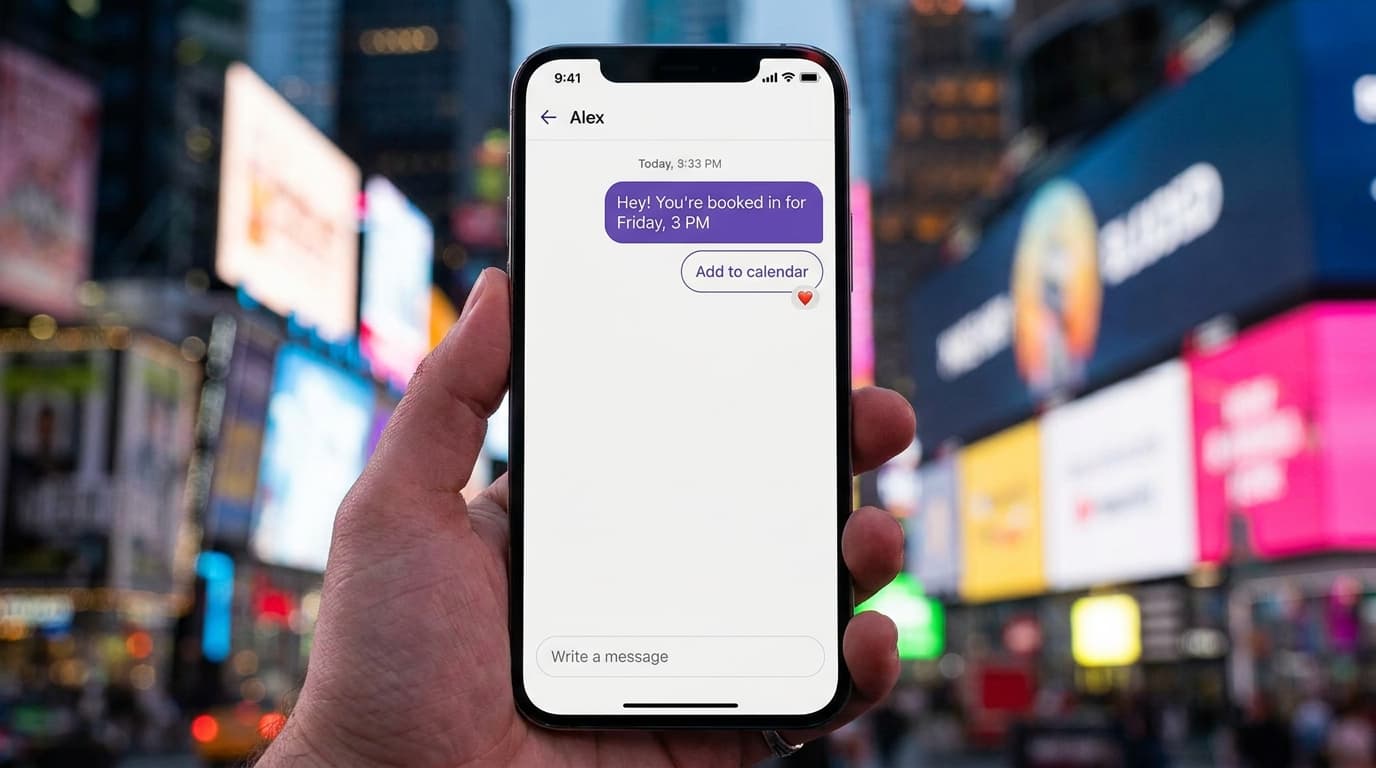
Conversational AI doesn't sleep, take holidays, or call in sick. It handles inquiries across WhatsApp, Instagram, Telegram, and your website around the clock. For a small retail shop or a busy salon, this means no more missed messages during off-hours. The customer who wants to book a haircut at 6 AM on Sunday? They get an instant confirmation instead of a "we'll get back to you Monday" that they'll never wait for.
This isn't just about convenience. Companies using AI for customer engagement report 25% higher satisfaction scores compared to those relying purely on human teams. Satisfaction drives loyalty, and loyalty drives revenue. It's a straightforward chain.
Eliminating Response Latency and Wait Times
Speed matters more than most businesses realize. A five-minute delay in responding to a web lead decreases your chances of qualifying that lead by 80%. Five minutes. That's barely enough time to finish a coffee.
Conversational AI responds in seconds. Not minutes, not hours. Seconds. The bot greets the visitor, understands their question through natural language processing, and delivers a relevant answer before they've even considered clicking away. For healthcare practices fielding appointment requests or finance firms handling loan inquiries, this instant response is the difference between a new client and a bounced visitor.
The key here is setting clear escalation triggers. If the bot detects negative sentiment, encounters a question it can't handle, or if the user explicitly asks for a human, it should route to a live agent immediately. Platforms like Wexio include a "Route to Operator" function that makes this handoff smooth, so customers never feel stuck talking to a wall.
Managing High-Volume Inquiries Without Increasing Headcount
Peak seasons crush small teams. Think Black Friday for retailers, enrollment periods for education providers, or tax season for financial advisors. Hiring temporary staff is expensive, slow, and inconsistent.
Conversational AI absorbs volume spikes without breaking a sweat. One bot can handle 500 simultaneous conversations with the same quality it delivers for five. Your team stays the same size. Your payroll stays the same. But your capacity to engage customers multiplies dramatically.
This is especially valuable for businesses operating across multiple messaging channels. Instead of hiring separate agents for WhatsApp, Instagram, and Telegram, a unified inbox powered by AI handles all three from one dashboard. Your existing team focuses on complex cases that genuinely need a human touch.
Driving Operational Efficiency and Cost Reduction
Every business has a cost-per-interaction number, whether they track it or not. Phone calls cost the most. Email sits in the middle. Chat and messaging are cheapest. Conversational AI pushes that number even lower.
The math is compelling. Customer service automation via conversational AI can cut enterprise support costs by up to 92%. Even if your results are half that aggressive, a 46% reduction in support costs transforms your bottom line. For a mid-size business spending $15,000 monthly on customer support, that's nearly $7,000 back in your pocket every month.
Automating Repetitive L1 Support Tasks
Think about what your support team actually does all day. A huge chunk of their time goes to answering the same ten questions. "What are your hours?" "Where's my order?" "How do I reset my password?" "Do you have parking?"
These are L1 tasks: simple, repetitive, and perfectly suited for automation. A well-built AI flow handles them instantly and accurately. Your human agents then spend their time on L2 and L3 issues that require empathy, judgment, or technical expertise.
Here's a practical setup:
- FAQ automation: Map your top 20 questions to AI responses with conditional branching for follow-ups
- Order status lookups: Connect your AI to your order management system via API for real-time tracking info
- Appointment scheduling: Let the bot check availability, book slots, and send confirmations without human involvement
- Document collection: AI gathers required files from customers before routing to the right department
Wexio's no-code visual flow builder makes this setup accessible even if you don't have a developer on staff. You drag, drop, and publish. With 12+ industry-specific automation templates available out of the box, you're not starting from scratch.
Lowering Cost-Per-Interaction Across Digital Channels
Phone support averages $8-12 per interaction. Live chat with a human agent runs $3-5. A conversational AI interaction? Often under $1, sometimes pennies.
The savings compound across channels. When you route Instagram DMs, WhatsApp messages, and Telegram chats through a single AI-powered system, you eliminate the tab-switching tax that bleeds time from your team. One interface, one set of automation rules, multiple channels covered.
Pay-as-you-go pricing models make this accessible for smaller operations too. You don't need an enterprise budget to get started. Wexio, for example, offers a free tier with 100 operations per month and no credit card required. That's enough to test the waters and prove ROI before committing further.
Enhancing Personalization Through Data-Driven Interactions
Generic responses feel lazy. Customers know when they're getting a canned reply, and it chips away at trust. Conversational AI changes this equation by pulling context from previous interactions, purchase history, and real-time behavior.
Hyper-personalization combines AI and real-time data to deliver content specifically relevant to a customer. That means your AI doesn't just answer questions. It answers them in a way that reflects who the customer is and what they've done before.
Leveraging Natural Language Understanding for Contextual Accuracy
Natural language understanding (NLU) is what separates a smart AI assistant from a glorified keyword matcher. NLU lets the system grasp intent, not just words.
A customer typing "I need to change my appointment" and another typing "Can I move my booking to next week?" are saying the same thing differently. Good NLU catches both. It also picks up on context from earlier in the conversation. If the customer already mentioned they're asking about their Tuesday appointment, the AI remembers that.
This contextual awareness matters most in industries where details are critical. A healthcare patient rescheduling a follow-up needs the AI to know which doctor, which location, and which type of visit. A finance client asking about their application needs the AI to pull the right file. Without NLU, you get frustrating loops of "Can you please clarify?" that drive people away.
Tailoring Recommendations Based on Real-Time User Intent
Intent detection goes beyond understanding what someone said. It predicts what they want next. A customer browsing winter coats who asks about sizing is likely close to buying. The AI can suggest complementary items, offer a discount code, or fast-track them to checkout.
For automotive businesses, this might look like a bot that recognizes a customer comparing two vehicle models and proactively shares a comparison sheet. For beauty salons, it could mean recommending add-on treatments based on the service someone just booked.
The data behind these recommendations should be reviewed regularly. Pull chat transcripts monthly as a form of free user research. Look at where customers drop off, what questions the AI struggles with, and which recommendations actually convert. Use median conversion values rather than just averages to account for outliers that might skew your picture.
Accelerating Lead Generation and Sales Conversion
Most websites convert at 2-3%. That means 97 out of 100 visitors leave without doing anything useful. Conversational AI attacks this problem head-on by engaging visitors before they bounce.
AI chat increases conversion rates by 4X. That's not a marginal improvement. It's a fundamental shift in how your website and messaging channels perform as sales tools.
Proactive Engagement and Lead Qualification Bots
Waiting for customers to fill out a contact form is passive. A qualification bot initiates the conversation. It pops up after a visitor spends 30 seconds on your pricing page. It greets someone who clicked through from an ad campaign. It catches the person who's been browsing your service pages for the third time this week.
The bot asks qualifying questions naturally. Budget range? Timeline? Specific needs? It scores the lead and routes hot prospects directly to your sales team with full context. Cold leads get nurtured through automated follow-up sequences.
Step one: define your ideal customer profile. Step two: map qualifying questions to that profile. Step three: set scoring thresholds that trigger different actions. A lead scoring 8/10 gets an instant call-back from sales. A lead scoring 4/10 enters a drip campaign. This structure ensures your sales team spends time on conversations that actually close.
Reducing Friction in the Bottom-of-Funnel Journey
The last steps before a purchase are where most friction lives. Confusing checkout flows, unanswered product questions, shipping concerns, payment issues. Each one is a reason to abandon.
A conversational AI assistant sitting on your checkout page answers objections in real time. "Is this compatible with my existing system?" "What's your return policy?" "Can I pay in installments?" These questions get answered instantly, keeping the buyer's momentum going.
For service businesses, the friction point is often scheduling. A bot that handles booking, confirms availability, collects payment details, and sends calendar invites removes every barrier between "I'm interested" and "I'm booked." No phone tag. No email chains. Just done.
Improving Employee Productivity and Internal Support
Conversational AI isn't just customer-facing. Internal use cases are equally powerful and often overlooked.
Your HR team answers the same benefits questions every open enrollment period. Your IT department resets passwords all day. Your operations team fields "where do I find this document?" requests constantly. An internal AI assistant handles all of this, freeing your staff to do higher-value work.
AI can reduce average handling time by 40%, allowing teams to handle 50% more interactions daily. Apply that to internal support, and your IT team of three suddenly performs like a team of four or five. No new hires needed.
Practical internal use cases include onboarding bots that walk new employees through their first-week checklist, policy bots that answer questions about PTO or expense reports, and knowledge base assistants that surface the right document from a library of hundreds. Always be transparent with employees that they're interacting with a bot. Trust matters internally just as much as externally.
Gaining Actionable Business Insights from Conversational Data
Every conversation your AI handles generates data. Most businesses ignore this goldmine. Don't be one of them.
Thousands of customer interactions contain patterns about what people want, what confuses them, and what almost made them buy but didn't. Conversational data reveals product gaps, service failures, and market opportunities that surveys and focus groups miss entirely.
Review your chat transcripts regularly. Treat them as free user research. Look for recurring themes: are customers consistently asking about a feature you don't offer? That's product development intel. Are they confused by your pricing structure? That's a website fix waiting to happen.
Identifying Customer Pain Points via Sentiment Analysis
Sentiment analysis tags conversations as positive, negative, or neutral based on language patterns. This isn't just a nice-to-have. It's an early warning system.
A spike in negative sentiment around a specific product means something's wrong before it hits your review pages. Negative sentiment during the checkout flow points to a UX problem. Repeated frustration in conversations about shipping tells you your logistics partner needs attention.
Build automated alerts for sentiment drops. When negative conversations about a topic exceed a threshold you set, the system flags it for your team. This turns reactive problem-solving into proactive quality control. You fix issues before they become PR problems.
Track sentiment trends over time using median scores rather than simple averages. A few extremely negative interactions can distort your mean, but the median gives you a clearer picture of typical customer experience.
Building Brand Loyalty via Consistent Omnichannel Experiences
Your customer messages you on Instagram, then follows up on WhatsApp, then calls your office. If each touchpoint feels like talking to a different company, you've got a consistency problem. And consistency problems kill loyalty.
Conversational AI ensures the same tone, the same information, and the same quality across every channel. The bot on WhatsApp knows what the customer discussed on Instagram yesterday. The agent who picks up the phone sees the full conversation history. Nothing falls through the cracks.
This omnichannel consistency is where many businesses stumble. They set up separate tools for each channel, creating data silos and fragmented experiences. A unified approach, one platform managing all messaging channels from a single dashboard, solves this. Your brand voice stays consistent. Your customer data stays connected. Your team stays sane.
Security matters here too, especially for businesses in healthcare and finance handling sensitive data. Look for platforms with enterprise-grade protection: AES-256 encryption, TLS 1.3, and GDPR compliance are non-negotiable standards. SOC 2 readiness signals that a platform takes data security as seriously as you need it to.
The benefits of conversational AI for business aren't theoretical anymore. They're measurable, proven, and accessible to companies of every size. From 24/7 availability that captures revenue you'd otherwise lose, to personalization that builds genuine loyalty, to cost reductions that directly improve your margins, the case is clear.
Start small. Pick one channel, one use case, and one measurable goal. Prove the ROI, then expand. If you're ready to bring AI-powered conversations to WhatsApp, Instagram, Telegram, and beyond from a single platform, get started with Wexio and see the difference a unified, intelligent approach makes for your business.
Sources
- Fortune Business Insights - Conversational AI Market Report
- LivePerson - ROI with Customer Service AI
- NICE - Best Uses of Conversational AI in Customer Service
- AcquireX - Conversational AI Chatbot for Business Success
- IBM - AI Personalization