I spent a few years at a WhatsApp BSP before Wexio, so I've watched a specific mistake repeat itself more times than I can count: a business picks a WhatsApp provider based on the demo price, scales up, and six months later opens an invoice that looks nothing like the demo.
At low volume it doesn't matter much. Any provider works, the numbers are small, you move on. At high volume, tens of thousands of messages a month, the provider you picked becomes one of your largest line items, and the difference between the cheapest and the most expensive option for the exact same messages can be thousands of dollars a month.
That gap is almost never about the quality of the product. It's about how each provider marks up Meta's fee. So this isn't a "top 15 tools" list. It's a breakdown of the WhatsApp Business API providers that actually make sense at scale, ranked by what you really pay once the volume is real.
First, the thing nobody explains: you're paying two different companies
Every WhatsApp Business API bill is two layers stacked on top of each other:
- Meta's message fee. This goes to Meta. Every provider pays the same rate, set by Meta, not by them.
- The provider's markup. This goes to the BSP (Business Solution Provider) sitting between you and Meta. This is the number that varies wildly.
You can't avoid layer 1. Layer 2 is the entire game. A provider that adds a small per-message fee looks cheap on a demo of 500 messages and turns brutal at 50,000, because that markup multiplies by every single message. A provider that charges a flat monthly fee and passes Meta's cost through untouched looks more expensive on the demo, then gets cheaper per message the more you send.
So before comparing providers, you have to understand layer 1.
How Meta actually charges in 2026 (it changed)
This trips people up, because Meta moved the goalposts. As of July 1, 2025, WhatsApp switched from per-conversation pricing (the old 24-hour "conversation window" model) to per-message pricing. You now pay per template message delivered, by category:
- Marketing messages. Promotions, offers, re-engagement. The expensive category, and the one high-volume senders live in.
- Utility messages. Order updates, receipts, alerts tied to a transaction. Cheaper.
- Authentication messages. OTPs and login codes. Cheapest, and priced separately by market.
- Service messages. Your replies to a customer inside the 24-hour window they opened. Free today. (Worth knowing: Meta is widely reported to start charging for service messages from October 1, 2026. It isn't on Meta's own pricing page yet, but if service replies are a big part of your volume, keep an eye on it.)
One more free case worth knowing: utility templates delivered inside an open 24-hour service window are also free. Only utility sent outside that window gets charged.
Two things matter for high volume:
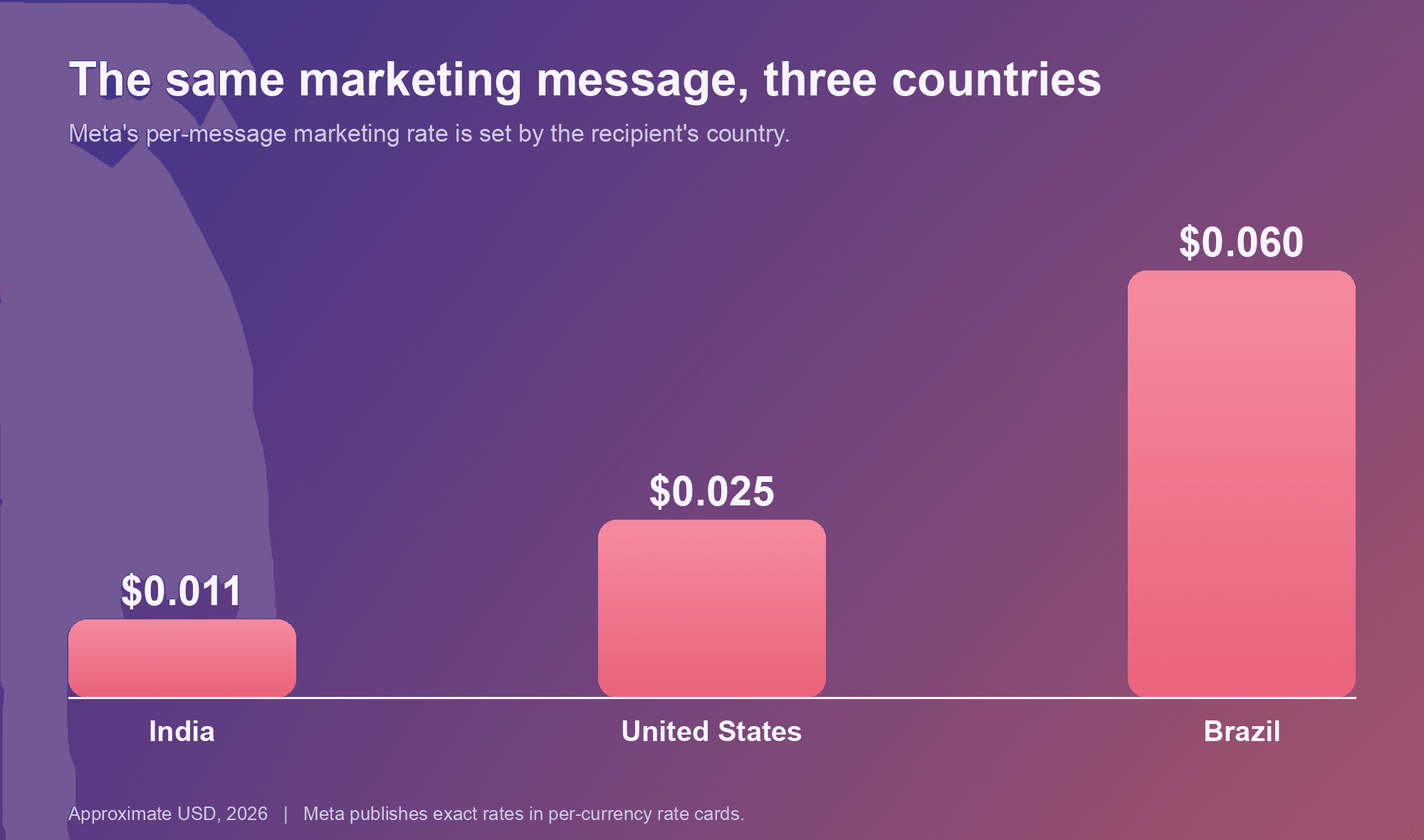
- Rates are per country, and they vary a lot. A marketing message runs roughly $0.011 to India, $0.025 to the US, and $0.06 to Brazil (approximate: Meta publishes the exact numbers only in downloadable per-currency rate cards, so treat these as directional). If you send mostly to one region, that region's rate is the number that decides your bill, not the headline "from $0.00X" a provider puts on its site.
- Marketing is where the money goes. If your high volume is transactional (utility) or auth (OTPs), your Meta bill is far smaller than a marketing-heavy sender's, and the provider markup matters even more as a share of the total.
Everything below assumes you know roughly which category and which country dominate your traffic. That's the single most important input, and it's the one most comparison posts ignore.
One more thing that bites at scale: messaging limits
Meta caps how many unique customers you can start a conversation with per rolling 24 hours, and you climb the ladder as your quality and verification hold up: 250, then 2,000, then 10,000, then 100,000, then unlimited. You get bumped up a tier automatically (within about 6 hours) once you use at least half your current limit over 7 days with healthy quality.
Don't confuse that with throughput, which is raw speed: around 80 messages a second by default, up to 1,000 a second on the top tier. The volume tier is how many people you can reach. Throughput is how fast. High-volume senders need to plan for both.
The providers, ranked for volume
Ranked by the thing that matters at scale, how the markup behaves as you grow, not by how nice the demo is.
1. 360dialog, the high-volume favorite
360dialog built its reputation on one decision: a flat monthly platform fee, with Meta's messaging cost passed through at cost, zero message markup. Its direct-API tiers are EUR 49/mo (Regular), EUR 99/mo (Premium), and EUR 249/mo (High Throughput), per number, plus Meta's fees.
That flat model inverts the math. On a 500-message demo, EUR 49 looks worse than a "$0.00X per message" competitor. At 50,000 messages, it's usually the cheapest option on this list, because the platform fee is fixed while everyone charging per-message keeps scaling their cut with your volume. That's why so many high-volume senders, especially marketing-heavy ones, end up here.
Best for: high, predictable volume where you want the markup to stop growing. Gotcha: it's API-first infrastructure, not a polished inbox, so you (or your tools) bring the front end.
2. Meta Cloud API direct, the zero-markup baseline
You don't strictly need a BSP. Meta's Cloud API is hosted by Meta, free to use, and you pay only layer 1: Meta's message fee, no markup at all. It's the true price floor. (If a genuinely free setup is what you're chasing, I went deeper on the free WhatsApp Business API separately.)
The catch is everything else. You handle the webhooks, the infrastructure, the number registration, the reliability, and you get no inbox, no team seats, no dashboard. For a company with engineers and a purely programmatic use case (a platform sending its own notifications), this is often the right answer. For a business that wants people to actually reply to customers, it's a foundation, not a product.
Best for: technical teams sending programmatically who can build the rest. Gotcha: you own all the plumbing and support tooling.
3. Twilio, pay-as-you-go where the markup rides every message
Twilio is the developer default, and its pricing is refreshingly clear: $0.005 per message (its own platform fee, inbound and outbound, flat regardless of category or country) on top of Meta's per-template fee, which Twilio passes through. No monthly minimum, just pure usage.
That transparency is also the catch at scale. $0.005 sounds like nothing, but it applies to every message with no ceiling, so at 50,000 messages that's $250 a month in Twilio fees alone before a single Meta cent, and it keeps climbing linearly forever. Great for building on, expensive as a pure sending channel once you're big.
Best for: developers who want clean pay-as-you-go and are already in the Twilio stack. Gotcha: the per-message fee never stops scaling with you.
4. Gupshup, strong in emerging markets
Gupshup adds a small per-message fee on top of Meta, reported around $0.001 per message, wallet-deducted with no monthly subscription on its self-serve tier. It's particularly strong in India and other high-volume emerging markets, with pricing tuned for exactly those regions. At massive volume the per-message model still compounds, but its rates are competitive where a lot of the world's WhatsApp traffic actually is.
Best for: high volume across India, SEA, and LATAM. Gotcha: per-message markup means the cut grows with you, and exact rates are quote or wallet-based rather than a public rate card.
5. Infobip, enterprise omnichannel
Infobip is a full CPaaS: WhatsApp plus SMS, voice, email, the works, with custom, negotiated pricing. If you're large enough to have a procurement conversation, you can negotiate rates that per-seat SaaS tools can't match, and you get genuine enterprise support and reliability.
Best for: large enterprises wanting one omnichannel vendor with a contract. Gotcha: pricing is opaque until you talk to sales, and it's overkill for a focused WhatsApp need.
6. Respond.io, great inbox with a SaaS markup
Respond.io is one of the nicer team inboxes in the category, with strong automation. But it's priced as tiered SaaS, from $79/mo (Starter, billed annually, around $99 monthly), plus Monthly Active Contact (MAC) limits, so the platform's margin is baked into a fee that climbs as your contacts grow. You're paying for the product experience, which is real, but at high volume that experience gets expensive.
Best for: teams who value the inbox and automation over squeezing message cost. Gotcha: cost scales with plan tier and active contacts, not just messages.
7. Wati, SMB-friendly but watch the markup
Wati was originally built on top of 360dialog and wraps it in an approachable SMB product (shared inbox, broadcasts, no-code flows) from around $39 to $49/mo. That makes it easy to start and genuinely pleasant for small teams. But you're paying a markup on top of the underlying BSP (reported around 20% over Meta's message cost), so at high volume you're usually better off closer to the source, unless Wati's product layer is doing real work for you.
Best for: small teams who want easy over cheap. Gotcha: a markup layer above the underlying flat-fee BSP, plus seat caps that force plan jumps. (I dug into where it pinches at scale in our Wati alternatives piece.)
8. Wexio, the layer that answers (not just sends)
Disclosure: this one's mine, so weigh it accordingly. Wexio isn't a raw high-volume blaster, and WhatsApp is still rolling out on our side, so for a pure 250,000-template blast today you'd pick a flat-fee BSP from higher up this list. What we're built for is the other half of high volume: broadcasts plus an AI layer that answers the replies those campaigns generate, built-in by default or bring-your-own-key for the technical crowd, with no per-resolution markup, and an agent that books, takes payment, and updates your records. More on that, with screenshots, just below.
Best for: teams who want broadcast plus AI that actually answers, in one inbox, without an AI markup. Gotcha: WhatsApp is landing soon, not live today. Web chat and Telegram are live now.
The honest all-in comparison
Here's the shape of it at 250,000 messages a month (illustrative, so plug in your real country rate and category mix before deciding):
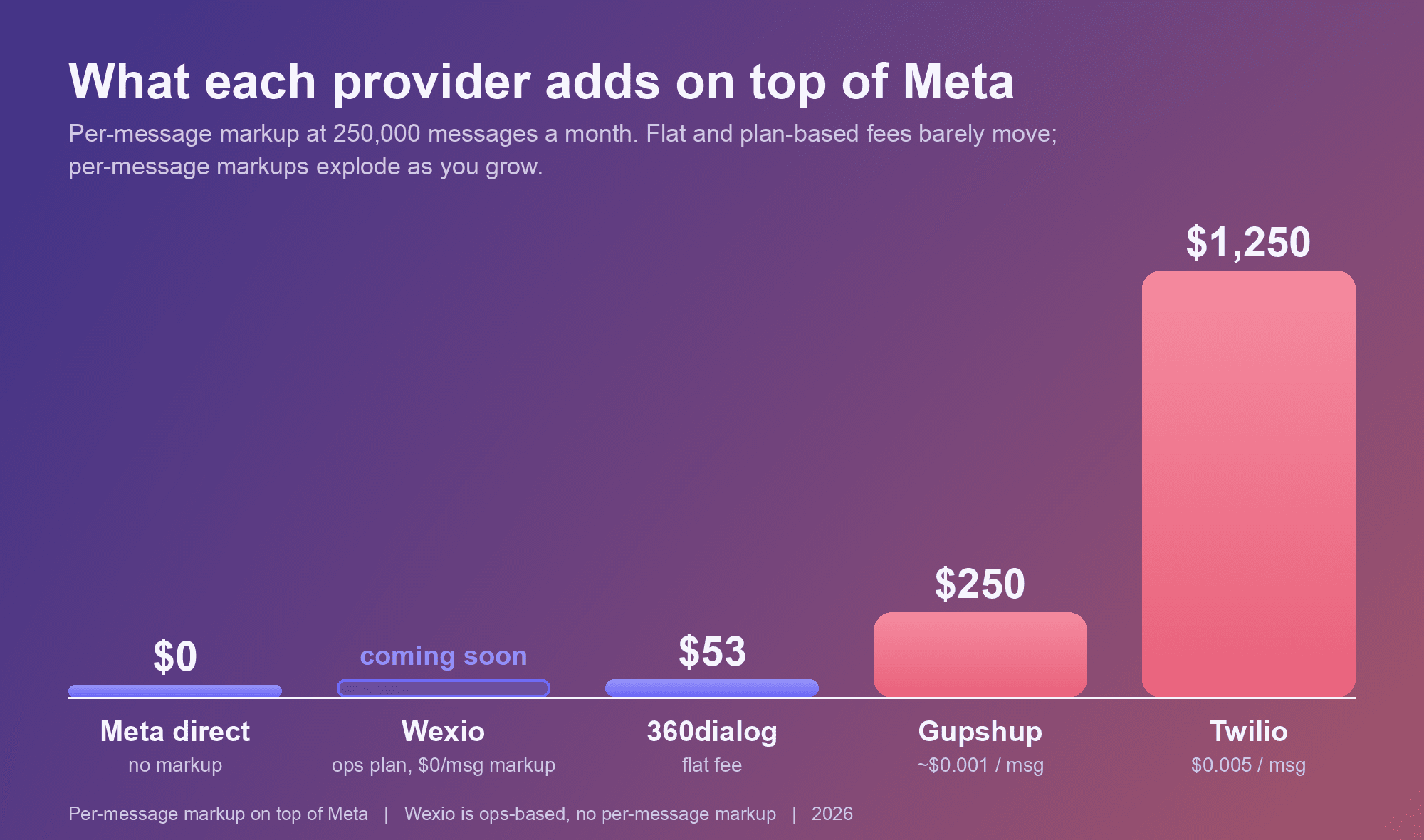
The pattern is easiest to see if you strip out Meta's fee (everyone pays that) and look only at what the provider adds at 250,000 messages:
- Meta Cloud API direct. $0 markup. Cheapest, most work, since you build everything else.
- 360dialog. A flat EUR 49 to EUR 99 a month, whether that's 50,000 or 500,000 messages. The cheapest managed option at scale.
- Gupshup. About $0.001 a message, so roughly $250 a month at this volume, and rising as you send more.
- Twilio. $0.005 a message, so $1,250 a month at this volume, purely in platform fees, climbing linearly.
- Wati and Respond.io. A SaaS plan plus markup. You pay for the product experience, and it scales with tier and contacts.
That's the whole thesis in one list: flat fees stay put as you grow, per-message and SaaS markups climb forever. Do the calculation with your dominant country rate and your category mix, because a marketing-heavy US sender and a utility-heavy India sender get completely different answers from the same table.
Where Wexio fits, and where it honestly doesn't (yet)
I run Wexio, so here's the straight version, no spin.
One honest caveat first: if you need to blast 250,000 WhatsApp templates this month, WhatsApp is still rolling out on our side. It isn't live yet, so for that exact job today you want a flat-fee BSP like 360dialog, or the Cloud API direct. I'd rather tell you that than pretend otherwise. But that's a timing thing, not a missing feature. WhatsApp is landing soon.
Because Wexio does both halves of high volume, not just one. Broadcasts too. You can send scheduled outbound campaigns, not only answer inbound, with delivery tracked per message.
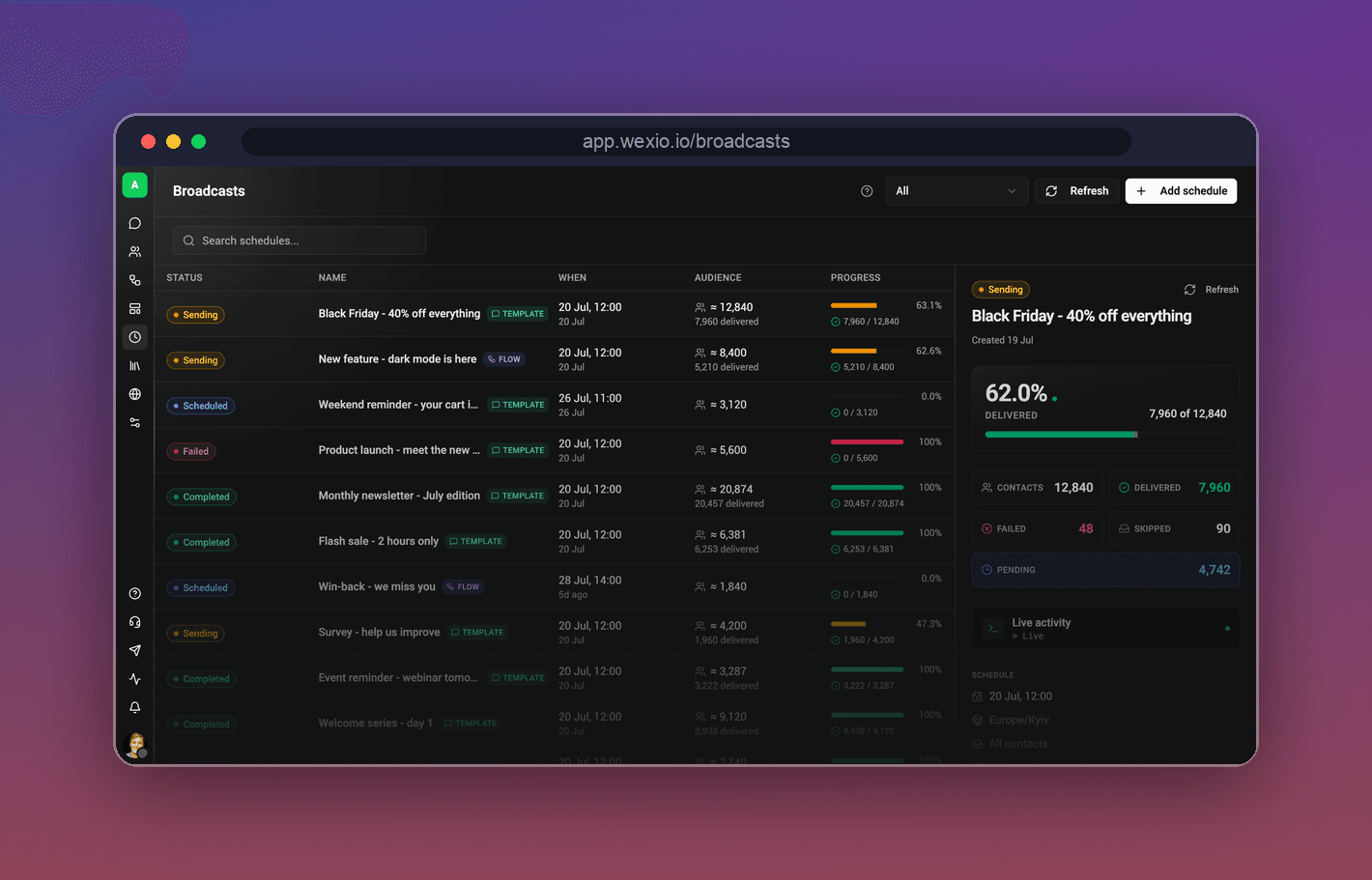 Broadcasts in Wexio: campaigns to tens of thousands of contacts, with live delivery, failed and pending counts per send.
Then the other half is where most platforms quietly bleed you: what happens when all those messages get replies. Sending is a commoditized problem. Answering instantly, around the clock, without a per-resolution toll is where cost explodes, because most tools mark up the AI. Wexio is usage-based, with AI built in so most people never have to think about an API key, it just works. For the technical crowd who'd rather pay the model wholesale, there's also bring-your-own-key: connect your own OpenAI or Anthropic key and pay the provider directly, no markup. Either way, the agent actually does the work. It books, takes a Stripe payment, updates your records, hands off to a human. Web chat and Telegram are live today. WhatsApp, Instagram, and Viber are on the way.
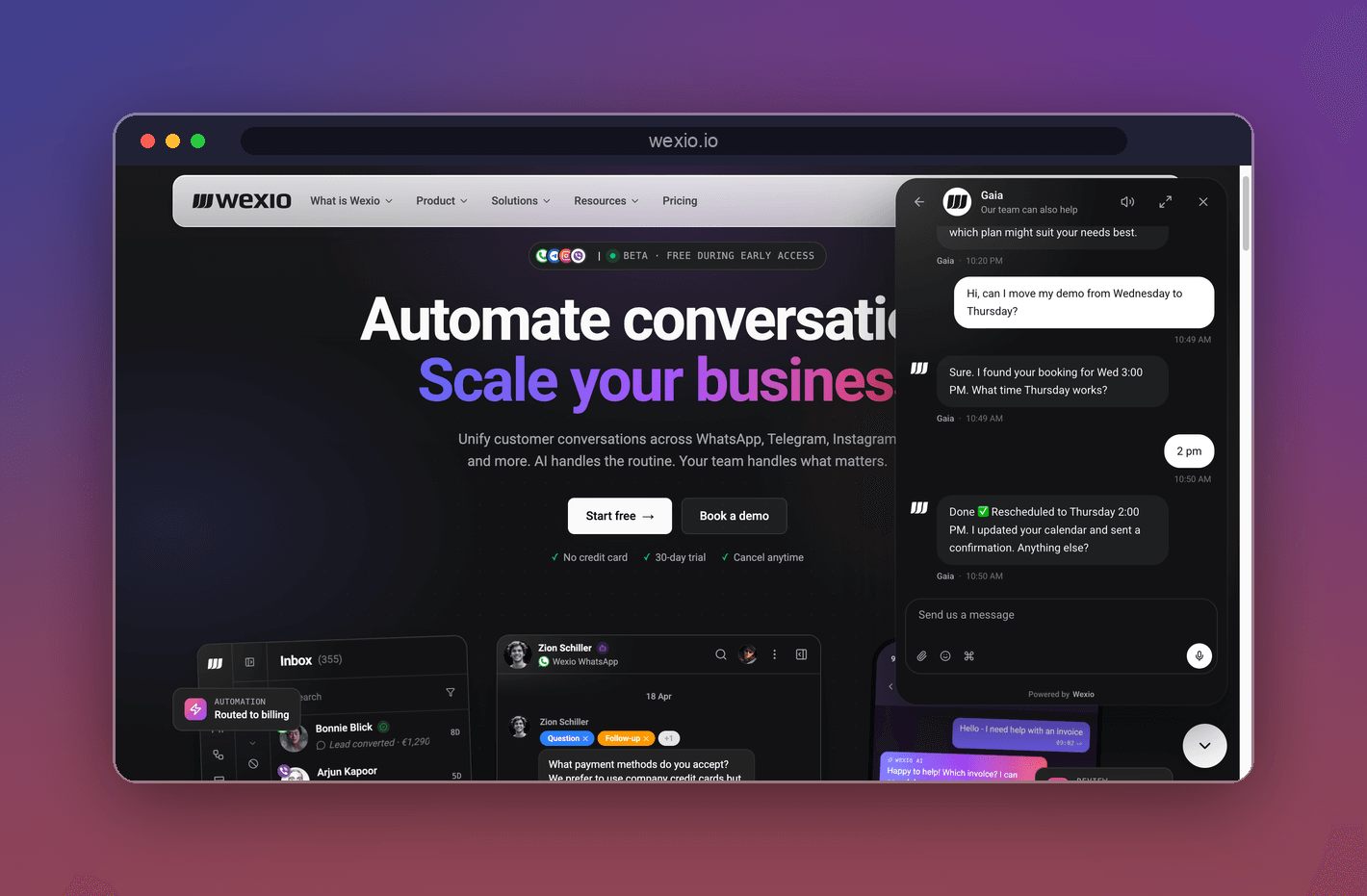 Not just answering, doing. Here the AI reschedules a booking on the live web widget and updates the calendar itself.
And it all lands in one place. Every channel, one thread per customer, so nobody re-explains themselves and nothing slips between the first message and the sale.
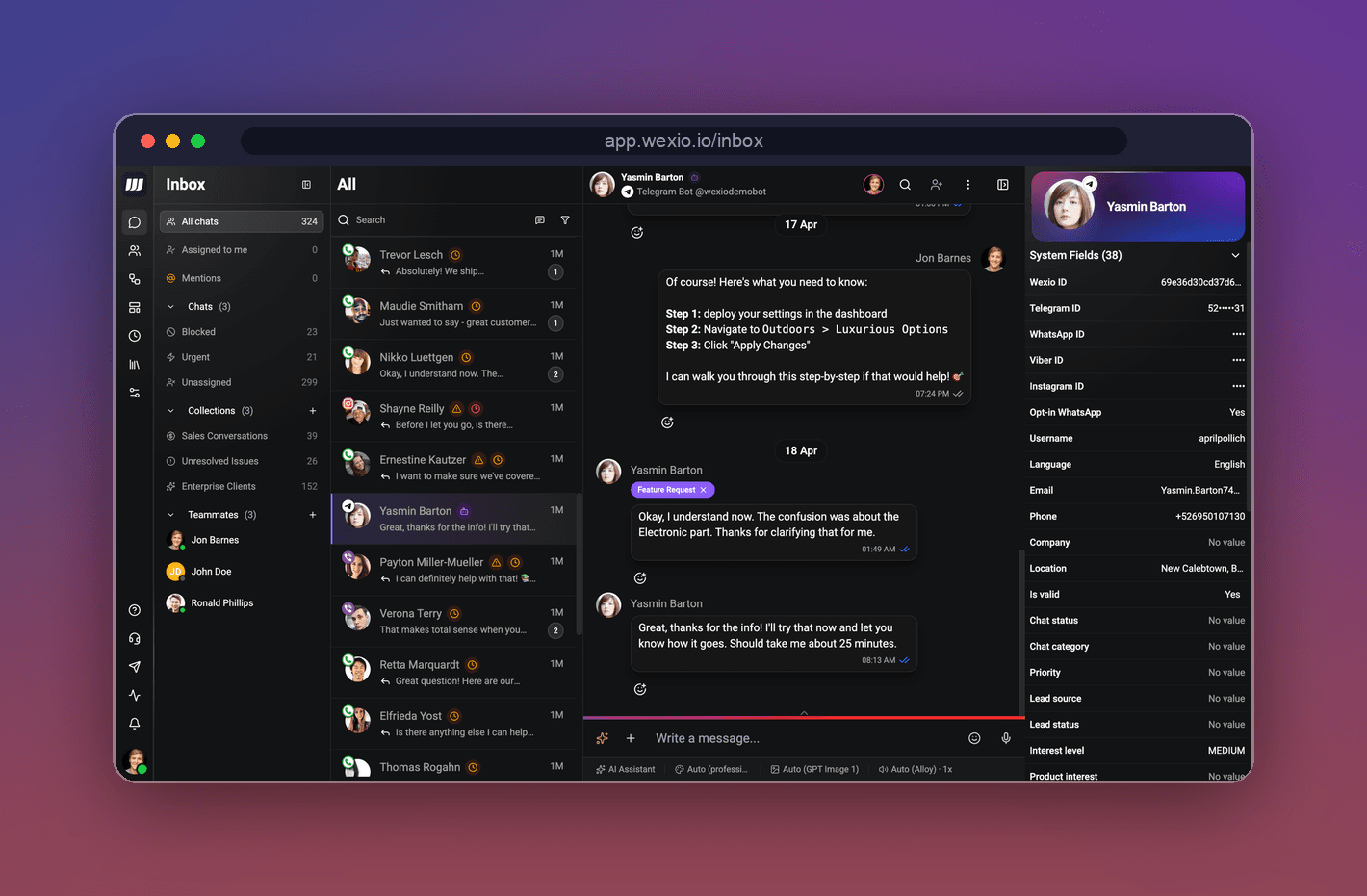 One inbox, one thread per customer, here on Telegram (live today), with the AI answering step by step and enriching the profile as it goes.
So the honest framing: for a pure high-volume WhatsApp blast right now, pick a sending provider from the list above by your volume and region. But if you want broadcast plus an AI layer that answers, without turning every resolved conversation into a line item, that's exactly what Wexio is. And WhatsApp support is coming soon, so the whole thing lives in one place.
The one-line version
At high volume, ignore the demo price and ask one question: does the markup stay flat, or does it grow with every message I send? Flat-fee models (360dialog) and going direct (Meta Cloud API) win as you scale. Per-message and SaaS markups (Twilio, Gupshup, Wati, Respond.io) are fine until they aren't. Run the math on your own country rate and category mix. That number, not the headline, is your real bill.